Councils face 'uphill struggle' after elections delay U-turn

 Getty Images
Local election administrators have warned that councils face "an uphill struggle" to be ready in time for local elections in May after the government reversed its plan to delay some votes.
Local Government Secretary Steve Reed had initially approved delays in 30 council elections in England until 2027.
But in a surprise announcement on Monday, the government announced it would be abandoning plans to postpone ballots following a legal challenge brought by Reform UK.
Explaining the U-turn, the government said its legal advice had changed - but it has not provided further details, and is now facing pressure from opposition parties to publish the advice.
Speaking to BBC Radio 4's Today programme, Heath Minister Stephen Kinnock said: "We had a process that we went through, and then that changed.
"Sometimes circumstances change, and that's the nature of the beast."
Ministers had previously justified the delays by arguing that some councils were worried about the cost of running elections in authorities that are due to be abolished as part of Labour's overhaul of local government in England.
Writing in The Times last month, Reed had said running elections for "short-lived zombie councils" would divert "scarce resources away from front-line services like fixing pot holes and social care."
However, the postponements had been met with a huge political backlash, whilst the Electoral Commission, the UK's elections watchdog, said it did not believe "capacity constraints" were a "legitimate reason" for delays.
A group that represents electoral officials in the UK said the teams who help to run elections had lost months of preparation time and would struggle to be ready.
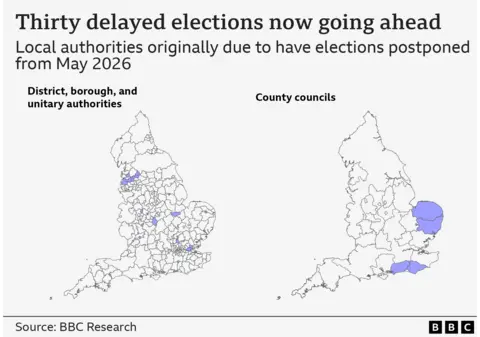
Local elections in Norfolk, Suffolk, Blackburn, Lincoln, Thurrock and two dozen more parts of England, will now take place on 7 May.
Some organisers said they were still preparing anyway, aware there was a legal challenge to the government's decision to postpone votes in their areas, which was due to be heard in the High Court on Thursday.
The Association of Electoral Administrators (AEA), which provides training for electoral officials in the UK, said it was "extremely disappointed" that months of "essential planning time" had been lost.
On Monday, the AEA's deputy chief executive Laura Lock said returning officers, electoral registration officers, and electoral administration teams would be affected.
"These teams now face an uphill struggle to catch up to where they should be," she said.
"They have paused planning to avoid unnecessary cost, but this means they are now playing catch-up."
In the run-up to elections, tasks for local councils include printing ballot papers, booking polling station venues and recruiting additional staff.
In a statement on Tuesday, Lock said that the affected areas had kept their polling station and count venue bookings "on hold" as a precaution, in case the postponements did not go ahead.
"This sensible approach means there is less work to do than might otherwise have been necessary," she added.
She also said the main print suppliers for election stationery and ballot papers had "indicated they feel confident about stepping up production to meet increased demand".
"So, all round, the sector as a whole is pulling together and rapidly getting back up to speed to administer these elections."
The U-turn means Labour will now be defending 2,558 seats, up from 2,317, whilst the Conservatives will be defending 1,362 instead of 1,074.
Jonathan Carr-West, chief executive of the Local Government Information Unit, told BBC Breakfast the elections would put pressure on "hard-working council officers".
"It will be done, as always, by hard-working council officers just going the extra mile, working harder, doing the extra hours, giving up their weekends. They can do it, but I don't think it's fair to ask them to", he said.
He said the situation "damages our democratic process", and warned the last-minute change sends the message that "these elections are optional".
Matthew Hicks, leader of Tory-run Suffolk County Council said: "Local councils across the country are experiencing whiplash as major government decisions shift repeatedly and without warning."
Hicks said the uncertainty impacted on the ability "to plan effectively" and "deliver stability for residents".
Meanwhile, the leader of Labour-run Thurrock Council Lynn Worrall said it was "disappointing that this decision has been reversed so late in the day".
The U-turn, the latest in a string of climbdowns by the government, was announced during Parliament's mid-February recess, meaning MPs will have to wait until next week to question ministers on the move.
In celebration of his win, Nigel Farage, writing on X, said: "We took this Labour government to court and won."
Speaking at an event on Tuesday, the Reform UK leader said he was "surprised" Steve Reed "as the minister responsible" was still in his job.
The government has agreed to pay Reform's legal costs relating to the proceedings, which a party source said would be at least £100,000.
Conservative Party leader Kemi Badenoch said it was "predictable chaos from a useless government that cannot make basic decisions".
Liberal Democrat leader Sir Ed Davey said his party "fought tooth and nail to stop this stitch-up and the government has been forced into a humiliating U-turn".
Zack Polanski, the Green Party leader of England and Wales, welcomed the decision adding that "attempting to cancel elections" was "part of a disturbing authoritarian trend of this caretaker prime minister".
Here is the full list of councils where elections were due to be postponed but will now take place:
Adur District Council
Basildon Borough Council
Blackburn with Darwen Council
Burnley Borough Council
Cannock Chase District Council
Cheltenham Borough Council
Chorley Borough Council
City of Lincoln Council
Crawley Borough Council
East Sussex County Council
Exeter City Council
Harlow District Council
Hastings Borough Council
Hyndburn Borough Council
Ipswich Borough Council
Norfolk County Council
Norwich City Council
Pendle Borough Council
Peterborough City Council
Preston City Council
Redditch Borough Council
Rugby Borough Council
Stevenage Borough Council
Suffolk County Council
Tamworth Borough Council
Thurrock Council
Welwyn Hatfield Borough Council
West Lancashire Borough Council
West Sussex County Council
Worthing Borough Council

