The intriguing world of ‘circular design’

 Ideo
IdeoWe live in a world full of waste but what if the products we used were all repackaged or resold when they needed to be replaced? Welcome to the circular economy.
 Ideo
IdeoWaste is a huge problem. In December 2017 plastic in our oceans was dubbed a "planetary crisis" by the UN.
Much of our planet's waste can be attributed to the abundance of throwaway one-use products. An emerging way for companies to combat waste, and help consumers get the most out of their products, is now referred to as the "circular economy". Simply put, these are products that stay in use for longer. Then the idea is to "recover and regenerate products and materials at the end of each service life".
A new exhibition called Never Finished aims to show how the circular economy can apply to everyday products we all use.
Below are some theoretical ideas from consulting company Ideo. While the products are not available on the market, the ideas behind them exist. "These are ingredients of innovation that haven’t been put together often for [other] uses," says Ideo's Chris Grantham.
 Ideo
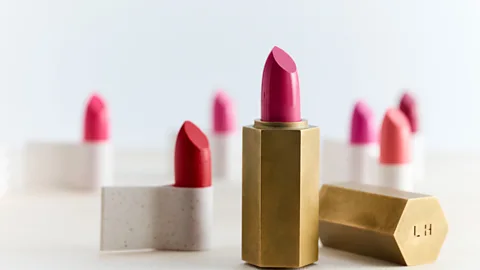
IdeoThis lipstick from the exhibition has a holder that is "designed to get more beautiful, more useful and more valuable with age", according to Ideo. That's because its holder is made out of brass, a long-lasting metal.
The lipstick holder is also designed to be refillable while a sensor on the blusher checks when you are close to running out and automatically sends refills.
"We were thinking about how would that create packaging that you want to hang onto for a long time, it might be more expensive initially, it becomes a beautiful item that becomes more useful to you," says Grantham.
 Ideo
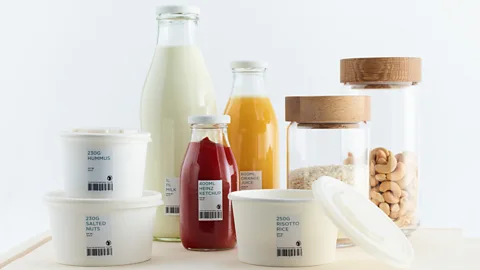
IdeoMost food packaging is considered wasteful because it’s only used once before being discarded. Ideo's food section – called Clean – shows packaging that is designed to be recycled, reused or composted. Its minimalistic, sleek design is unbranded and therefore intended to be longer-lasting. As part of a delivery service, the recyclable products can be picked up and any compost waste sold on to farmers.
Only a third of plastic packaging in the UK is reportedly recycled. Packaging like this could reduce the amount that is sent to landfill or that ends up in the oceans.
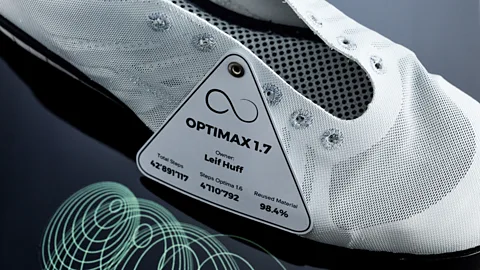 Ideo
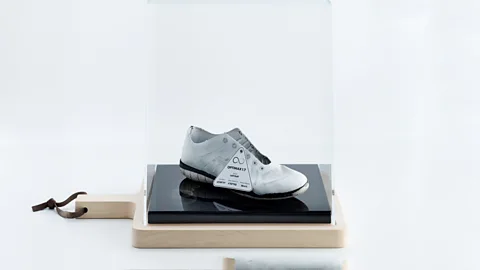
IdeoIdeo's vision for a running shoe is that it improves with time. These shoes have a sole which adapts to a runner's particular gait. Instead of throwing the shoe away, the owner can send their well-worn pair back to the factory so it can print a new version, using the same materials. This will therefore help the manufacturer use less resources.
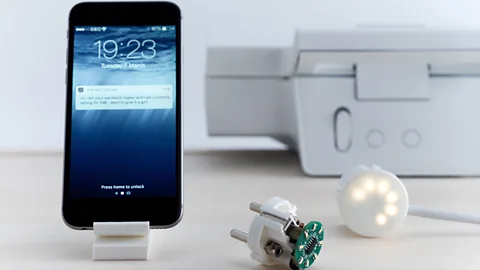 Ideo
IdeoGrantham says Ideo set themselves the challenge of creating better experiences for people when they are buying and using everyday products. Our tech-hungry lifestyle means we are constantly bombarded with new gadgets. The consequence? A lot of electronic waste.
One Ideo concept is called "Use me/Lose me", where each device has a chip that recognises how often it is used. If neglected, the chip informs the user via text a price they could get for selling.
If the user agrees, they simply reply to the text and the device automatically gets listed on an auction platform. The consequence? Customers will only buy what they really need.
 Ideo
IdeoEven the workplace can benefit from a circular economy. This is an office chair with a difference – it is produced so that when broken, repair is easy. The chair recognises when it needs a new part and automatically orders it. It means that "broken chairs don’t sit around redundantly and don’t have to be replaced with new chairs".
Such a system is "regenerative and restorative by design", explains Grantham. Materials used in a conveyor belt "take, make and dispose model" are doomed, because we only have so many resources, he says.
"We all need to find a way of regenerating those resources and using materials in a way that allows them to circulate in the economy for longer."
