Capsaicin: The kick from your chilli can have side effects

 Getty Images
Ramen noodles have been banned in some European countries for containing too much of the chilli extract capsaicin. Can it really be a danger to health?
A South Korean brand of instant ramen made headlines recently when Denmark’s food agency recalled some flavours of the product due to the risk they may cause “acute poisoning”.
Another story to make headlines recently was the case of a teenager in the United States with underlying health conditions who reportedly died after taking part in a spicy food challenge.
The cause of these concerns is capsaicin, the active component of chilli peppers that gives them their hot taste. But are the Danish authorities right to be so cautious? Is it really possible to eat so much capsaicin that it can poison you?
What is capsaicin?
Capsaicin is a compound that gives chillis their hot taste and the burning feeling we can get when we eat them. It is one of a family of compounds called capsaicinoids. Although around 23 different capsaicinoids have been found in chilli peppers, the most potent of these is capsaicin – although it has a similar level of pungency as a similar molecule called dihydrocapsaicin, which is generally found in lower concentrations in chilli peppers.
The UK's Food Standards Agency doesn't permit food producers to add pure capsaicin to foods, as it would be considered unsafe. But there are no limits on how much can be used when it is naturally present in chilli extract.
What symptoms can eating capsaicin cause?
Denmark isn't the first country to warn against eating food containing high levels of capsaicin. The Federal Institute for Risk Assessment in Germany (BfR) has also warned against excessive consumption of capsaicin.
Capsaicinoids can induce a painful sensation and inflammation due to activating a pain receptor called TRPV.
This can cause several symptoms. Specifically, human studies show that eating high doses of capsaicinoids may cause heartburn, reflux, nausea, diarrhoea and pain in the abdomen and chest, says the BfR.
It may also cause circulatory symptoms such as cold sweats, changes in blood pressure or dizziness at high doses, it adds. But there is not yet enough data to clarify at what dose this occurs at.
"Due to the numerous factors influencing the individual perception of pungency and pain and the limited data available regarding a dose-response relationship of capsaicinoids, no general recommendations can be made for consumers with health restrictions," says a BfR spokesperson.
However, based on the data from human studies, BfR adds, it can be estimated that an intake of 0.5 to 1mg or more of capsaicinoids can lead to mild undesirable effects, such as sense of warmth, pressure in the upper abdomen or heartburn.
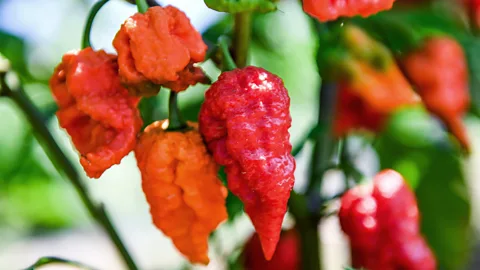
"At intake levels in the range of 170 mg, pronounced adverse effects can occur. A case of hospitalisation of a patient after ingestion of approximately 600mg of capsaicinoids has been reported," BfR says. The 27-year-old patient in question, who had been taking part in a chilli eating competition in Berlin, Germany, consumed four Bhut Jolokia chilli peppers and a variety of other spicy food. The Bhut Jolokia variety, or "ghost pepper" is estimated to rate at around 1-1.2 million SHUs on the Scoville Scale for measuring the spiciness of substances, making it among the world's hottest chilli peppers. (For comparison, Tabasco red sauce measures around 2,500-5,000 SHUs).
Around two-and-a-half hours after eating the spicy food, however, the man began to feel abdominal pains and severe swelling of his stomach, and later that evening took himself to the emergency department at the Helios Hospital Berlin-Buch. Doctors were unable to find anything else wrong and administered some painkillers which offered some temporary respite. Around 12 hours after eating the chillis the man vomited and slowly began improving.
But it's not just eating capsaicin that can cause symptoms.
"In the short term, capsaicin can cause irritation, discomfort and pain," says Christian Moro, associate professor of science and medicine at Bond University in Australia. "If it gets into the eye, it can really hurt, and induce blurry vision. If inhaled, it can cause prolonged coughing, and even stimulate a flare-up of illnesses such as asthma."
But the symptoms that eating capsaicin can lead to are nothing to worry about, says Moro.
"Capsaicin activates our nerves and this is what makes it feel like your body is burning, but it's just a sensation, and not actually doing us any harm," he says.
Are any of the symptoms harmful?
The BfR says high doses of capsaicin can cause "serious poisonings" in children, but that the dosage that can lead to these symptoms is unknown.
Some estimates put the lethal dose of capsaicin in humans to be around 500-5,000mg per kg of body weight. This would equate to around 35,000mg of capsaisin in someone weighing 70kg (11st or 154lbs). In 100g (3.5oz) of Jalapeno peppers contains around 15mg of capsaisin while the same quantity of Scotch Bonnet peppers contains around 260mg. The Bhut Jolokia contains around 4,000mg for every 100g of fresh chilli pepper.
However, there are no known reported cases capsaicin overdoses in humans, Moro says.
One 10-year-old review, The Two Faces of Capsaicin, details lab experiments with rodents that linked capsaicin to signs of cancer in the stomach and liver, and human studies where the effects of capsaicin have been found to cause gastric "microbleeding", but points to other studies that have shown none of these symptoms.
 Getty Images
Another umbrella review from 2022, which analysed 11 systematic reviews and meta‐analyses, concluded that the health effects – both good and bad – of spicy foods and chili peppers are uncertain, and the evidence they were able to draw from wasn’t good quality.
"I've been asked many times 'will eating superhot chilli peppers kill you?'. The answer, like most things in life, is 'yes and no'," says Paul Bosland, regents professor of plant and environmental sciences at New Mexico State University and one of the world's foremost experts on chilli peppers. "Chilli peppers can indeed cause death, but most people's bodies would falter long before they reached that point.” In other words, our bodies would expel the capsaicin-containing food before we could consume enough for a lethal dose.
"One would have to keep eating extremely hot chilli peppers, past the point of sweating, shaking, vomiting, and maybe feeling like passing out. So, it’s safe to say super-hot chilli peppers won’t kill you," he says.
Are some of us immune to the risks?
Like many other foods and drinks, how one person’s body reacts to capsaicin will be different to the next, and that can depend on several factors.
Consuming capsaicin can cause difference responses in different people, the BfR says – for example, children or people who rarely eat spicy food may be more sensitive than people who regularly consume them.
One study found that capsaicin may be an irritant in people with irritable bowel syndrome (IBS), but not in healthy volunteers. Researchers fed 20 people with IBS, and 38 healthy people without IBS, either a normal diet, a spicy meal, or a standard meal with 2g of chilli in capsules. In healthy volunteers, the spicy meals and meals with chilli capsules only caused mild abdominal discomfort, but induced significant levels of abdominal pain and burning in those with IBS.
 Getty Images
In addition, people with existing gastrointestinal problems such as reflux diseases may react more to the intake of capsaicinoids in the gastrointestinal tract, the BfR says, and could also pose a risk for people with cardiovascular diseases, due to the observed circulatory symptoms associated with consuming high amounts.
The effects of eating chillis may also be influenced by how accustomed someone is to eating spicy food, Bosland says
"Every human has a different level of tolerance to the capsaicinoids, so what may seem extremely hot to one person can seem medium to another," says Bosland.
Not only this, but we can become accustomed to the heat profile of certain chillis if we eat them regularly, he adds. One Tawainese study, for example, found that regularly exposure to capsaicin could reduce the symptoms of heartburn as the body becomes more tolerant of it.
"Once I had two chilli pepper scientists – one from China and one from India – visiting my laboratory," says Bosland. "I took them to lunch, and as we ate our enchiladas, the scientist from China stated that when he visited India the food seemed hotter than in China."
"The scientist from India said, 'I experienced the same reaction when I visited China!'"
While both scientists came from countries known for their spicy food, each thought the other had hotter dishes, Bosland says.
Health benefits
Throughout history, chillies have been used as a health remedy, and modern medicine has its uses for capsaicin, too. Chilli extracts are used in the formulation of many medicines, including topical products for pain relief, migraines, headaches and psoriasis. Capsaicin has even been suggested by researchers as a drug for gastric cancer prevention and therapy.
As well as the concerns around capsaicin’s potential adverse effects, numerous studies have found that regularly consuming capsaicin may also have some health benefits, due to its antioxidant and health-promoting compounds, Moro says.
More like this:
• Are there benefits to eating turmeric?
• Can some foods fill you up for longer?
Studies have linked regular capsaicin consumption to contributing to lowering the risk, or slowing the progression, of conditions including high blood pressure, metabolic syndrome, and obesity. And while it's sometimes thought to cause gastric ulcers, there’s evidence to suggest consuming capsaicin can actually help to prevent and heal them.
"Reaching for the chilli also means we’re less likely to reach for salt, so is an excellent, healthy salt alternative in many meals," Moro says.
While there are some concerns around high levels of capsaicin causing adverse reactions in some people, there's no evidence to suggest that a sensible amount of chillies in our diet will cause us any harm beyond a burning sensation. On the contrary, there's lots of evidence to suggest it may actually be beneficial to have some capsaicin in our diets.
But one mystery remains: is it China or India that has the hotter food? The answer, we suspect, will remain hotly debated.
--
If you liked this story, sign up for The Essential List newsletter – a handpicked selection of features, videos and can't-miss news, delivered to your inbox twice a week.