Why we need new words for life in the Anthropocene

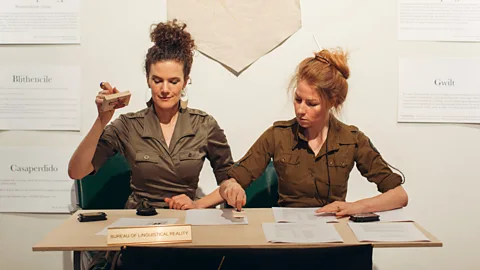 The Bureau of Linguistical of Reality
The Bureau of Linguistical Reality is assembling a new lexicon for people's experience of climate change and environmental upheaval, writes Richard Fisher.
One day, Harold Antoine Des Voeux realised he lacked a word. It was the beginning of the 20th Century, and the doctor had been treating multiple people for lung ailments. Gradually, he figured out the reason for the excess illness he was seeing: it was the air pollution caused by nearby factories burning so much coal. In one 1909 incident that affected Glasgow, more than 1,000 people had died.
There was no name for this pollution, so Des Voeux coined one: "smog" – a portmanteau of smoke and fog. "He didn't ask for permission. He didn't consult a linguist. He just put it in his paper and announced it," says Heidi Quante, an artist who specialises in new environmental vocabulary. "It became a neologism, because people were desperate to name what was in the air."
It wouldn't be the last time that a new word was needed to describe environmental change. It's why Quante and her fellow artist Alicia Escott have spent almost a decade collecting and creating new words to define the experience of living in the Anthropocene (which, of course is itself a neologism, popularised in the 2000s.)
Quante and Escott call their project The Bureau of Linguistical Reality, and their goal is to co-create a new lexicon for a time of climate change, biodiversity collapse and other transformations in the natural world. Through public participation and pop-up installations at places like climate summits, they ask people to help them come up with brand new vocabulary. You might not have used words like nonnapaura, chuco헐sol, or preuphoreau before – but you may do soon.
You may also like:
Quante and Escott have been working on The Bureau of Linguistical Reality since 2014. A founding motivation for the pair was a belief that the discussion of climate change needed to be participatory, not a one-way lecture. "One of the things that frustrated me so much while working for major environmental groups is this concept that there are anointed people who 'know' and there are people who are 'not knowing'," says Quante. "But with the Bureau, everyone has knowledge: if you have a feeling you have knowledge; if you have an experience, you have knowledge."
So, Quante and Escott see it as important to work with members of the public to coin words, rather than dreaming up new vocabulary on their own.
 Javier Hirschfeld
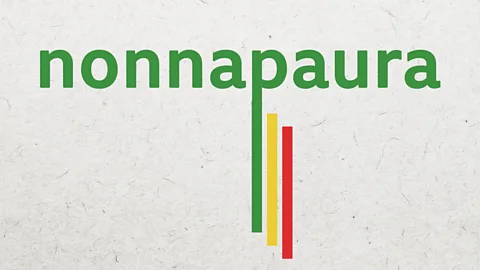
To illustrate how, the pair tell the story of how the word nonnapaura was coined. At an event they attended, a woman called Linda Ruth Cutts came up to them, and explained an emotion about climate change that she couldn't quite articulate. "She said: 'I am terrified for my children… but I'm simultaneously wanting to experience grandchildren. I don't know how to share that with them.' It was simultaneous hope and fear," says Quante.
So, working with Cutts, they turned to Italian, combining the word nonna (grandmother) and paura (fear): nonnapaura.
Indeed, much of the inspiration for their words comes from non-English tongues. "I grew up speaking three languages, and was always frustrated that the English language was so anaemic compared to French or others where there's a lot more emotions," says Quante.
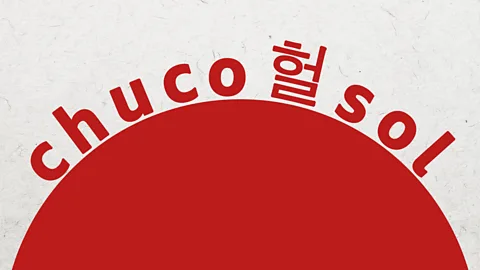
Another non-English neologism came from a conversation with two young people of El Salvadorian and Korean origin in Los Angeles. There had been some tensions between their respective communities, explains Escott, so they wanted a word that helped remind them of what they had in common. They came up with chuco헐sol– a mixture of El Salvadorian slang, Korean and Spanish. It essentially means "dirty – wow – Sun", and describes the Los Angeles sunset.
 Javier Hirschfeld
"Los Angeles has these gorgeous sunsets that are perfect for Instagram. They're orange, they're red. But the reason they're so beautiful is because of the pollution in the air," explains Quante. "They wanted to say, 'We all look at the same Sun, we all experience the same pollution'. They created a word to embody this experience.
"We didn't ask them to change their mother tongues; we didn't ask them to adhere to some rules of the English language," she continues. "We let them do it in a way that they felt literally represented what they were trying to say. They got so much joy out of just putting these languages together."
Submit your word
While The Bureau of Linguistical Reality coins many of its words at live events, in conversation with people, its founders do also take submissions. If you have an idea for a word that describes life in the Anthropocene, complete this form on its website.
It wouldn't be the only word that Escott and Quante would unearth for environmental change in California. In 2018, they and a contributor called Jessica Decker coined the word pyrora – to describe the air during Californian wildfires, when the atmosphere takes on a different hue due to the soot particulates within it.
And when the pair visited the community of Pacifica, near San Francisco, they co-created words about the experience of living on land that was slowly being eaten away by the ocean. "Pacifica is on the forefront of navigating coastal erosion, sea level rise and fraught conversations around the topic of planning for the future and 'managed retreat'," says Escott.
 Javier Hirschfeld
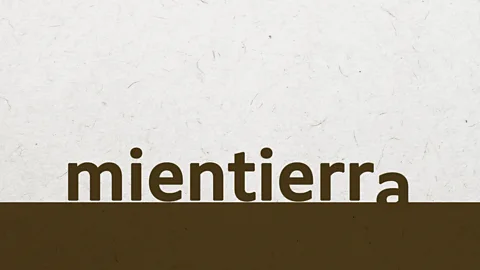
The pair collaborated with Cindy Abbott of the Sanchez Art Center in Pacifica, as well as the artists Kim Anno and Modesto Covarrubias, who are both from the San Francisco Bay area, to work with local people on new terms to describe the situation they are facing. Together they coined terms like sandulate, a verb which means to "understand that the coast is alive, and we can't just build the solid structures that we have; respecting it", says Quante. Or mientierra– from the Spanish miente (she/he lies) and tierra (land). It means "a false sense of solid ground beneath us", says Escott, to describe the experience of not being able to trust the land near a retreating coastline. It could also be applied as a metaphor for contemporary structures and systems that seem robust, but are not.
The human relationship with water also informed their word shellaqua, which is particularly relevant to the recent flooding across California. Shellaqua is the act of covering a once-permeable surface with human-made materials like tarmac, increasing flood risk (based on a "shellac" coating and "aqua"). But it also has an allegorical meaning: an individual can shellaqua themselves, becoming impermeable and resistant to restorative ideas and thinking.
Then there are the words that describe hubristic, or perhaps misguided, responses to climate change. One of those is teuchnikskreis, which came from a conversation with a German engineer about the limitations of technology. "There's a concept in German called the 'devil's circle', teufelskrieis," says Quante. "He switched it to 'teuchnik'", referencing the word for technology, technik. So, teuchnikskreis is the "false belief that creating technology will get us out of our mess, when in fact, our mess is cultural", explains Quante.
Another is marsification, which describes the expansion of colonial ideas to other planets. Its creators – Zara Zimbardo of the consultancy Partners for Collaborative Change in California and Oakland-based writer-activist Patrick Reinsborough – wanted a word to help them describe what they saw as a mistaken attitude that Mars could one day be a refuge from climate change and all of Earth's problems.
 Javier Hirschfeld
My own favourite words from the Bureau, however, are the more hopeful ones. For example, the word refuvescence – coined with Zimbardo and San Francisco-based artist Georgia Carbone in 2017 – describes a moment when things take an unexpected turn for the better. It echoes the word eucatastrophe, which I wrote about earlier in the Wise Words series, but is decidedly more organic in its origins. "There is this moment where compost goes from smelling rank, to smelling sweet and full of life. [Refuvescence] is thinking about that as a moment within culture," says Escott.
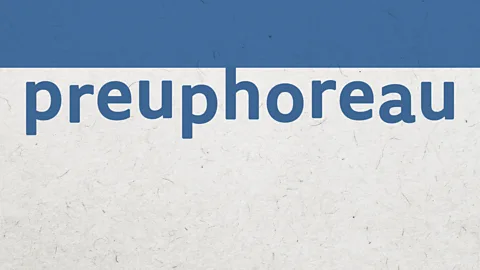
I also like the word preuphoreau, coined with scientist Faith Kearns of the California Institute for Water Resources, which is the bodily feeling of sensing a change in the atmosphere because rain is coming. It can also describe a moment of hopeful anticipation that change is coming. It's a mixture of pre + euphoria + eau (French for water).
Hopeful, sad, overwhelmed or pessimistic, Quante and Escott argue that when people have the opportunity to describe their emotions with new words, they feel more connected to what is happening in the Anthropocene. And ultimately this leaves them more empowered in the face of daunting transformations. (Learn more about the complex emotions that climate change is fostering in people around the world in our series Climate Emotions.)
As Quante says: "A lot of people come to us and they say, 'Oh, I finally feel like I have a place in the climate conversation' because heretofore they would imagine that you have to protest in the street with a sign, or you have to be a politician, or have to be a scientist. But they have the agency to be culture-shifters through words."
*Richard Fisher is a senior journalist for BBC Future. Twitter: @rifish
--
