Is this a totally new kind of aircraft?


 National University of Singapore
Do you want to fly but think a private plane is too conventional? Some Singaporean students may have designed the answer.
The age of the drone is in full swing, and unmanned aircraft are being touted for everything from package delivery to search and rescue.
We’ve got used to the acronym UAV, short for Unmanned Aerial Vehicles. But how about PPD? If current experiments work, “personal passenger drones” may become a whole new category; a tiny rotor-driven aircraft that can be controlled by the passenger, or directed from another person on the ground. Electrically-powered, too. Not quite a drone, but something new.
 Getty Images
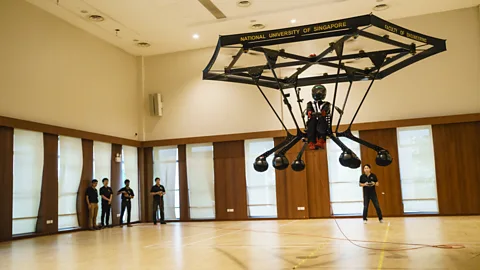
One interesting example is being developed by a team of students at The National University of Singapore. It’s a one-person flying machine, called Snowstorm.
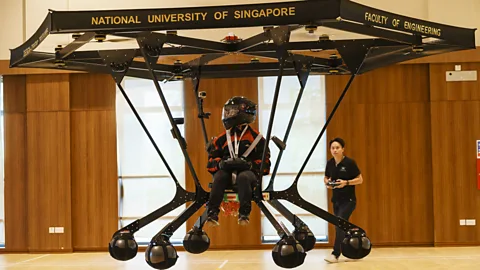
Snowstorm looks like a scaled-up drone. It has a hexagonal frame, with 24 rotors attached to it. The pilot is suspended underneath, in a five-point harness, and below him is the landing gear, which has inflatable balls as feet and should make landings a little less jarring. To keep weight down the structure is built from aluminium, carbon fibre, and Kevlar.
Early tests have been indoors, and of limited duration, but show potential, as you can see in the video below:
It took a team of eight students a year to build the craft, under a programme known as Frogworks, which “engages students in the study, design and construction of clean leisure craft”.
In its current form the Snowstorm can carry a person weighing around 70kg, for up to five minutes. That is unlikely to get most people from home to work, but the team says at this early stage they see the craft as more of indoor ‘fun’ rather than a vehicle that will replace cars for the daily commute.
“We think that recreational aviation is rife for an electric revolution,” says associate professor Martin Henz, who helped supervise the project at the NUS. “We want to be part of this. Snowstorm is our starting point. We think that a good part of the ultralight aviation community will go electric in a few years time. It’s very exciting.”
Snowstorm is not fully autonomous, but it does make use of UAV software to provide basic functions such as maintaining its altitude automatically. The human on board has to physically control the thrust, and the direction through pitch and roll. If all else fails, there’s a cut-off switch operated by the team on the ground, which ends the flight and brings the machine down – hopefully gently.
The team is getting ready to show the public the progress they have made so far. The next time we will get to see Snowstorm flying is at the Founders Forum event in London in June 2016.
“We managed to secure funding for an improved version of the machine, which we are currently building and testing,” says Henz.
 National University of Singapore
It’s not the only craft emerging in this new category. For example, Chinese company Ehang recently made headlines when it showed a scaled-up drone capable of carrying a human at this year’s CES. The Ehang 184 is designed to carry a passenger about 10 miles (16 kilometres) or for about 23 minutes, and be totally autonomous.
Still, there are a huge number of challenges to be overcome before Ehang’s machine-piloted aircraft can become a reality. The pilot software would have to be incredibly sophisticated, and the craft itself would need to pass stringent safety regulations in countries around the world. Notably, it was not actually demonstrated at CES, in the United States, where its operation would be illegal.
Snowstorm, which is only semi-autonomous, might be the stop-gap solution.
So what are these craft like to fly in? Henz says most of us will have to wait to see. To date, the actual flight experiences on Snowstorm are very limited. However the upcoming public demonstration is spurring further development.
“We are gearing up to extensive flight tests in May using an improved machine,” says Henz, “and will train a team of pilots, who you can then ask this question!”
Join 600,000+ Future fans by liking us onFacebook, or follow us onTwitter,Google+,LinkedInand Instagram
If you liked this story, sign up for the weekly bbc.com features newsletter, called “If You Only Read 6 Things This Week”. A handpicked selection of stories from BBC Future, Earth, Culture, Capital, Travel and Autos, delivered to your inbox every Friday.
