The hideaways designed for peace and tranquility

 David de Vleeschauwer
It’s good for the soul to be ‘at the end of the world’, says a new book by Debbie Pappyn. She talks to Lindsay Baker about the stunning retreats created with calmness in mind.
“In an age of distraction, nothing can make us as happy as a feeling of absorption, of being lost in the scene around us,” writes the essayist and novelist Pico Iver. “And in an age of fragmentation, nothing leaves us feeling richer – more ourselves – than lingering over a single point in a single place.” Iver’s musings provide the foreword for a new book, Remote Places to Stay, that explores some unique sanctuaries at the ‘end of the world’. The book advocates the notion of remoteness and seclusion as therapeutic, and the idea that carefully-planned design enhances our enjoyment of these settings. And the images by David de Vleeschauwer of these stunning retreats and hideaways certainly have a meditative quality about them.
More like this:
So what appealed to the author, Debbie Pappyn, about the subject? “Remote places often have a strong sense of place; they force you to slow down and appreciate the smaller or obvious things in life again,” she tells BBC Designed. “Silence, dark skies, space, emptiness, solitude. After 15 years of almost non-stop travel to these distant corners of the world, we [she and De Vleeschauwer] often ran into other travellers asking us for our advice about where to travel next.
 David de Vleeschauwer
“It’s easy to compile a list of extremely remote hotels, but our list is not only about being geographically or physically remote. It is more about the feeling, and the way a place gently invites the traveller to disconnect from digital distractions and let go of an often very high-paced life.” The book showcases buildings in remote places that have been designed to generate a mood of calm and tranquillity – and to make the most of their extraordinary surroundings.
 David de Vleeschauwer
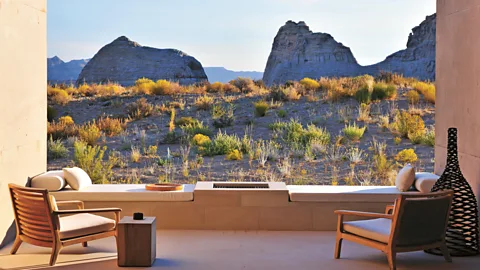
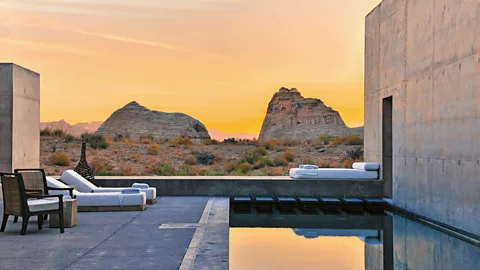
The way in which architecture blends into its dramatic, remote surroundings is a strong theme throughout the book. The Amangiri hotel, in Page, Utah, located in the Navajo Desert, and designed by 1-10 Studio in Arizona, is a prime example. “The architects did an amazing job to let the whole hotel melt into the red-coloured landscape,” says Pappyn. “So it does not attract too much attention.” The building’s interior also works in harmony with the setting, with panoramic views from each room opening onto the desert and, at night, a dramatically starry sky. The Amangiri’s interiors are, says Pappyn, “all about flowing in and out of the landscape with windows, corners or passages bringing the Estrada stones of the desert inside, and allowing constant viewing of the surroundings.”
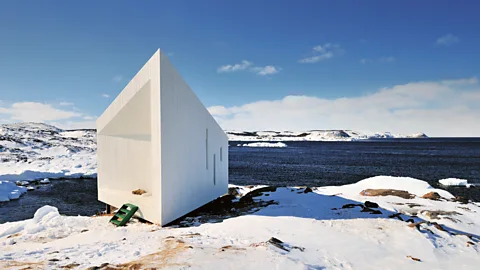
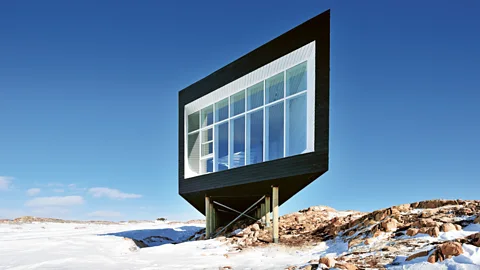
David de VleeschauwerArchitecture and its setting are approached differently at the Fogo Island Inn, in Newfoundland, Canada. The striking, angular building by Saunders Architecture is in contrast to the surrounding traditional wooden fishing houses. “But somehow it works,” says Pappyn. “It doesn’t clash”. And the huge windows help to “pull inside” the nearby beautiful expanse of the Labrador Sea. “Staying here is all about constantly looking outside, and the design and architecture allows this. It is modern, fresh white but still feels cosy and intimate. Perfect on a winter’s day when it’s -25C outside.” The colourful accents used in the interior’s soft furnishings add to the warm and welcoming effect. And nearby are the artists’ pavilions, created by Shorefast Arts Foundation – secluded retreats for artists and writers.
 David de Vleeschauwer
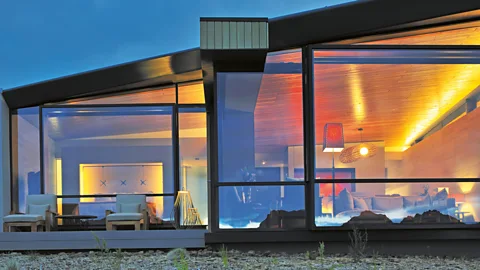
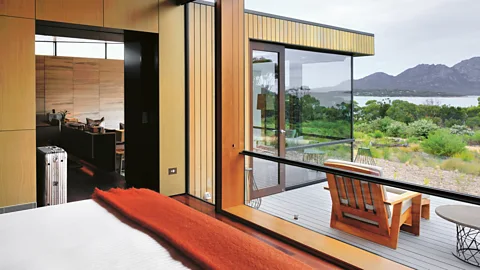
In the untamed environment of Coles Bay, Tasmania, creating a luxury hotel without infringing too much on that wildness must have been a considerable challenge. The Saffire Freycinet hotel, designed by Morris Nunn & Associates, is all about “balance” says Pappyn. “The architect used a lot of natural and local materials with lots of wood and warm colours, so the contrast between staying here and going out into this wild nature of Tasmania is not too big. Even in remote places, it’s all about balance, even between being out in the wild during the day and staying in very comfortable surroundings at night.”
 David de Vleeschauwer
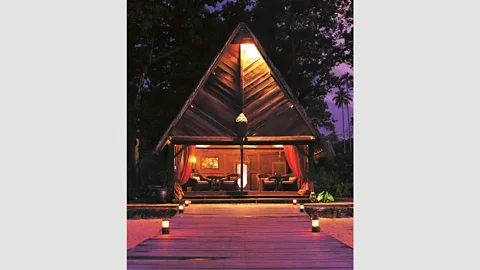
The designers responsible for the buildings on Ratua private island, in Espiritu Santo, Vanuatu, are all local craftspeople. Here, the slow Pacific Island pace informs the mood. The island is all about “not messing around” with the wildness of the tropical surroundings, according to Pappyn. “There are no chic and modern over-water bungalows. Here you stay in wooden, hand-built houses hidden away in a lush, tropical scenery with views over the most transparent lagoons and the azure-blue Pacific. This is for travellers not wanting to stay in air-conditioned, glass boxes but to connect with this island, the nature, the semi-wild horses roaming around, the people of Vanuatu who are kind and friendly.”
 David de Vleeschauwer
The book, Pappyn tells BBC Designed, is a “very personal selection” of diverse places to stay, from small inns on secret Greek islands to far-flung lodges in Alaska. “They all have their own story to tell and are incredibly unique… it’s for the traveller looking for off-the-map retreats that allow you to slow down, disconnect and enjoy again the smaller things in life.”
 David de Vleeschauwer
And the sense of calm and tranquillity we get from remoteness is perhaps needed ever more in our hectic world. As the essayist Pico Iver puts it: “The more space you have around you, the more space you discover within yourself. The less you have in the room, the more you have to bring to others. And the fewer worries you have, the wealthier you feel, in the deepest sense.”
Remote Places to Stay is published by gestalten.
And if you liked this story, sign up for the weekly bbc.com features newsletter, called “If You Only Read 6 Things This Week”. A handpicked selection of stories from BBC Future, Culture, Worklife and Travel, delivered to your inbox every Friday.
