When art meets jewellery

 Didier Ltd/Man Ray Trust/Adagp
Dali, Picasso, Man Ray and Louise Bourgeois are among the surprising names featured in a Paris exhibition of jewellery.
Long excluded from the museum world proper, fashion has, in recent years, found a foothold in some of the world’s most prominent institutions, many of which were previously dedicated solely to what the establishment deemed to be art.
Jewellery, too, has faced an uphill battle to be accepted by ‘the club’, and to be shown alongside old school art. The situation is gradually changing. A new exhibition at La Musée des Arts Décoratifs,in Paris, From Calder to Koons: Jewellery by Artists, is part of that change.
Two hundred pieces from French collector Diane Venet form the backbone of the show, which puts on display 260 jewellery creations (60 are loans). The exhibition features 150 artists including: Man Ray, Yayoi Kusama, Pablo Picasso, Damien Hirst, Ai Weiwei and Louise Bourgeois. It is one of the largest artist jewellery exhibitions ever to be assembled, Venet tells BBC Culture.
Bernar Venet
 Greg Favre/Adagp
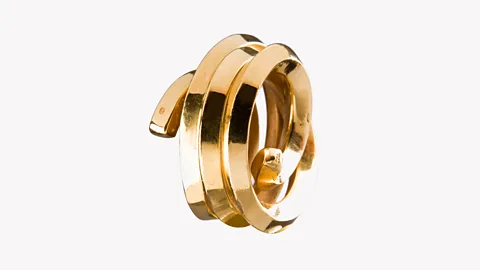
French collector Diane Venet has amassed one of the most significant collections of jewellery by artists worldwide. The story began more than 30 years ago, when Venet’s husband, the sculptor Bernar Venet, wrapped a piece of silver around her finger, creating an engagement ring and igniting her interest in what she calls, “the overlooked world of jewellery made by artists.”
The ring, which is on show alongside a larger-scale, mirror-image sculpture by Bernar Venet, launches this “surprising” journey, as Venet calls it. “I started it all because my husband gave me a ring. From there, he gave me other pieces, and so I went on for 30 years collecting pieces from artists,” Venet says.
“Often, what you find here are personal stories, pieces made by an artist not for commerce but for somebody,” she adds. “I don’t think it’s a tradition. I think it’s a challenge for these artists. They pick it up when they want to do it, when they have time, sometimes when they meet me and like me. It’s random. It’s often about friendship. In my case, with my husband, it’s a love story.”
Pablo Picasso and Georges Braque
 Musée National Picasso
Jewellery by avant-garde artists including Pablo Picasso, Georges Braque, Jean Dubuffet and André Derain, forms the first section of the show. Their glittering creations are shown alongside examples of their works of art, creating a reference point for their jewellery designs. Inspirational objects, including African sculptures, are also shown. Some of these jewellery pieces have a personal meaning for Venet too.
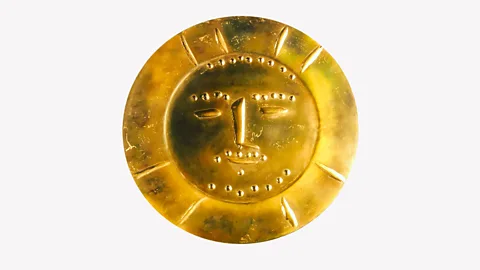
“I collected ceramics with my father from Vallauris because we had a house near there. This was a present from my father,” she says pointing to a piece shown inside a display cabinet that features Picasso’s golden medallions, a ceramic necklace and a smiling golden pendant called Le Grande Faune.
Picasso’s jewellery-making began as a happy accident, says Venet. He asked a friend, the French goldsmith François Hugo, to cast some of a damaged plate’s decoration in gold. Hugo then created a limited edition of some of Picasso’s medallions and brooches. “You can recognise the master in the pieces. You recognise him very well,” says Venet.
One of the most prolific artist makers of jewellery, Georges Braque, collaborated with jeweller Herger de Lowenfeld to create 110 gouaches (brooches, rings and necklaces). In 1963, there was an exhibition of these works. Twelve of the pieces are now part of France’s state collection. Braque decorated his dainty pieces in precious stones, including agate, jasper, turquoise and rubies.
Man Ray
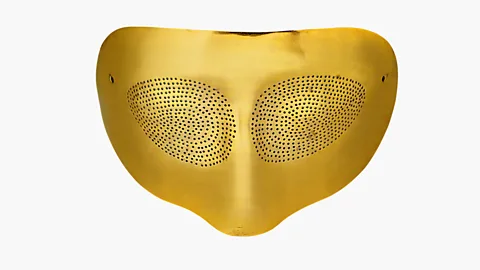
Didier Ltd/Man Ray Trust/AdagpStunning jewellery by Surrealist artists including Man Ray, Salvador Dali, Giorgio di Chirico and Jean Cocteau form a second section of the exhibition. Here, a lamp that inspired a pair of Man Ray’s spiralling golden earrings – worn by Catherine Deneuve – is on display, alongside an experimental Optic-Topic mask that he created with jeweller GianCarlo Montebello. The jeweller collaborated with many artists to realise their pieces - very few artists make or made their own. Meanwhile, a chunky golden fish pendant is among the eye-catching designs from Max Ernst, as well as a triangular brooch that has lost a corner and gained a pair of empty eyes. “You can see a connection between Ernst’s sculptures and the pieces,” says Venet.
Salvador Dali
 Philippe Servent/Fundació Gala-Salvador Dalí/Adagp
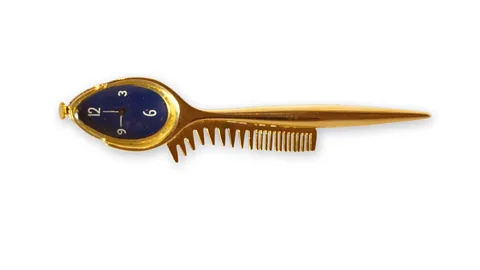
Most artists made just a few pieces, and sometimes only one, Venet says. One of the most prolific, and an exception, was Salvador Dali, whose pieces include a brooch fashioned in the shape of a spoon. “I love this Dali piece because it is so Surrealist,” she says. “It is one of my favourites. It displays such a sense of humour. Look, a watch, a spoon, and a comb combined.”
“Dali did a lot,” she adds. “He also did a lot with precious stones. It’s a challenge to do it small when they are used to creating it big. It has to have meaning. Some have difficulty finding it in something like this.”
Alexander Calder
 Sherry Griffin/Calder Foundation/Adagp
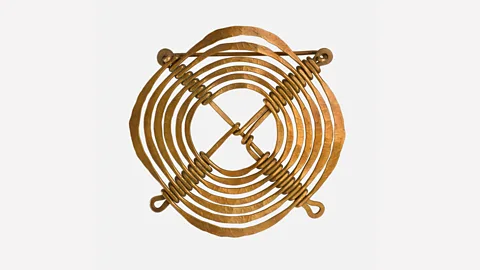
Several swirling bronzed designs from the prolific Alexander Calder form a highlight of the exhibition. As well as spirals, Calder favoured non-luxury materials, including steel, hammered brass, wire, and occasionally gold. Calder is rare in that he made the pieces himself. Altogether, he made around 2000 jewellery designs, some of which now belong to Venet.
“Calder is very special because his are always unique pieces. You would invite him for dinner. He would come with a nail,” she says.
Niki de Saint Palle
 Niki Charitable Art Foundation
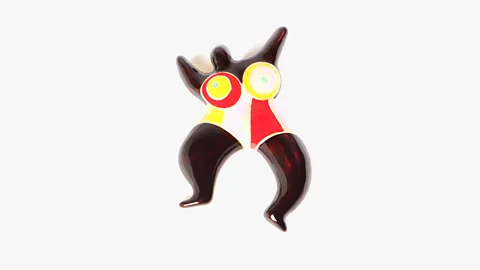
The French feminist artist, Niki de Saint Phalle, is perhaps best remembered for her voluptuous female sculptures, or Nanas, which challenged perceived roles of women. Between 1971 and 1991, she also collaborated with Montebello to realise bright ceramic designs. Several of her pieces are shown in a cabinet, alongside a doll pendant by Grayson Perry.
Louise Bourgeois
 Gregory Favre/The Easton Foundation/Adagp
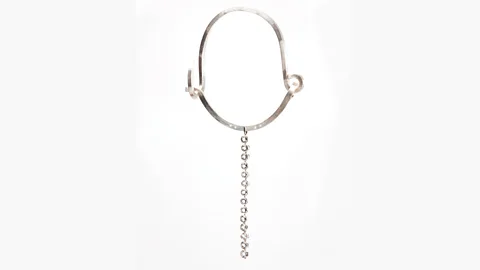
Spiders and sexuality are recurring themes in the art of feminist artist Louise Bourgeois. Two of her jewellery pieces on display show her favourite obsessions, including a spider-shaped brooch made for her mother, and a necklace that looks like a chastity belt.
Lucio Fontana and Fausto Melotti
 Philippe Gontier/Fondation Lucio Fontana/Adagp
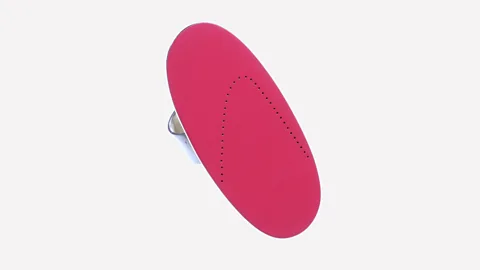
The second hall of the exhibition has been divided into national and thematic sections. It begins by showing jewellery from a prolific set of Italian artists that were ahead of the crowd, says Venet. They began making jewellery in the late 1950s. Display pieces include a bracelet that resembles a pink surfboard, designed by Lucio Fontana in 1967, and a unique gold necklace by sculptor Fausto Melotti which comprises a dangling arrangement of finely curved golden chord hanging from a simple golden ring. “Other nationalities followed on later,” she says. “The British were quite late.”
Pop art
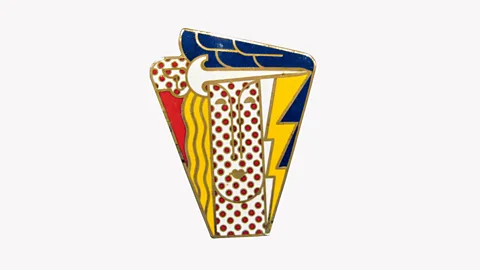 Didier Antiques Ltd/Adagp
Venet began collecting jewellery by artists when she lived in New York, so the collection includes a significant number of American artists, including her friend Frank Stella who agreed to make her a piece after months of begging. He finally presented her with a necklace “badly wrapped in newspaper.” Its fragile structure resembles a golden butterfly in motion. The two also collaborated on a ring. “What interests me the most is the intimate story,” says Venet. “It’s never for commercial reasons. It’s usually for friendship or love. I lived in New York for 20 years so often these artists were friends of mine. It was relatively easy to ask them.” The first piece she ever bought was a Lichtenstein brooch that was a souvenir from an exhibition. “I bought it for three dollars. One sold recently for $5,000,” she says.
Other artists
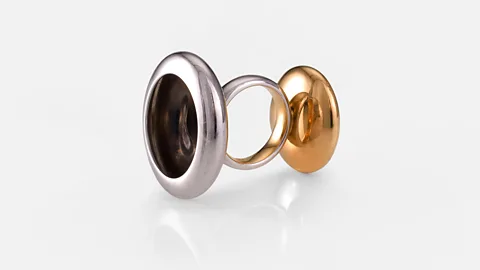 Sherry Griffin/Anish Kapoor/Adagp
The exhibition includes works by artists from around the globe, including China’s Ai Weiwei and Russia’s Ilya and Emilia Kabako. There are a number of edgy creations from British artists, including Tim Noble and Sue Webster, Anish Kapoor, Gavin Turk and Damien Hirst. One of the most striking objects on display is a ring by the Greek artist Jannis Kounellis which is a mould of his lips, and one of the more inventive pieces featured is a gold-plated potato design by Jacqueline de Jong.
If you liked this story, sign up for the weekly bbc.com features newsletter called "If You Only Read 6 Things This Week". A handpicked selection of stories from BBC Future, Culture, Capital and Travel, delivered to your inbox every Friday.
