The cross-dressing gents of Victorian England

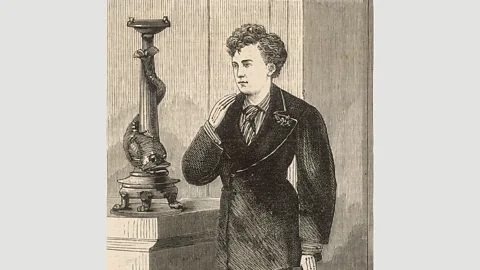
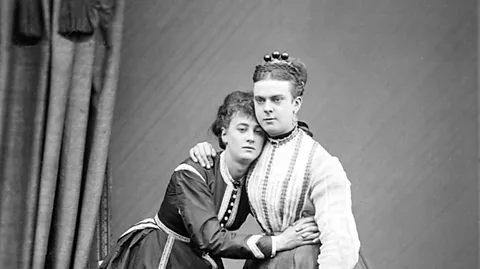 Fred Spalding, c1870/Wikipedia
A new play tells the astonishing story of Stella and her companion Fanny, two men who scandalised Victorian society by dressing as women. Holly Williams takes a look.
Had you been sitting in the Royal Strand Theatre one evening in April 1870, you might have noticed a giddy young woman in a low-cut cerise silk dress, larking around in a box before repairing to the ladies’ lavatory. If you had looked a little closer, you would have realised this was no lady after all: rather, a 22-year-old man by the name of Ernest Boulton. Or, to give her the name she preferred, Stella.
The question of what gender you have to be to use which toilet is, depressingly, still capable of causing uproar today – witness the ongoing furore over North Carolina’s controversial ‘bathroom bill’. And in the Victorian era, a cross-dressing young man popping into the ladies’ lavatory was absolutely scandalous. On leaving the theatre, Stella and her fellow cross-dressing companion Fanny were arrested on the charge of sodomy.
 Matthew Hargraves
Remarkably, Stella got off – and, rather than being publicly shamed and cowed into submission, she dyed her hair blonde, changed her name, and hoofed it over to Broadway, where she performed as a female impersonator to adoring crowds. Stella was to spend the rest of her life on stage.
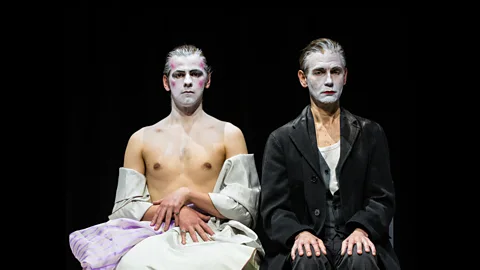
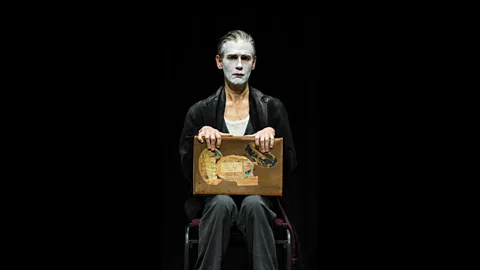
This astonishing story is being told in a new play by Neil Bartlett. A “one-woman show for two bodies”, audiences will meet Ernest Boulton as both fabulous young drag queen, and as an older man, preparing to go into hospital shortly before his death in 1904.
 Matthew Hargraves
Bartlett first encountered Stella in 1983, when he was writing a queer history book; now he’s returned to her story, acknowledging that at 56 – the same age Stella was at her death – he’s less entranced by the high jinks of a beautiful young “flaming queen”, but more in awe of a whole lifetime of courage. This is the tale of an individual who continued to question her identity, asking “who am I?” right up until her death.
Shape shifter
It also seems like a timely moment for Stella to step back into the limelight. In recent years, there’s been a massive increase in the visibility of transgender or gender-fluid individuals, from Caitlyn Jenner, Andreja Pejić and Anohni’s public transitions to TV programmes and films, such as Orange is the New Black, The Danish Girl and Transparent, that tell previously ignored stories.
“Because of the extraordinary work that trans and non-binary people are doing at the moment to make us more aware that gender identity categories are often imprecise and useless, that there are as many genders as there are people, I think we can see stories like Stella’s in a new light,’” suggests Bartlett. “For Stella, identity was never a destination – it was a journey, a constant transformation. And that’s an idea we’re now very open to.”
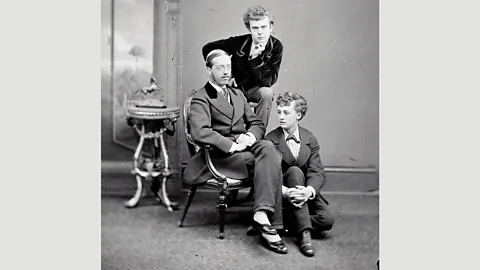
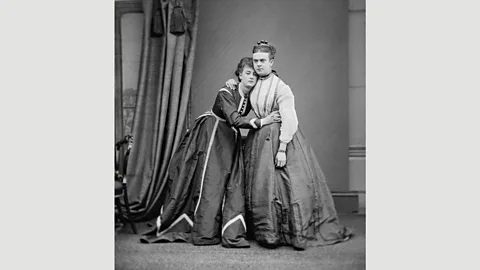 Fred Spalding, c1870/Wikipedia
Given that Stella was a part-time gay sex worker, how on earth did she get acquitted? It was down to a clever lawyer – and to the complete incredulity of the Victorian public: they simply could not believe that anyone could be so brazenly homosexual. The lawyer managed to persuade the jury at the Old Bailey that Ernest Boulton was merely a high-spirited young man with a taste for amateur theatricals, and that no sodomite would be so bold as to advertise the fact by running up and down the Strand in a ballgown.
That’s another reason the story is worth telling, Bartlett suggests: in contrast to most of our narratives about queer history, which involve miserable people having a horrendous time, Stella’s story is one of good fortune and chutzpah. Splashed across the tabloids (who dubbed her and Fanny ‘the He-She Ladies’), the whole trial was “unbelievably scandalous” – and yet she survived it. “Was she downhearted? Was she hell! Less than a year after the trial, she’s appearing on Broadway.”
Still, trying to pin down Stella’s gender identity, employment and relationships isn’t easy; she was able to shape-shift to fit her lovers’ (and customers’) desires, as well as her own proclivities. Evidence given at the trial seemed to describe several different people.
 Alamy
AlamyThere was Ernest Boulton, the nice middle-class man from Maida Vale, who turned up at the court looking neat and tidy, even having grown a moustache for the occasion. There was Ernest the “flaming queen”, an out gay man strutting the streets of the West End in tight trousers and low cut shirts.
Then – brace yourself! – there was Lady Stella Pelham Clinton, who lived as the wife of a Tory MP named Lord Arthur Pelham Clinton, sharing a bed with him in a flat just off the Strand. As Lady Clinton, Stella “passed”, with engraved calling cards, a wedding ring, and a maid who, as she testified in court, believed Stella to be female. Finally, there was just plain Stella: a gay sex worker cross-dressing in fabulous frocks, seen to pick men up in the theatre by, according to Barlett, “exposing herself, making chirruping noises, and using the time-honoured line: ‘hello darling, do you fancy a blow job?’”
‘Everyone is a unique case’
Stella may have smiled in the face of notoriety, but her lover was not so resilient. Lord Arthur was subpoenaed to appear in court – and was found dead before the date arrived. The family claimed it was scarlet fever, but it’s likely to have been suicide.
 Paul Townsend/Flickr/CC BY-NC-SA 2.0
No wonder Stella fled across the pond. On stage, she was always billed as a man dressed a woman – and she was so convincing that audiences struggled to believe she wasn’t really a woman. After a successful few years as a female impersonator in New York, she returned to the UK, but her glamorous act faded with age. She ended up, as Bartlett puts it, performing “at the absolute arsehole end of the British variety circuit”.
So, in today’s terminology, what would we call Stella: was she a trans woman, a transvestite, a drag queen? We can’t ever really know – and it may have changed throughout her life. “Why would we need to label her?” asks Bartlett.
He is also wary of the idea of Stella being ‘claimed’ as trans, used as historical evidence instead of being treated as an individual. “The question everyone wants to ask me is ‘was Stella trans?’ Because wouldn’t it be wonderful if we could then say trans is an identity that predates [gender reassignment] surgery… well, why do we ask that question? Is it because we believe that trans people need to ‘prove’ they’ve got an identity that transcends medicine? I think that’s a really weird question for us to ask.” For Bartlett, it’s more important that we avoid categorising people, lumping them together in boxes. “Everyone is a unique case.”
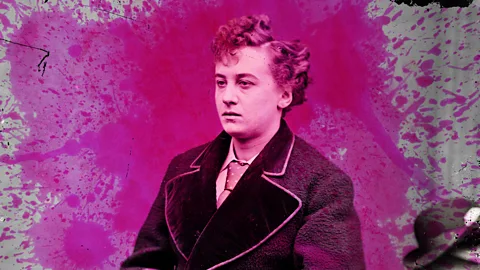
Stella took three years to write, and feeding into her voice – she talks directly to the audience – were the voices of “a lot of people who live in bodies and/or gender identities and/or wardrobes different to the ones they were born in.” Bartlett spoke to gender-fluid friends, transgender cabaret artist Justin Bond, and Nakamura Tokizô V, a Japanese onnagata Kabuki performer who specialises in female roles, and their perspectives have enriched Stella’s voice.
It is, however, very much a period piece, and the play is being staged in two gorgeous old Victorian theatres in Brighton and London, much like the sort of venues in which Stella herself would have performed. What does he think she’d make of the show? “I think she would be thrilled with where we’re playing; I chose those two theatres because I thought she would feel at home. And I think she would be thrilled to be talked about – every queen loves to be talked about.”
Stella was at the Theatre Royal Brighton, part of the Brighton Festival; Hoxton Hall, London, 1 to 18 June, as part of the LIFT festival, and at De Brakke Grond, Amsterdam, 20 and 21 June.
This story is a part of BBC Britain – a series focused on exploring this extraordinary island, one story at a time. Readers outside of the UK can see every BBC Britain story by heading to the Britain homepage; you also can see our latest stories by following us on Facebook and Twitter.
And if you liked this story, sign up for the weekly bbc.com features newsletter, called “If You Only Read 6 Things This Week”. A handpicked selection of stories from BBC Future, Earth, Culture, Capital, Travel and Autos, delivered to your inbox every Friday.
