How Western art learned to stop fearing the East


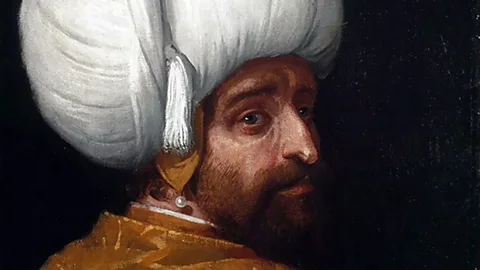
Western depictions of the Ottoman Empire range from terrible foe to exotic paradise. Alastair Sooke examines what was perceived as ‘the horror of the orient’ – and how artists got over it.
On 29 May 1453, Constantinople, capital of the mighty Byzantine Empire, fell to an army of Ottoman Turks who had besieged the city for seven weeks. For three days, the victorious 21-year-old Sultan Mehmed II allowed his soldiers to rampage in the metropolis, pillaging whatever they could find.
From the perspective of Europe’s rulers, it was a catastrophic blow for Christendom: the balance of power in the world had changed for good. Nearly three decades later, the Ottomans struck deeper into Europe, storming the southern Italian city of Otranto, and executing more than 800 inhabitants who refused to convert to Islam.
By 1529, Ottoman troops led by Sultan Suleyman the Magnificent were outside the walls of Vienna. According to Haydn Williams, author of Turquerie: An Eighteenth-Century European Fantasy, published last year, Western Europe fell into “a state of shock”.
In fact, the Ottoman reputation for merciless military discipline grew so great that the Islamic superpower even inspired a new term among cowed Europeans: “danger of the Turk”, or Turkengefahr, as German-speakers put it. This paranoid state of mind endured for a long time. In the 16th and 17th Centuries, the world was still a fractured place, divided between the Christian West and its Islamic archenemy in the East.
At least, this is the orthodox version of history. Recent scholarship, though, suggests that the rift was not quite so antagonistic. It is true that after the fall of Constantinople a torrent of European propaganda cast the Ottomans as barbarous infidels. But there is also evidence of increasing European fascination with the Ottoman Empire, stimulated by enterprising diplomats and merchants, as well as artists, who travelled to Constantinople and witnessed Turkish culture firsthand.
Eastern promise
This spirit of curiosity, respect and exchange is explored in The Sultan’s World: The Ottoman Orient in Renaissance Art, a new exhibition at the Bozar Centre for Fine Arts in Brussels, which I visited to find out how the Ottoman Empire intersected with the Renaissance.
One of the most famous instances of contact between these two worlds was the visit of Gentile Bellini, an official painter of the Venetian Republic, to the court of Mehmed II towards the end of the 15th Century. The sultan had asked the Doge of Venice for a sculptor and a bronze caster who could fashion medals, and the Venetians, who were keen to encourage commercial relations with the Ottomans, were happy to oblige. In 1479, Bellini arrived in Constantinople with the Paduan sculptor Bartolomeo Bellano.
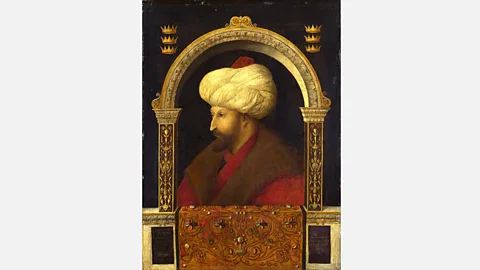
Bellini’s bronze medal of the sultan survives, and we know that during his stay he also painted a view of Venice for Mehmed II, as well as portraits of members of his court. A painting from 1480 in the National Gallery in London may be a portrait by Bellini of the sultan himself.
It presents Mehmed sitting behind a stone parapet and arch, wearing a puffy white turban that contrasts with his gaunt features underneath. His nose is noticeably aquiline, tapering to a point that “rhymes” with the shape of his beard. On either side, floating gold crowns represent conquered kingdoms.
“He has a very noble appearance,” says Guido Messling, who has curated The Sultan’s World. “He must have commissioned the portrait to immortalise his own image for posterity. In the Ottoman context, a portrait like this was unprecedented – and Bellini had a strong impact on later Ottoman miniaturists.”
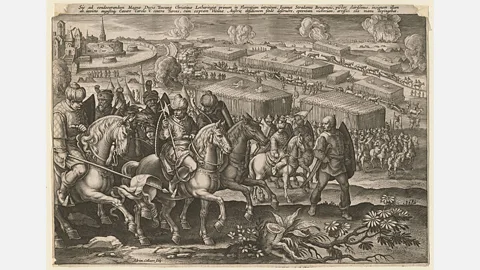
During his stay in Constantinople, Bellini also executed a number of detailed drawings of its inhabitants, including a pen-and-ink study of a seated janissary (an elite soldier responsible for the sultan’s safety) wearing a distinctive tall hat. Images like this anticipated the popularity in the second half of the 16th Century of so-called ‘costume books’ that documented sumptuous and flamboyant Turkish fashions for European readers.
A 1568 publication by Nicolas de Nicolay, geographer to King Henri II of France, is the best-known example. De Nicolay claimed that he had sketched Istanbul’s inhabitants “as they are and as I saw them, representing them in portraits according to nature”, but in fact he used prostitutes as models. Increasingly, European fantasies about Turks would have an erotic subtext.
Following the failed Ottoman siege of Vienna in 1529, European fears about the Turkish threat began to recede. At the same time, the way that Ottomans appeared in European culture started to change. “As the Ottomans were pushed back and the danger became less acute, so their exotic features became more important,” explains Messling. “Europeans felt safer, and that made it easier to fantasise about the Ottomans.”
Feasts of the senses
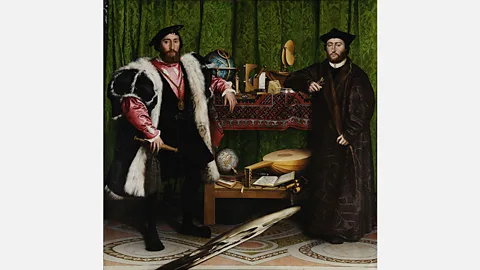
Oriental rugs, for instance, were highly prized by Renaissance artists such as Hans Holbein the Younger, who found the pictorial possibilities of their bright, dynamic designs especially beguiling. Carpets also functioned as powerful status symbols for sitters in portraits: the prominent rug in Holbein’s The Ambassadors (1533) is a good example, as is the red Ushak carpet laid on a table that dominates a group portrait painted 70 years later to commemorate the Somerset House Conference of 1604.
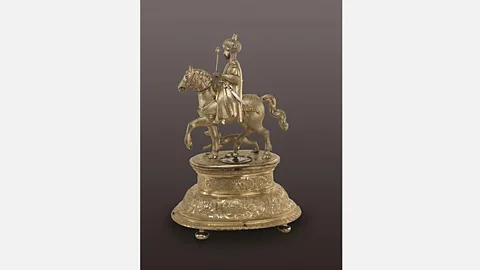
Intricate clocks and sundials decorated with generic ‘Turkish’ figures began to be produced. Christian liturgical vestments incorporated richly patterned Ottoman textiles. Even the Holy Roman Emperor Matthias had himself depicted in a portrait of 1611-12 wearing a precious Ottoman silk caftan with a peacock pattern – reflecting the fashion of the times.
Slowly but surely, in the minds of Europeans, the Ottoman Empire was becoming something not to be feared but to be desired. As Haydn Williams writes: “The stereotype of the fierce Turk metamorphosed into a more peaceable being.” And that being embodied a sense of glamour, voluptuousness and luxury.
Alastair Sooke is art critic of The Daily Telegraph
