Hero or brutal tyrant? The controversy over 16th-Century explorer Magellan

 Getty Images
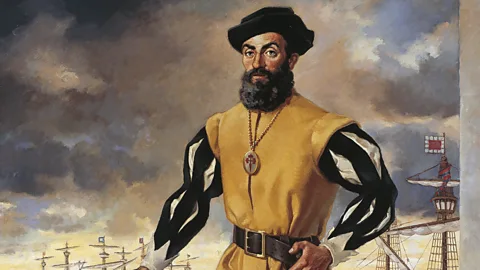
An acclaimed new film dramatises the pioneering voyage of the world-famous Portuguese navigator – a trailblazer who has been accused of "incontinent bloodlust".
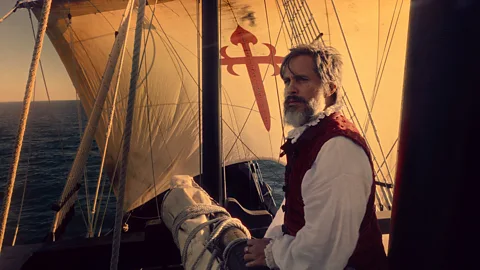
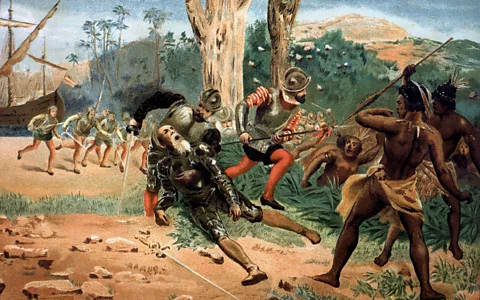
Few films are as epically gruelling as Magellan, the new drama about 16th-Century Portuguese navigator Ferdinand Magellan by Filipino auteur Lav Diaz. It begins with the famous explorer – played by Mexican star Gael García Bernal – harbouring grand ambitions of forging a new maritime route to what were then dubbed the "spice islands" in Indonesia. He defects from his home country to Spain and with the support of King Charles I, helms a bitterly arduous voyage – during which many of his crew perish from scurvy or are executed for mutiny. Reaching the island of Mactan in what is now known as the Philippines, Magellan himself is killed in brutal fashion during a battle with local people.
The circumstances around this extraordinary odyssey, which he began in 1519, have become somewhat fabled. It was a voyage that many historians suggest marked the first full circumnavigation of the globe; after Magellan died on Mactan in 1521, his fleet's round-the-world route was completed under his fellow captain Juan Sebastián Elcano the following year. The biographer Laurence Bergreen claims the Portuguese sailor's feats are more "significant" than those of Christopher Columbus, while Nasa christened one of their spacecrafts after him. But others dispute his importance, especially since he did not live long enough to finish the journey back to Spain.
 Janus Films
There are other reasons why Magellan is a controversial figure, including his betrayal of his own country, which was preceded by accusations of illegal trading; his alleged tyranny aboard his fleet; and his forced conversion of Mactan inhabitants to Christianity. As recently as 2022, the historian Felipe Fernández-Armesto attempted to debunk the narrative of Magellan as hero in his book Straits: Beyond the Myth of Magellan, calling the leader reckless and fanatical, and his mission an "unmitigated failure", due to its high number of deaths (of roughly 270 sailors, only 18 are believed to have returned to Spain) and failure to make a profit. Fernández-Armesto also says Magellan was guilty of "imperialism, slavery, incontinent bloodlust and unjust discrimination" against Indigenous peoples. So should he be considered a trailblazer or a traitorous power-grabber?
Making Magellan's legacy yet more murky, the records which remain about his round-the-world expedition are scant. Most of what we know about Magellan is thanks to his onboard chronicler Antonio Pigafetta, who acted as the navigator's assistant – but has been characterised by Fernández-Armesto as Magellan's "PR agent".
Changing the Magellan narrative
To create his own semi-fictionalised account of Magellan's expedition, Diaz spent seven years undertaking research and visiting archives in Lisbon. Initially, it was Magellan's overlooked wife of nearly four years, Beatriz Barbosa de Magallanes, who drew the writer-director's attention. "But then through the course of my research, I just thought Magellan is more interesting," Diaz tells the BBC – particularly because he saw an opportunity "to balance the narrative, to put the Malay perspective as well [in it]. Because it's always about Magellan – the point of view of the white man."
Part of recalibrating the story involved emphasising the significance of Magellan's slave of 10 years, Enrique of Malacca (played in the film by Amado Arjay Babon). Before Magellan set out on his journey to the Philippines, he had purchased Enrique, a former Muslim, in the Malaysian city of Malacca and taken him back to Spain. Upon their arrival in Mactan, Magellan's entourage were startled to discover Enrique spoke the native language – suggesting he was raised nearby. Some historians have even conjectured that, in returning to the region, Enrique may actually have ended up circumnavigating the globe before any of Magellan's crew.
Diaz's film also shines a light on anti-slave trade sentiment during the era: Magellan is warned against it by a fellow member of the Spanish court. Fray Bartolome de las Casas – a member of the Spanish royal council – preached against slavery, while new laws restricted the trade in Portugal in 1570.
 Alamy
AlamyAlthough solid facts about Magellan's life are limited, the narrative that often prevails is about his heroism. Diaz's Magellan, on the other hand, takes an unflinching look at what we know about his treatment of his crew members aboard the Armada de Maluco, which included executing one of them for alleged sodomy and, as his paranoia mounted, marooning the priest, Pedro Sanchez de Reina. Mutinies were recurring, and in November 1520 one of the fleet's five ships, the San Antonio, and its entire crew deserted the mission.
Magellan may have felt compelled to deliver such severe punishments out of insecurity, because by fleeing his own nation, he had made himself a pariah in both Portugal and Spain. "Magellan had the handicap of not being Castilian, which reduced his authority over the Castilian nobility," João Paulo Oliveira e Costa, history professor at the University of Lisbon, tells the BBC. "His Castilian captains aimed to get control of the expedition. Punishment had to be brutal to discourage new rebellions. If Magellan had not killed them, they would have killed Magellan."
In Diaz's biopic, the colonial violence Magellan and his men wrought is also brought to the fore. When they set ashore in Guam and a small boat was stolen, the sailors wreaked bloody revenge against the Indigenous community, setting fire to homes. Communities in Malacca and the Philippines were subject to similar brutality. Unlike other cinematic depictions of colonial violence, however, such as The Nightingale (2018) or Soldier Blue (1970), Diaz's portrayal steers clear of explosive, potentially exploitative action. "The Magellan saga is an epic thing," he explains. "But I didn't want to do that the conventional way, [with] the spectacle… I was on the police beat when I was a young reporter and you see the aftermath, you don't see the action. There's a disrespect of humanity [portraying] that, for me."
Despite Magellan's flaws, Diaz wasn't interested in demonising him. "I wanted to see a real character," insists Diaz. "A real human being is ambitious [and] dreams, not just for himself or his family. He really believed in a Christian faith." Along with being widely considered the first European to make contact with the Philippines, Magellan was also responsible for introducing Catholicism to the region. The Santo Niño (Holy Child), a statue of which Magellan gifted to local chieftain Rajah Humabon and supposedly brought about the miraculous recovery of sick children in that community, is "still the biggest icon in the country," says Diaz. Today, 93% of the population in the Philippines is Christian.
Who killed Magellan?
Diaz's mythbusting approach also applied to the centuries-old mystery of Magellan's death in the so-called Battle of Mactan. Pigafetta asserted in his journal that, as 2,000 Malay warriors tackled the 60 surviving crew, Lapulapu, another local chieftain, slayed the conquistador. Diaz was not so convinced: "For me, it's some kind of cold case, because they always accept the Pigafetta, that Lapulapu killed Magellan – but nobody saw Lapulapu." In Diaz's version of events, Lapulapu is in fact a fictional invention of Humabon, an allegedly quasi-supernatural blood-drinker who Humabon conjured up to frighten Magellan and his men.
“Humabon didn't want conversion [to Christianity],” says Diaz. “And then Magellan said [Humabon] would die in two days, because he had a decree that anybody who didn't want to be converted must die.” In the film, Magellan is not seen being killed by one specific person, but instead it's implied it was a collective effort by Humabon's men.
 Getty Images
This suggestion that Lapulapu is not a real figure stoked controversy in the Philippines when the film was released there last September. That's because of Lapulapu's legendary status: according to Dr Danilo M Gerona, historian and author of Ferdinand Magellan: The Armada de Maluco and the European Discovery of the Philippines (2016), Lapulapu was for a long while "emblematic of Filipino nationalism as evident in monuments, insignia and names of localities [paying tribute to him]”, even though “most of what we know [about him is from] apocryphal, legendary and folk stories drawn from oral transmissions. For this reason, little attention is given to him among scholars." Yet Diaz's film prompted two anonymous historians to come forward in Philippines newspaper The Freeman to dispute his take on the figure.
More like this:
Magellan himself has had a similarly ongoingly contested reputation in the Philippines. Once recognised as a "champion of the Catholic faith", says Gerona, he became increasingly unpopular amid the rise of nationalism during President Rodrigo Duterte's tenure between 2016 and 2022, and is now reviled by "younger generations” amid rising "anti-western" sentiment. His role in Philippine history is also much debated. The historian and former chairman of the Philippines' national historical commission Ambeth Ocampo has asserted, "Magellan should not be seen as the beginning of Philippine history but one event [in] a history that still has to be written and rewritten for a new generation."
It's unsurprising that, with centuries' hindsight, the legacy of an explorer like Magellan should be complex, with even his intentions remaining in doubt. "Magellan did not wish to circumnavigate the globe,” claims Oliveira e Costa. However, among his achievements, he says, Magellan "discovered the connection between the Atlantic Ocean and the Pacific Ocean, as well as the large size of the Pacific Ocean. It was after his expedition that cartographers were able to make planispheres [world maps showing a view of the Earth's surface] with the three great oceans, and the elites realised finally the size of the planet itself."
At the end of the film, it is the conflicted perspective of Enrique of Malacca, rather than that of Magellan or his co-captain Elcano, which closes out the story: he regretfully admits to helping slaughter the Portuguese and Spanish men still stranded on Mactan island, while also reflecting on the colonial violence wrought against him and other Malays. Diaz hopes that his film encourages a dialogue around Magellan's voyage that is "more balanced, that's more inclusive, in a way, not just the dominant eye, the Europeans".
Magellan is released in the US today
--
If you liked this story, sign up for The Essential List newsletter – a handpicked selection of features, videos and can't-miss news, delivered to your inbox twice a week.
