Africa unseen

How are photographers challenging preconceptions about the continent? BBC Culture takes a look at the artists who are reframing Africa.
A family portrait: standing in a line, they pose in front of the gate to their home. It’s like countless traditional photographs – except this family is waist-deep in water. The image is part of a series called The Drowning World, and it features in an auction of African contemporary photography believed to be the first of its kind.
Held by The Auction Room, the online sale is an acknowledgement of the booming interest in art from the continent. Photography, in particular, has been picked up by collectors, who are drawn to “imagery from a continent that has always fascinated outsiders,” says Ed Cross, a dealer and curator specialising in African contemporary art.
Buyers used to want ‘exotic’ works that reinforced colonial views of Africa. But now, Cross believes, demand is fuelled by “the amount of creative talent that’s finding its way out to the rest of the world. All these different tributaries are leading into the scene: photojournalism, performance art, film, advertising, fashion and studio photography.”
“Photography is so cheap to do, people can use their phones,” he says. “Artists can play with costume and ‘Africanness’, reinventing themselves.”
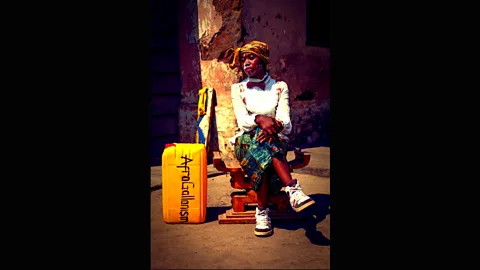
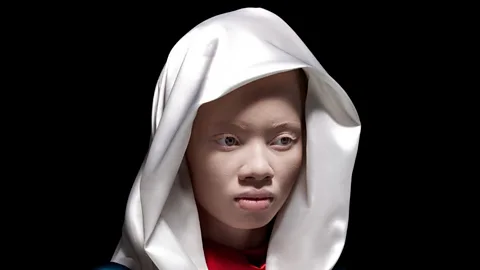
Serge Attukwei Clottey draws on fashion to create arresting images that mix Western street style with Ghanaian textiles and give a different take on the airbrushed consumerism of the advertising shoot. Justin Dingwall also brings his experience in fashion to his work. The South African has collaborated with model and campaigner Thando Hopa for his latest series Albus, which addresses negative perceptions of albino people. “It’s very slick photography, in a good way,” says Cross. “It’s well lit – that’s him coming from that background.”
Mozambique photographer Mário Macilau develops the studio photography concept pioneered by Malick Sidibé and Seydou Keïta in Mali, allowing his subjects to show off their own style – down to choosing the background cloth for their shoots. It is both a new view of a country often shown through images of drought or famine, and homage to the artists who went before him.
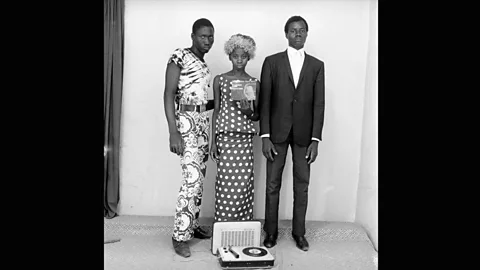
Sidibé, who is also included in the auction, is seen as one of the fathers of African photography. He photographed people in Bamako in the decades before and after Mali’s independence from France in 1960, capturing the country shaking off its colonial past.
“The majority of photography until independence was being done by outsiders,” says Cross. “Sidibé gave people the freedom to dress up and do what they wanted in a studio setting.” He highlights a shot of Jimi Hendrix fans taken in 1971. “It shows there’s a whole scene going on – it’s very revealing about the real stories of people at that time.”
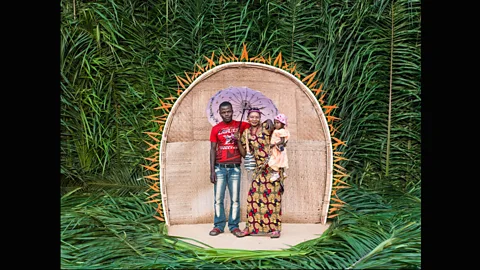
This is something Cross believes comes across in the work of many contemporary photographers. “People tend to generalise foolishly about Africa,” he says. “But photography shows the incredible diversity within the continent.”
A French photographer who grew up in the Democratic Republic of Congo has reinterpreted the rituals of the Ekonda pygmies in a series called I Am Walé, Respect Me. Patrick Willocq creates huge sets to recreate scenes from the tribe’s cultural practices. “There’s a danger with the notion of ‘Africa rising’, that everything should be about the metropolis. But there is this whole vast area of traditional culture which should not be ignored either.”
