
CrowdScience
CrowdScience
How can we save the Great Barrier Reef?



27 February 2026
26 minutes
Available for over a year
Australia’s Great Barrier Reef is one of the richest and most complex natural ecosystems on earth, and it’s home to over 600 species of coral – marine animals that are most closely related to jellyfish.
But the coral is under threat, with climate change, ocean acidification and marine heatwaves endangering the reef and the many iconic animals that depend on it. CrowdScience listener Felix, aged 9, wants to know what we’re doing to protect it, and presenter Caroline Steel is on the case.
In this special edition of CrowdScience, we follow scientists from Australia’s Institute of Marine Science as they attempt to restore the reef with baby corals that they’ve nurtured in experimental tanks at their Sea Simulator facility on the country’s northeast coast.
This experiment kicked off in December, as the researchers recreated the annual mass coral spawning event in controlled conditions, manipulating temperature, pH, light, and nutrients to breed coral baby that they can then use to reseed damaged sections of reef.
After loading up a lorry full of corals and waving it goodbye, Caroline heads north for a rendezvous at dawn, as the corals are loaded onto a boat in Cairns. She travels across the coral sea with marine biologists from AIMS, and is on hand as the corals are introduced to their new home in the ocean.
This is just the beginning - a proof of principle. In future years, the scientists are hoping to reseed heat-tolerant corals, and to scale up and automate this work. But even then, is the scale of the problem too big? Can we restore a reef area the size of Japan, or is it too late?
Presenter: Caroline Steel
Producer: Marnie Chesterton
Editor: Ben Motley
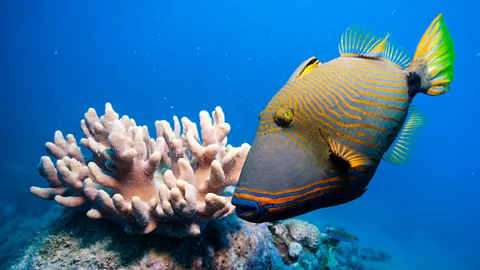
(Photo: Orange-lined triggerfish by coral in beautiful blue water - stock photo. Credit: treetstreet/Getty Images)
