The rise of the Kazakh capital

 Taylor Weidman
From an international expo centre to a massive indoor beach, Astana, the capital of the world's largest landlocked country, is entering the limelight.
 Taylor Weidman
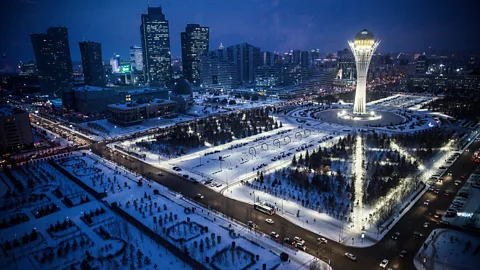
Oil wealth has transformed Astana’s dusty steppes into a landscape punctuated by gleaming, futuristic architecture.
Since Astana’s inception, Kazakh President Nursultan Nazarbayev has been determined that his vision for the capital would reflect his ambitions for the country. Since 2005, more than $300 billion in foreign direct investment has flowed into Kazakhstan’s economy, with the vast majority coming from the extractive industries.
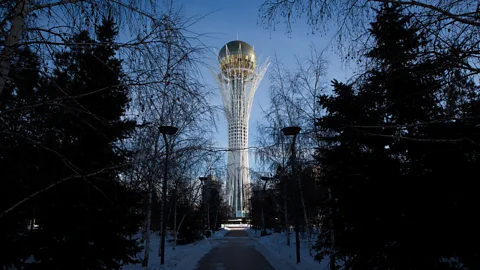
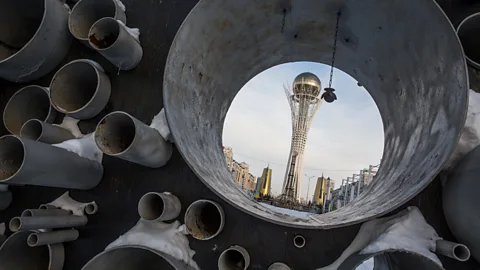
Its first significant new landmark, completed in 2002, was Bayterek Tower, a monument resembling a giant egg atop a tree. It’s an observation deck where you can see how the city’s centre has been reshaped over the last 15 years by architects of diverse styles. To the tower’s east is the Khan Shatyr Entertainment Center, a massive shopping mall housed in the world’s largest transparent tent, designed by British architect Norman Foster. To the west is the Presidential Palace, which resembles the White House, save for a massive robin-egg blue dome. Next to that is the Central Concert Hall, a turquoise structure mimicking an unfolding spaceship, designed by Italian architect Manfredi Nicoletti.
Despite a slowdown in the economy after crude oil prices tumbled in 2014, the construction boom continued in the city through 2017.
 Taylor Weidman
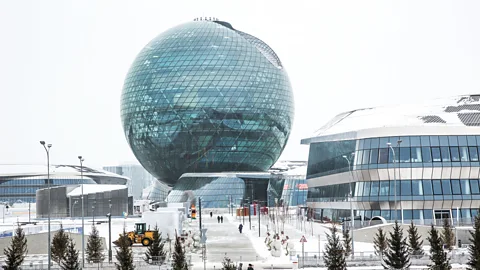
Beating Belgium to win the rights to host Expo 2017, an annual international exhibition that is modelled after the World Fair, Kazakhstan invested a reported $3 billion in preparation for the event, which ran from June to September. The theme, Future Energy, was a somewhat ironic decision given the country’s heavy reliance on oil and oil-adjacent products. A whole new Expo site was constructed with a silver globe at the centre and the brand new Mega Silk Way shopping mall next to it.
Since 2012, Kazakhstan has seen a sharp rise in business numbers with more than 275,000 visitors passing through the country for business reasons. That number has since tripled, growing to more than 1 million visitors. Astana itself has also seen a steady increase in foreign arrivals. After a lull in 2015 – likely due to the economic slowdown because of rising oil prices – the number of visitors increased by 25% in 2016, and then again by 19% the following year.
 Taylor Weidman
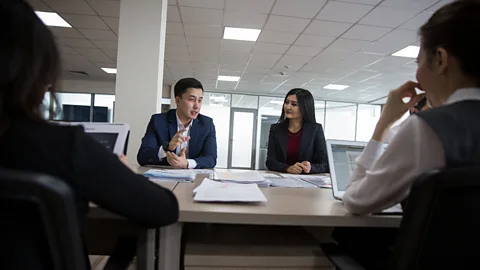
As part of a five-year investment plan from the government, the Astana International Financial Centre (AIFC) launched in January to attract more foreign companies in to work. The AIFC operates under a separate legal regime based on English common law, so that companies feel more comfortable working under similar standards of international financial centres. Financial technology companies will also be able to operate within a regulatory sandbox, allowing them experiment with new technology without restrictive regulations.
The AIFC wants to attract innovative newcomers in the fintech, green finance and Islamic finance sectors, says Baur Bektemirov, the body’s managing director. “Our goal is to be innovative and to try to leapfrog and embrace new knowledge,” says Bektemirov.
Astana’s geographical position between Chinese and Russian interests also makes it a favourable transit point for businesses, explains Alexey Sidorov, a fintech entrepreneur who is the CEO of Silkway Ventures Group.
“We are a huge piece of land with a lot of transit routes that go from China to the rest of the world, and there’s a lot of traffic, a lot of railway and highways are built under China’s One Belt One Road initiative,” says Sidorov. “This means there will also be a lot of financial flows in and out of Kazakhstan.”
 Taylor Weidman
We are a huge piece of land with a lot of transit routes that go from China to the rest of the world, and there’s a lot of traffic - Alexey Sidorov
 Taylor Weidman
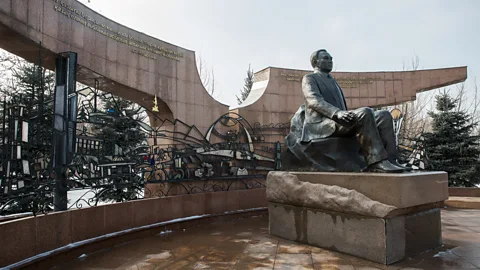
With President Nazarbayev hanging onto his position as head of state for nearly three decades, Kazakhstan’s democracy is nominal at best. In 2015, he was proclaimed winner of the national election with almost 98% of the vote but no opposition party to contest it.
The government is also taking its cues from China and Russia on how to treat its media. The president recently approved increased reporting restrictions on journalists. The new amendments also prohibit anonymous comments by the public on news websites. Independent and opposition journalists have long faced harassment, attacks and criminal charges that have been criticised as being politically motivated. Currently, Kazakhstan holds the 157th spot, out of 180, in the World Press Freedom Index by Reporters Without Borders.
There has also been a crackdown on the labour rights movement, says Human Rights Watch, with the recent conviction of Larisa Kharkova, the head of the Confederation of Independent Trade Unions of Kazakhstan.
 Taylor Weidman
Judging by its well-heeled residents, the city’s favourite pastime appears to be shopping. Astana is a fashionable city. Even with Arctic temperatures in winter falling as low as -40 degrees, some women still walk through the city dressed to the nines in heels and thick fur coats.
While the population tends to be very “brand-addicted”, there was a decline in sales over the last few years when the country went through currency depreciation, says Saule Izmaganbetova, marketing department head of Khan Shatyr Entertainment Center.
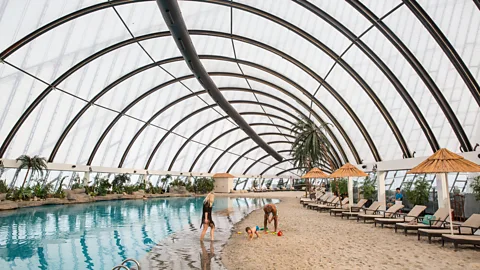
However, that did not deter people from coming to the shopping mall just to pass the time, especially in the winter, says Izmaganbetova. On Khan Shatyr’s top floor is an indoor beach and waterpark, with temperatures as high as 36C (98F), a welcome respite from Astana’s sub-zero winters.
Another favourite winter activity is ice-skating. As evening falls, the open-air skate parks fill with families. The Expo site boasts an “ice town”, which features a 260ft (80m) maze illuminated by colourful lights at night.
Entrepreneur Sidorov has been periodically visiting Astana for work from Almaty, the former capital, since 2000. “The last time I was there, just for the Expo to bring my family there, I was pretty impressed,” he says, adding that the capital is helping to change some misconceptions about the country.
“The further (away) people are, the less they know about Kazakhstan. For them, any '-stan’ is the same. They think Kazakhstan, Afghanistan, Tajikistan – all of them are all the same in Eurasia,” Sidorov says. “So we, as a country, have to do a lot to help change that perception.”
