Malacca’s forbidding debal curry

 Tim McDonald
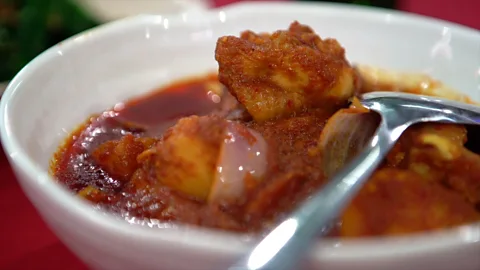
Perhaps no dish encapsulates Malacca’s tiny Portuguese community better than debal curry. Once a luxury reserved for Christmastime, it’s become far more common over the years.
 Tim McDonald
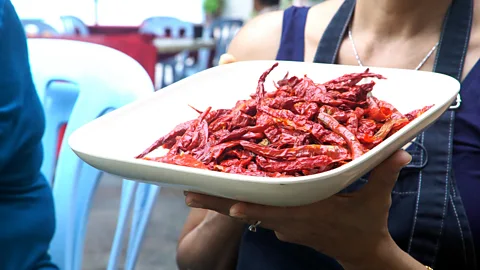
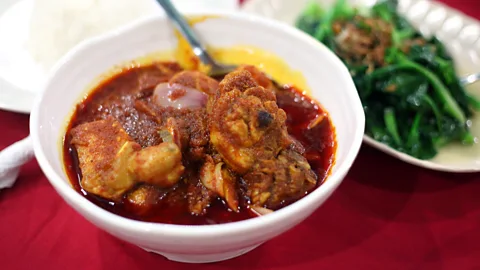
There’s something immediately forbidding about debal curry. Even though ‘debal’ actually means ‘leftovers’ in the local Kristang language (a creole version of Portuguese), many visitors assume it means ‘devil’s curry’. It’s not hard to see why. The dark ochre colour telegraphs its intention to burn a layer of skin off your tongue.
Still, it’s not like some Szechuan dishes, which seem designed solely to inflict maximum agony. It’s hot enough to make most people sweat, but it burns in the right places. The heat lingers, but doesn’t seem to overstay its welcome. A little rice and a cold beer help to take the edge off.
Perhaps no dish better encapsulates the tiny ‘Portuguese’ community here in Malacca, a city on Peninsular Malaysia’s south-west coast. The inhabitants descended from Portuguese settlers who came here in the 1500s. And although they’ve mixed extensively with other communities, they remain a distinct group with their own traditions and cuisines. In a single bowl of debal curry, there are reminders of the Catholicism and half a millennium of geopolitics that helped to shape this culture.
 Tim McDonald
Debal curry is also an interesting gauge of how the Portuguese community is changing. Once, the dish was a luxury reserved for Christmas or the day after, as a sort of spicy bubble and squeak made from the holiday leftovers. But in more prosperous times, it’s far more common.
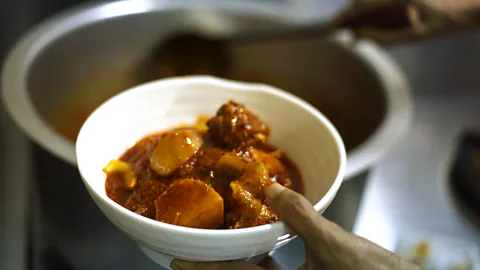
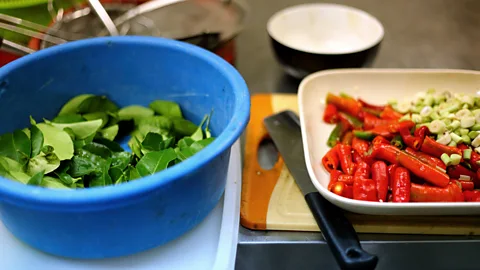
In some ways, this is a fairly simple dish. It’s just chicken or pork, potato and that dark red sauce, with a few red onions and maybe some greens thrown in as a garnish. But the sauce, which has a multitude of ingredients, is the chilli-fuelled star attraction.
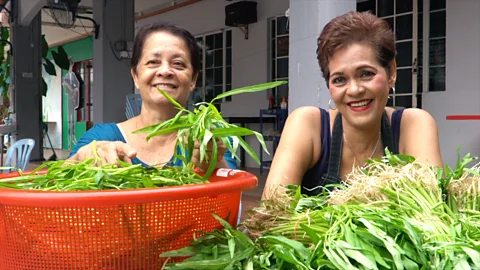
The pork version is the best one, according to sisters Janet and Helen Monterio, who run a restaurant in Malacca’s Portuguese Settlement. But they don’t serve it. In fact, it’s hard to find a restaurant here that does, because in predominantly Muslim Malaysia, you can chase off customers by having pork in your kitchen.
 Tim McDonald
It used to be cooked at home so spicy that people changed it to ‘devil curry’,” Janet said.
 Tim McDonald
A bowl of curry seems an apt metaphor for this community. Over 500 years, all kinds of cultural ingredients have been mixed into the pot.
“Originally, the Portuguese didn’t take chilli, of course. Too spicy,” said Chris De Mello, managing partner at the Portuguese Settlement Heritage Museum. But he explained that the local Portuguese cuisine changed as the community interacted with Malays, Chinese and Indians. “So we modified it. We changed it. We added some better items,” he said.
 Survivalphotos/Alamy
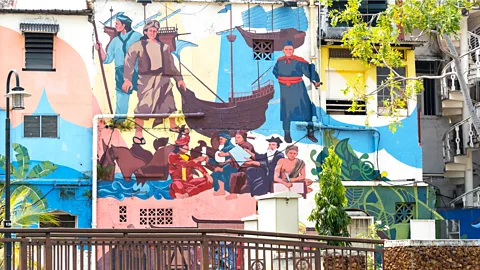
Even before the Portuguese arrived, Malacca was already very cosmopolitan. Chinese, Javanese, Indian and Arab traders were already here. After the Portuguese took Malacca in 1511, they almost immediately started marrying locals. At the start, there wasn’t much choice, said De Mello, because women didn’t come on those first voyages. Today, it’s still very common for Malacca Portuguese to marry outside their community, mostly with Indians and Chinese. They marry Malays too, but it’s less common because staunchly Catholic Portuguese are often unwilling to convert to Islam, De Mello explained.
The Portuguese settlers mixed with other European colonial powers, too. The Dutch took control of Malacca in 1641, who later ceded it to the British, who held it until independence in 1957, save for a few years of Japanese occupation during World War Two.
“We have English surnames also, like Smith. And Dutch,” said De Mello. He jokes that his large, meaty hands are Dutch, passed down from his mother’s side of the family.
 Tim McDonald
Debal curry is something of an exception in Portuguese food as the Portuguese had a seafaring past, and seafood often forms the basis of a meal in the Portuguese Settlement; not meat. The restaurants here serve up clams, squid and baked fish. Most, including Monterios Portuguese Seafood Restaurant, don’t even have debal curry on the menu. People just know to ask for it.
Debal curry’s past is as tangled as this community’s, and pinpointing exactly how it originated is all but impossible. It’s quite possible that it has its roots in Goa, India, another Portuguese colony, but was modified when it arrived in Malacca.
Celine Marbeck, who wrote a book about Eurasian food called Cuzinhia Cristang, notes that it has a lot in common with Goa’s fiery vindaloo curry, which uses similar ingredients such as vinegar, dried chilli, garlic and turmeric. Candlenut and galangal (the local ginger) were almost certainly added into the mix here in Malacca.
But like many Portuguese dishes, there are many variations of debal curry. For example, in Singapore, which also has a Portuguese community, it’s more likely to be pork-based and it’s often served with sausages.
 Tim McDonald
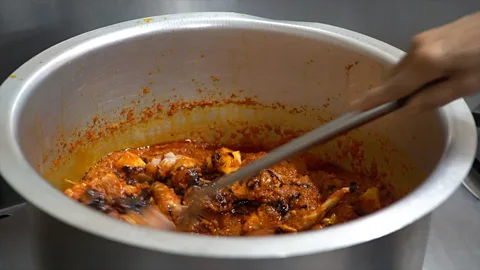
In the restaurant kitchen, Janet Monterio stirs the debal curry, which is popular among tourists (who have read about the dish) and locals alike, in a giant iron pot. But a few decades ago, it was hard to find if you didn’t show up at the right time of year. And when Janet was young, it was a far less prosperous time, so the curry was rationed out carefully between family members. It was one serving each, with no seconds.
Still, for this community, there’s no other dish that tastes so strongly of home. Many Malacca Portuguese live and work elsewhere, but debal curry is often the first thing they ask for when they return home. One of Janet’s friends even had a craving after spending decades overseas.
“She went to Australia. In 30 years, she has not eaten this curry. Thirty years! So, she called me, and I cooked it specially for her, because she missed that curry so much,” Janet said.
 Tim McDonald
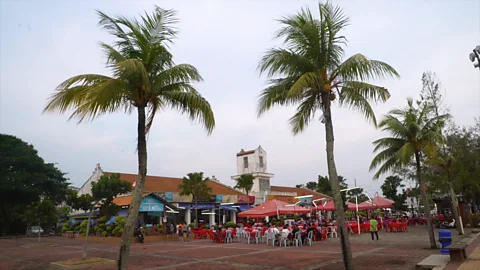
What is now known as the Portuguese Settlement is actually a modern creation. Jesuit missionaries bought up the land in the 1930s and started encouraging local Portuguese residents to move here. Previously, they were spread throughout the city.
For visitors, apart from visiting the small Portuguese Settlement Heritage Museum, eating is the only real activity on offer. The settlement extends a few blocks in every direction, with restaurants everywhere, and is noticeably different from the rest of Malacca. For one thing, there are more dogs here. The school of Islamic law to which most Malaysian Muslims adhere sees dogs as ritually unclean. The Portuguese don’t mind as much. Also, the houses almost all have a statue of The Virgin Mary or St Peter in the front yard. The great majority of locals go to mass every week, and religious festivals – such as the Feast of St Peter, the Feast of St Anne and Inturdu, which is a Lenten celebration involving water fights like Thailand’s Songkran celebrations – are the biggest events of the year.
A few other distinctly Portuguese features have persisted here too, including Portuguese music and dance.
 Tim McDonald
[Debal curry] is the main dish of Portuguese cuisine,” said De Mello.
 Tim McDonald
When the Monterios were growing up, the dish was a luxury. Meat was expensive, and the diet then was mostly made up of seafood. In fact, just a few decades ago, most of the community made its living from fishing; now just a handful ply their trade.
Now, chicken is cheap but seafood is expensive. “Like for the Catholics here, they cannot eat meat during Lent time, or during Fridays. But I think they should change it, so you cannot eat fish. Because fish is so expensive now. It used to be so cheap before,” Janet said.
With greater prosperity, not to mention more tourists, debal curry is now almost always available. Nearly every restaurant in the Portuguese Settlement will make it. They tend to tone down the heat a little for the tourists, though; the homemade version will have an entire blender full of chillies mixed into the sauce.
But other than a few alterations tailored to visitors or Muslim customers, the dish itself hasn’t changed much over the years, and it still occupies a special place in this community. According to De Mello, “[Debal curry] is the main dish of Portuguese cuisine.”
Soul Food is a BBC Travel series that connects you with cherished memories through comfort foods from around the world.
