How failure shaped our relationship with the North Pole

 Alamy
AlamyGenerations dreamed of reaching the Earth's northernmost point, finally succeeding in 1926. Ahead of the centennial, we remember the stories of those who valiantly came before – and failed.
Before humankind first reached the North Pole, it was theorised to be an open sea, a hollow shell and even the birthplace of the human race. The fight to be first was front-page news as nations raced to find Earth's northernmost point.
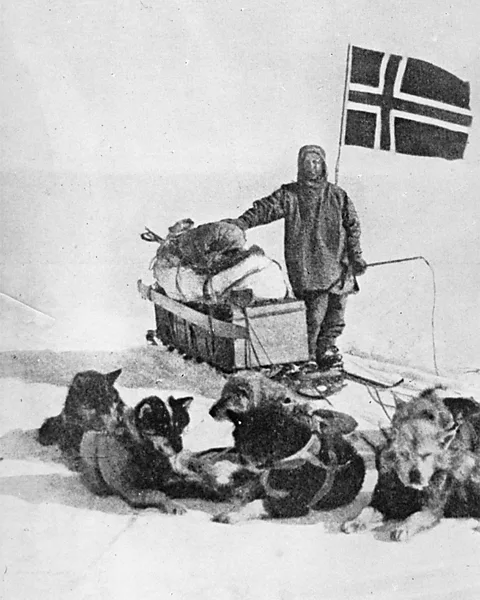
Norwegian explorer Roald Amundsen finally won the race on 12 May 1926. Thanks to his valiant efforts, it is now textbook knowledge nearly 100 years later that the North Pole is located in the middle of the Arctic Ocean, covered in ice. Lesser known are the stories of the manifold failures and mishaps that came before its discovery.
 Nils Strindberg, courtesy of Grenna Museum
Early attempts
"These were foolhardy expeditions combined with the sober pursuit of cutting-edge research data," says Eystein Markusson, museum director of Svalbard Museum.
Cold competition
Though Amundsen is most often credited as first to reach the Pole by land, there were competing claims. Frederick Cook (1908) claimed to have arrived with two Inuit men, but the commission found his documentation insufficient, and his story was widely discredited. Then Robert Peary (1909) claimed to have reached the Pole with his valet, Matthew Henson, and four Inuit men. While his account was widely believed at the time, it later faced scrutiny. In 1988 the National Geographic Society concluded after analysing his records that his claim was unproven.
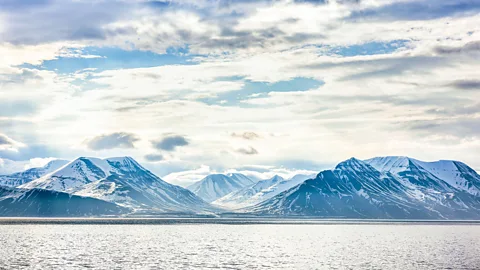
Svalbard – a remote, treeless archipelago between mainland Norway and the North Pole – is home to polar bears and the midnight sun. Longyearbyen, its icy capital, was the starting point for numerous expeditions thanks to its northernmost location and logistical support for Arctic travel.
By the 17th Century, Svalbard had become a whaling hub. The dangers of working in the brutally icy high North were well known, and men brought feathers, soil or a layer of moss from home to place in their own coffins. Those who died were buried at Likneset ("Corpse Point") and Gravneset ("Grave Point"). In the early 18th Century, Russian trappers became the first to hunt year-round here, but Svalbard remained a perilous place to conduct research.
An 1861 attempt to find the Pole by Adolf Erik Nordenskiöld, a geologist and professor at the University of Stokholm, was thwarted when his reindeer ran away. Scientists in the early 1900s made several expeditions financed by the Prince of Monaco as more would-be explorers were attracted by the prospect of the Pole discovery.
"When I talk to people now, there's a clear distinction between adventurer and researcher, but at the time, these expeditions had scientific value – they were very closely intertwined," says Markusson.
 Gösta Florman, courtesy of Grenna Museum
Lost for 33 years
Of all the doomed, early expeditions, the ill-fated Andrée mission is "perhaps the most unfortunate," says Markusson.
After executing daring balloon flights across the Baltic Sea, Swedish engineer Salomon August Andrée decided he would succeed where dogs and sledges had failed by flying over the ice.
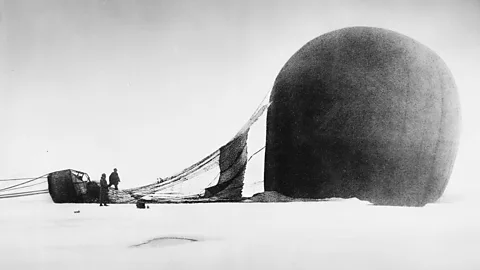
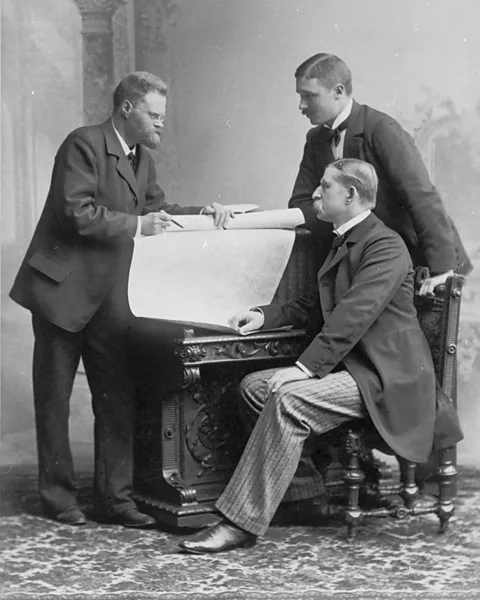
After an aborted first try in 1896 due to the wind blowing in the wrong direction, he returned the following year with photographer Nils Strindberg and engineer Knut Frænkel. They set off in a hydrogen balloon, tuxedos and Champagne packed for celebration, planning to fly over the North Pole and drop a Swedish flag in a matter of just a few hours. After liftoff, nothing was heard of them for 33 years.
Decades later, a Norwegian expedition stumbled upon the wreckage and the three men's remains. Their recovered diaries fill in the gaps: during their ascent, the long tow lines they used for steering tangled and they lost control of the balloon. As they drifted farther north, rain and fog caused the balloon to ice over, and after just 65 hours in the air, they were forced to make a crash landing. The men then embarked on a 400km, three-month trek on foot, eventually reaching the small island of Kvitøya, where they perished trying to overwinter.
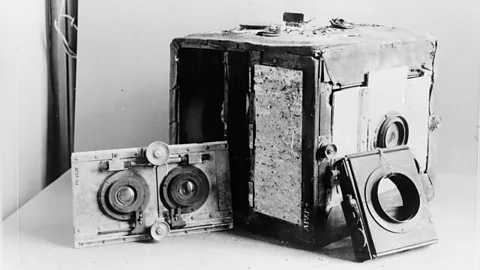
Alongside the crew and their diaries was Strindberg's unexposed camera film – still able to be developed after all the years in the ice.
The three men were returned and buried in Sweden. Seventeen years later, when Strindberg's fiancée Anna Charlier died, she had her heart cremated to be buried alongside him.
 John Hertzberg, courtesy of Grenna Museum
An icy string of catastrophes
Next was Walter Wellman, an American newspaper tycoon who made five unsuccessful attempts by steamer and airship (he was also later known for his failed attempt to cross the Atlantic Ocean by airship in 1910).
Five places to learn more about Arctic exploration:
North Pole Expedition Museum (Longyearbyen, Svalbard). Dedicated to the heroic efforts to reach the North Pole, its exhibits include original footage, telegrams, newspaper articles and artefacts from early polar expeditions.
The Polar Museum, Scott Polar Research Institute (Cambridge, UK). A centre for research into polar regions and glaciology worldwide, with artefacts, diaries, instruments from major polar expeditions in the Arctic and Antarctic.
The Polar Museum (Tromsø, Norway). Exhibits Arctic expedition equipment and displays about explorers from the 17th Century.
Fram Museum (Oslo, Norway). Home to the ship Fram, famous for its polar voyages and a new Roald Amundsen North Pole Flight Simulator.
Peary–MacMillan Arctic Museum (Brunswick, Maine, USA). Founded on the legacies of explorers Peary and MacMillan, its collections include expedition equipment, Inuit art and photographs.
Ahead of his widely publicised 1906 foray, Wellman's newspaper pledged $75,000 (today equivalent to around $2.7m; £2m) towards the construction of a French-designed airship. At the Paris test site, the engines performed better than expected. But when the expedition reached Svalbard, the airship's engines self-destructed.
A year later in 1907, the $100,000 airship carrying Wellman and two others came down onto the ice after being buffeted by a north-west wind that turned into a snowstorm and drove it up a glacier. The first powered airship voyage to the North Pole was over in only three hours.
Over the next 15 years, Wellman journeyed to Norway at least five more times in his quest.
Dr Susan Barr, vice president of the International Polar Heritage Committee, says that Wellman's "spectacular failures" gave "good reason to classify him as a dilettante more interested in publicity than actual achievement".
Even Amundsen himself failed – twice. On his first attempt in 1925, his aircraft's landing gear could not withstand the ice, rendering the plane unusable.
He tried again in 1925, taking off from Ny-Ålesund – the time, the world's most northerly settlement. After only hours of flight, the crew was forced to make an emergency landing, hacking through ice and trample down the snow to make a runway for the plane – a mere 251 km from the North Pole.
But the lessons he learned finally led to success: the following year, with Italian engineer Umberto Nobile, he flew the airship Norge over the Pole on 12 May 1926.
"Even failures bring us another step further in our understanding of the world and our way through it," says Barr. "They were pioneer attempts, good or bad, and ticked plus or minus boxes for those following after."
 Grenna Museum
Triumph and tragedy
But even Amundsen, who is widely accepted as the first person to make it to both poles also met a tragic end. In 1928, Nobile tried again, this time without Amundsen. He returned with 11 men aboard the airship Italia, which crashed on the ice.
More like this:
• The North Pole: one of Earth's last 'un-owned' lands
• Visiting Antarctica or the Arctic? Here's how to minimise your impact
• Matthew Henson: The US' unsung Black explorer
A major search ensued with 22 aircraft, 15 ships and two teams on dog sleds, as around 1,500 men searched for the Italian in what remains the most extensive Arctic rescue operation ever undertaken. Amundsen joined the search for his partner but disappeared on 18 June 1928 when his Latham aircraft crashed between the Norwegian city of Tromsø and Bear Island. Neither he nor his crew were ever found.
"If only you knew how splendid it is up there... that's where I want to die," Amundsen wrote before his plane was lost.
For Norway, newly independent from Sweden, Amundsen became a national symbol. "Being able to raise a strong, hardy Norwegian self-image in Amundsen was useful for polar imperialism," says Markusson.
"It is unfair to look at them as heroes or fools from our viewpoint," he adds. "These expedition failures informed Amundsen's eventual success in reaching both the North and South Poles."
--
If you liked this story, sign up for The Essential List newsletter – a handpicked selection of features, videos and can't-miss news, delivered to your inbox twice a week.
For more Travel stories from the BBC, follow us on Facebook and Instagram.
