The sweet Chinese dumpling that honours the dead

 Imaginechina Limited/Alamy
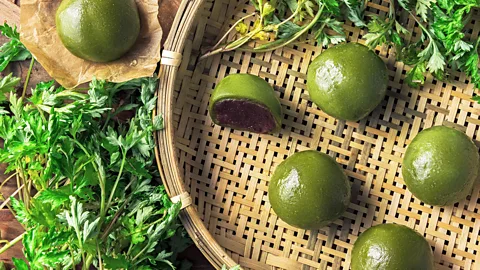
China's qingtuan is a sweet, jade-coloured treat eaten to commemorate the dead during spring's Qingming Festival, or Tomb Sweeping Day.
Beloved as they may be, many Chinese dishes only show up on family tables once a year, marking holidays or seasonal observances. When the Qingming Festival, or Tomb Sweeping Day, approaches each spring, one particular delicacy begins to appear in supermarkets and bakeries all over the country: qingtuan, a sweet, jade-coloured treat that commemorates the dead.
"In Chinese culture, it's really important that, as you go through life, you always honour and remember your ancestors," said Lillian Luk, the Shanghai-born-and-raised founder of the London pop-up Shanghai Supper Club. During the Qingming Festival (which is on 4 April this year) people all over China embark on pilgrimages to their deceased loved ones' burial sites to sweep the graves, burn incense and present offerings.
Though tomb sweeping is still widely practiced today, Luk doesn't recall travelling to visit her ancestors' graves when she was growing up. At the time, China was "coming out of the Cultural Revolution, so a lot of old customs were frowned upon", she explained, adding that domestic travel was also financially and logistically difficult for most people during that era. Instead, Luk's family would venerate their ancestors at home by lighting incense, offering good wishes and preparing foods like qingtuan.
These green dumplings are now popular all over the country, but they originally hail from eastern China's coastal Jiangnan region, which includes Shanghai and parts of surrounding provinces like Jiangsu and Zhejiang. Rice plantations flourish in this area, and the crop's abundance explains the regional popularity of rice-based treats, from ci fan tuan (sticky rice enveloping fried dough) to nuo mi ou (lotus root stuffed with sticky rice).
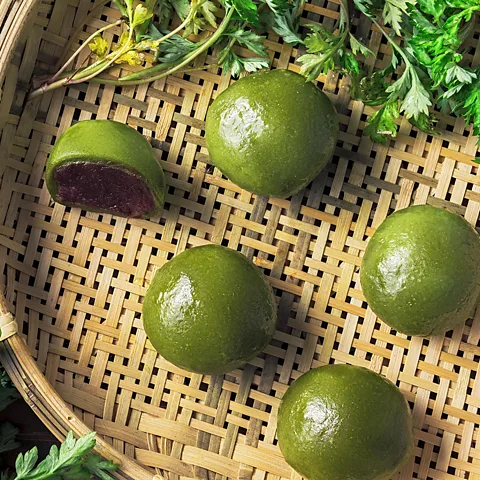
Made with glutinous rice flour, qingtuan dough is emerald-green because of the addition of mugwort, a fragrant herb that imparts a grassy aroma and is best picked in spring. "Mugwort also gives the qingtuan a nice medicinal benefit. It's meant to lower blood pressure," said Luk, who now makes and sells the verdant treats at her pop-up restaurant when the Qingming Festival rolls around.
 China Photos/Getty Images
Conveniently, qingtuan can be prepared in advance and kept at room temperature – a factor that once held practical significance. In China, many Tomb Sweeping Day rituals evolved from the Hanshi Festival, or Cold Food Day, another occasion for commemorating lost loved ones. Because that observance banned lighting of any fires, even for cooking, people could only eat foods that didn't require heating up, and qingtuan fit the bill. Over time, the dish became intertwined with remembrances of the dead.
In recent years, Luk has noticed qingtuan evolving. She's seen all sorts of novel iterations pop up, from dumplings dyed green with matcha instead of mugwort, to ones filled with custard or sweet potato. Luk acknowledges the value of unexpected flavour options – particularly for maintaining younger generations' interest in the old-fashioned custom – but her heart still beats for the kind she grew up eating, filled with creamy red bean paste. "I try to throw it back to an earlier time when things were done in a simpler way," she said. "Sometimes there's a reason something has been around for a long time."
More like this:
For Luk, sharing her qingtuan has become a way to introduce her fellow Londoners to a holiday custom that isn't well known outside of China. "It's also a way for me to wave the flag for Shanghainese food," she said, pointing out that the Jiangnan region's cuisines aren't as recognised overseas as regional styles like Sichuan or Cantonese.
But the biggest upside of launching her pop-up is one she hadn't expected: seeing her children become excited and curious about foods from their culture. "Somehow, I have kind of woven this thread that ties my kids to my heritage, unintentionally," said Luk.
And the fact that qingtuan are eaten just once a year only makes her children appreciate them more.
 Imaginechina Limited/Alamy
By Lillian Luk
Makes 10 qingtuan
Ingredients
180g (6⅓oz) glutinous rice flour
50g (1¾oz) rice flour
43g (1½oz) caster sugar
8g (1½ tsp) mugwort powder (wheatgrass powder or barley grass powder may be substituted)
185g (6½oz) water
200g (7oz) red bean paste
neutral oil, like canola or grapeseed, for coating
Method
Step 1
In a medium bowl, whisk together the glutinous rice flour, rice flour, sugar, and mugwort powder. Pour in the water and, using your hands, form a smooth dough. Divide the dough into 10 equal pieces, about 46g each, and set aside.
Step 2
Divide the red bean paste into 10 balls. Set aside.
Step 3
Roll each piece of dough into a ball, then press an indent into it to form a cup shape. Place a ball of red bean paste into the "cup" and pinch the dough closed. Gently roll the dumpling between your palms to form a neat sphere. If cracks appear on the surface, dip a finger in some water and gently rub the crack until it is smooth. Set the dumpling on a heat-proof plate. Repeat with the remaining dough and red bean paste.
Step 4
Fill a medium pot with two inches of water, place a steamer rack inside and bring it to a boil. Once it boils, reduce the heat to low, place the plate of dumplings on the rack, and steam until the dumplings puff up slightly and become firm and glossy, 10-12 minutes.
Step 5
Carefully remove the plate then use a pastry brush to coat each dumpling lightly with oil. Leave the dumplings to cool on the counter. Serve at room temperature. You can store the dumplings in an airtight container at room temperature for 1-2 days or refrigerate for 4-5 days.
BBC.com's World's Table "smashes the kitchen ceiling" by changing the way the world thinks about food, through the past, present and future.
--
If you liked this story, sign up for The Essential List newsletter – a handpicked selection of features, videos and can't-miss news delivered to your inbox every Friday.
