Hamantaschen: The iconic jam-filled biscuits that are the signature treat at Purim

 Laurel Kratochvila
The ancient dramatic tale of Purim is celebrated every spring with the buttery, triangular-shaped biscuits called hamantaschen.
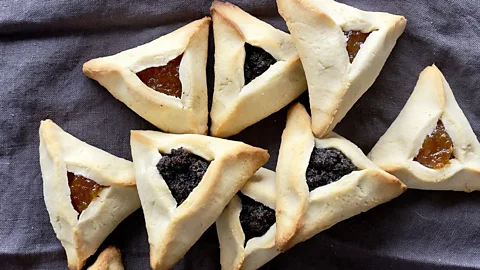
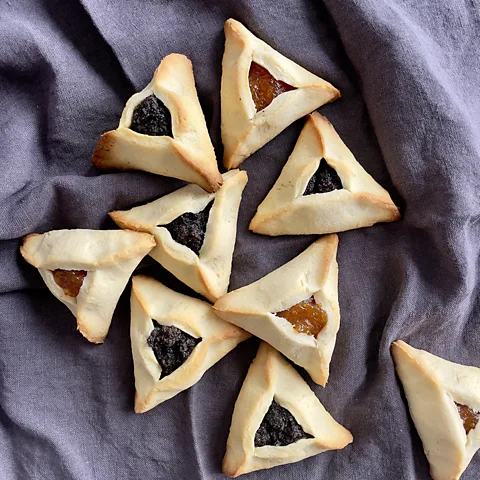
The holiday of Purim celebrated every spring commemorates a foiled attempt to annihilate the Jewish people by the biblical character Haman, a villainous high-ranking official in the court of King Ahasuerus' Persian Empire. Jews today mark the occasion by baking hamantaschen – a crunchy, triangular-shaped biscuit with a slightly nutty-flavoured poppy-seed filling, though other jams like prune, apricot or raspberry can be used to complement the buttery treat.
The ancient and dramatic tale of Purim from the Book of Esther (the third book in the Hebrew bible) is retold in a spiel ("play" in Yiddish) every year on the 14th day of the Hebrew month of Adar (falling on 23 and 24 March 2024). It's told through a comic dramatisation of the religious text. The practice dates back hundreds of years with the term spiel first gaining wide usage among Eastern European Ashkenazi Jews in the 16th Century.
The holiday is also celebrated with charitable acts called Matanot La'evyonim, which translates to "gifts to the poor". This mitzvah, or good deed, requires Jews to give money or food to at least two people in need on Purim. There also is the Talmudic (ancient teachings that define Jewish law) tradition to drink so much wine that you can no longer tell the difference between the evil Haman and virtuous Mordechai, the leader of the Jews in the tale.
But like any Jewish holiday, food is front and centre. Though many Jews might not be able to recall the finer details of the Purim story without googling or know exactly how to complete the mitzvah of charitable acts, they will certainly know about hamantaschen.
Hamantaschen – which is Yiddish for "Haman's pocket" – is a biscuit popularised by Ashkenazi Jews that likely stemmed/evolved from mohntaschen or poppy pockets (pastry typically stuffed with poppy seed filling) made by their Germanic cousins. Hamantaschen's distinct triangular shape (as opposed to the covered, round mohntaschen) comes with a number of interpretations. Although the name refers to Haman's pockets, there's a tradition that says the biscuit is shaped like Haman's three-cornered hat. In Hebrew, they're called oznei Haman or "Haman's ears". A feminist interpretation even sees hamantaschen as symbolising a vagina, given that the hero of the Purim story is Queen Esther.
Laurel Kratochvila is an American-born baker based in Berlin. Her bakery, Fine Bagels, is brimming with Jewish breads and pastries, including hamantaschen when Purim comes around. But like many Jews, Kratochvila likes to find a modern interpretation of the biblical tale and bake her hamantaschen with those lessons in mind.
A couple years ago when the war against Ukraine started, Kratochvila launched a Hamantashen for Ukraine fundraiser, using the analogy of Vladimir Putin as a modern-day Haman to rally bakers to bake and sell hamantaschen in the leadup to Purim and donate proceeds to The Legacy of War Foundation's Ukrainian Crisis Fund.
"The response was extraordinary and bakers from every corner of the world participated," she said. "That felt really meaningful to me."
In 2022, Kratochvila published New European Baking: 99 Recipes for Breads, Brioches and Pastries exploring the vast diversity of baking across the continent. Though it's not an explicitly Jewish cookbook, there's a certain pintele yid or Jewish spirit to the book.
Kratochvila draws from a French-style pâte sablée (sweet shortcrust pastry) recipe for the hamantaschen in her book. She landed on the recipe after years of experimenting with different biscuit doughs that never checked all the boxes. Her go-to recipe now is structurally sound, ensuring the edges of the biscuit stay firm and that the filling won't leak, burning the oven or the pastry itself.
When it comes to the making the dough and forming the biscuits, she is reassuring. "Don't worry, [the recipe] only sounds fancy but it isn't difficult," she said. "But it has the step of rubbing the margarine or butter into the flour to prevent any gluten development. This is key for having an easy to mould-and-hold [biscuit]."
More like this:
Though hamantaschen have been around for centuries, Jews tend to have a love-hate relationship with the biscuit itself; some have bad memories of soggy, tasteless hamantaschen with a bland poppy seed filling. Kratochvila says that she has a purely love-love relationship with hamantaschen, but added, "I love the gentle, nutty sweetness."
Still, like so many other cuisines, Jewish food has been swept up in a newfound enthusiasm for reinventing traditional recipes. Hamataschen are now being interpreted in unique, creative ways, from milk-and-cereal hamantaschen and steak and mushroom-filled hamantaschen to gluten-free iterations.
Despite all the possible variations, Kratochvila sticks to the traditional biscuit and poppy seed filling, and not just because she's in the Central European poppy belt where ground poppy seeds are in every supermarket. "I think there's something about being in Germany and a lot of negative space here with Jewish baking culture, stuff that should be here en masse but isn't for obvious reasons," she said. "I think I'd feel more playful if I were in America where there are more bakeries holding down tradition and therefore more space to change and adulterate."
 Laurel Kratochvila
By Laurel Kratochvila
Makes 24 biscuits
Ingredients
For the dough:
440g (3½ cups) plain flour, plus more for dusting
240g (1 cup plus 1 tbsp) cold butter or margarine, cubed
130g (1 cup plus 3 tbsp) finely ground almonds or almond flour
120g (¾ cup plus 3 tbsp) icing sugar (powdered sugar)
¼ tsp salt
2 eggs, beaten
1 tsp vanilla extract
For the filling:
150g (1½ cups) ground poppy seeds
75g (1½ cup plus 1 tbsp) granulated sugar
210g (¾ cup plus 3 tbsp) milk (if making these dairy), water or orange juice
2 tsp unsalted butter
½ lemon, juiced
2 tbsp honey
Method
Step 1
To make the dough, toss the flour and butter or margarine in a bowl until well-coated. Then, using your fingers, rub the butter and flour to create a sandy texture. When there are no more visible bits of butter, add the almond flour and powdered sugar and continue the rubbing motion until the mixture is homogeneous. Add the salt, eggs and vanilla and stir with a wooden spoon until there are no dry bits. Press the dough into a thick disk and wrap airtight. Refrigerate for 2 hours or up to 48 hours. (Note: you can also mix the dough in a stand mixer.)
Step 2
To make the filling, bring the ground poppy seeds, granulated sugar, milk, butter and lemon juice to a gentle boil in a thick-bottomed medium saucepan over medium heat. Reduce the heat to low and simmer until thickened.
Step 3
Remove from the heat, stir in the honey and let cool completely before using. Cover airtight and refrigerate for up to two weeks.
Step 4
To use the chilled dough, "break" it by giving it a very short knead – just a minute or two. This will make it possible to roll out without it cracking.
Step 5
On a lightly floured work surface, roll out the dough to about ⅓cm (⅛in) thickness. Use a water glass or biscuit cutter to cut out as many circles as possible. Set aside dough scraps to re-roll and use. Place the cut circles on a parchment-lined baking sheet.
Step 6
Prehat the oven to 170C/340F. Place a small spoonful of filling in the centre of each round. To shape, fold three sides inward to make a triangle, either overlapping or pinching where the edges meet. Once all the biscuits are formed, chill in the fridge for 20 minutes then bake for 15 minutes, or until golden brown.
BBC.com's World's Table "smashes the kitchen ceiling" by changing the way the world thinks about food, through the past, present and future.
--
Join more than three million BBC Travel fans by liking us on Facebook, or follow us on Twitter and Instagram.
If you liked this story, sign up for The Essential List newsletter – a handpicked selection of features, videos and can't-miss news delivered to your inbox every Friday.
