The Belgian waffle that brings New Year's luck

 Angela Dansby
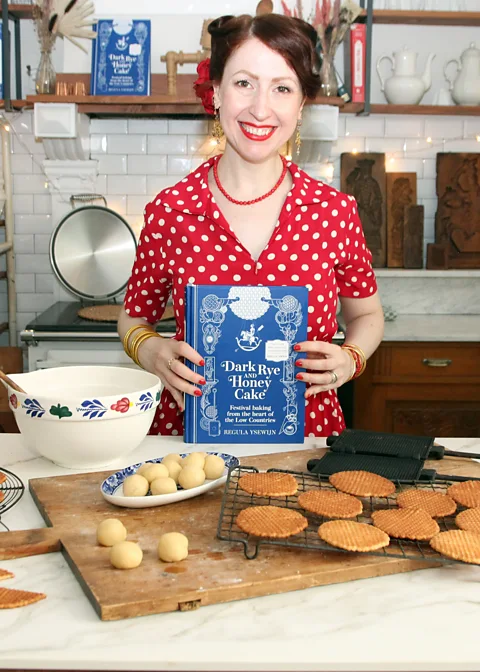
In her new book, Dark Rye and Honey Cake, Regula Ysewijn explains the history of Belgium waffles, and how to make the crisp, buttery lukken waffle for good luck in the new year.
There's no waffling about Belgium's baking heritage: waffles have a special place in the country's heart. In fact, the words "Belgium" and "waffle" are as synonymous as "France" and "baguette".
But there is no one single Belgian waffle, according to Regula Ysewijn, author of Dark Rye and Honey Cake: Festival Baking from the Heart of the Low Countries, published in 2023. The cookbook highlights her homeland of Belgium, featuring 13 different waffle recipes because just like Belgian beers, which are each served in a unique glass, every Belgian waffle is distinct. They differ in ingredients, shape, texture and even when and how they're eaten.
"Belgium has more waffle recipes than any other country," said Ysewijn, who does not have a favourite. "They all have their importance. Just naming one to represent Belgium would be simplifying my food culture."
In her cookbook, Ysewijn includes the round, caramelised Liège waffle from the 18th Century – named after the Belgian city in which it was invented – which is now one of the most common in Belgium and the only one justified as street food. She also shares a recipe for the rectangular, crispy Flemish waffle from the 19th Century, known today as the Brussels waffle. (This popular waffle is dusted with icing sugar and topped with optional items such as whipped cream, strawberries and chocolate syrup, though Ysewijn finds anything but cream on top to be "an abomination" regarding Belgian culinary tradition.)
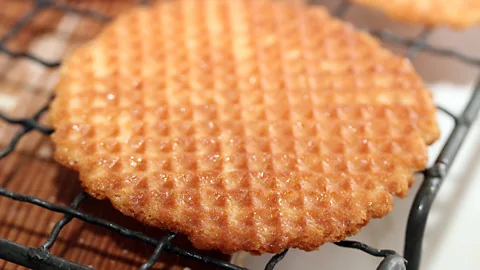
Over the centuries, several specialty waffles were invented as well, including brittle, thin and buttery lukken, which were common among nobility. Lukken contain more sugar than other types of waffles and since sugar was once costly, lukken were associated with celebrations and the holidays, especially New Year's Day. "Sugar makes these waffles crisp, caramelised and long-lasting," said Ysewijn.
No one knows exactly when the first waffle was invented, but Ysewijn notes the earliest known waffle iron in the Low Countries (this includes Belgium, the Netherlands, Luxembourg and parts of northern France and western Germany) is displayed in the Gruuthusemuseum in Bruges, Belgium, and dates from between 1430 and 1450.
The first waffle recipes were recorded in books in the early 16th Century in the region of Belgium that is now Flanders. Chef Philippe Édouard Cauderlier, known as the "father of Belgian cuisine", wrote the first cookbook with regional Belgian recipes, Het Spaarzame Keukenboek in 1861, which included Flemish and Brussels waffles. By this time, there were tearooms serving waffles in every Belgian town and it was a custom around New Year's Day for families to go out for waffles, according to Ysewijn. Fancy waffle "palaces" (pop-up tearooms) also moved from town to town with fairs to serve waffles throughout the year.
 Angela Dansby
Ironically, the United States coined the term "Belgian waffle" due to a branding accident at the New York World's Fair in 1964, Ysewijn said. That's where the Belgian Vermersch family had a waffle stand advertising "Bel-Gem Brussels Waffles," a marketing play on the words "Belgian" and "gem", because the waffles were a culinary gem. But people interpreted (and media reported) the name as "Belgian waffles".
For centuries, waffles have been associated with winter and revelry, appearing at all feasts from St Martin's Day on 11 November to Christmas, New Year's Day, Carnival and Easter. During the Middle Ages, in much of western Europe, the new year started at Easter. But with the advent of the Gregorian calendar, the new year shifted to 1 January and the custom of baking waffles shifted with it.
Nowadays, waffles are eaten and prepared year-round in Belgium, but a few types, such as lukken, are specifically made at home for the new year. Derived from the Dutch word geluk for luck, lukken are made to bring good fortune. Lukken originated in the region of West Flanders, where the family tradition of baking them for New Year's Day remains.
"There is a lot of weighing and rolling the dough involved, hence why baking these waffles used to be a family activity – and it still is to this day in many households in West Flanders," Ysewijn said, adding that practically every Belgian family owns an electric waffle iron.
Despite their regional association with the new year, in the 16th and 17th Centuries, lukken were eaten after different festive meals and served with sweet or spiced wine. In 1890, baker Jules Destrooper of Lo, Belgium, started making a thinner version of lukken year-round as "lukke" or galettes au beurre (butter crisps). He popularised them throughout the country, and in 1949 his son began exporting them to the US, where they were equally well received. In 1969, Destrooper created "butter waffles", which are most similar to homemade lukken and still widely sold today.
But is making them at home the best way to bring good fortune in the new year? "Of course!" Ysewijn exclaimed. "[Because] they bring luck immediately when people are making them."
 Angela Dansby
By Regula Ysewijn
Makes 63 small waffles (3 per person)
Ingredients
250g (9oz) unsalted butter
2 medium eggs
475g (1lb 1oz) caster (superfine) sugar
⅛ tsp salt
2 tbsp cognac or rum (or water, if you don't want to use alcohol)
500g (1lb 2oz) flour
Method
Step 1
Melt the butter in a small saucepan over low heat and let it cool.
Step 2
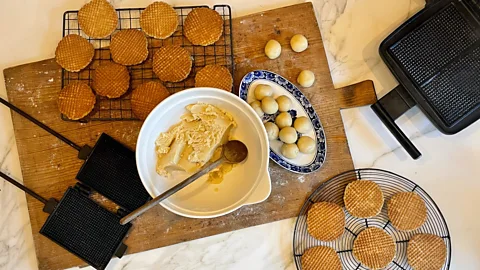
In a large bowl, whisk the eggs with the sugar, salt and cognac, then add the melted butter and combine well. Sift in the flour and knead to a smooth dough. Transfer the dough to an airtight container and leave to rest overnight in a cool place (not in the fridge).
Step 3
The next day, measure 20g (¾oz) nuggets of dough and shape them into ping pong-sized balls (2cm) or fat cigars, depending on the shape you want to achieve.
Step 4
Let your shallow electric or stovetop waffle iron get very hot and bake each waffle for 2-3 minutes or until they are a deep golden colour. Seconds mean the difference between golden and dark brown. There is no need to grease the irons as the dough doesn't stick. Once cool, store the waffles in an airtight container for up to three weeks.
Note
To make these waffles, you will need an ice cream cone, shallow electric or stovetop waffle iron, not a traditional one. There is no substitute for a waffle iron and one with interchangeable plates is recommended.
(Recipe reprinted fromDark Rye and Honey Cake: Festival Baking from the Heart of the Low Countries by Regula Ysewijn, Murdoch Books, 2023)
BBC.com's World's Table "smashes the kitchen ceiling" by changing the way the world thinks about food, through the past, present and future.
---
If you liked this story, sign up for The Essential List newsletter – a handpicked selection of features, videos and can't-miss news delivered to your inbox every Friday.
