Arculata: The bread that survived Pompeii

 Farrell Monaco
A discovery of a carbonised bread-ring leaves us with many unanswered questions, but one culinary archaeologist has traced its roots and recreated its recipe.
It was shortly after midday when the baker stepped out of the front door of his shop onto a small side street. He needed fresh air and a moment to himself. It had been a busy night of milling and bread-making.
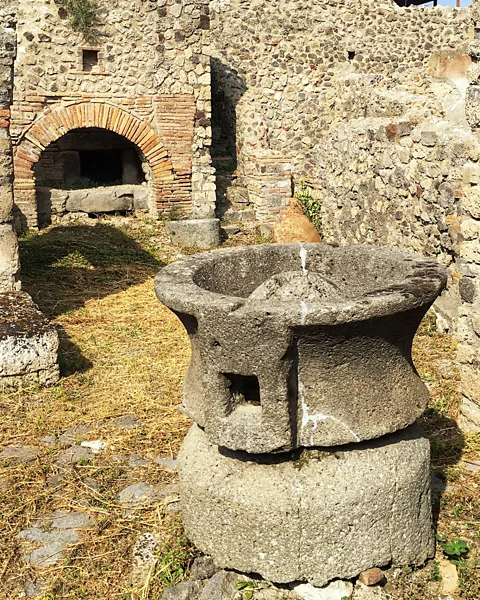
His last batch of loaves were now in the bakery's oven, and the milling horses were in a nearby stable – still and resting – after hours of clopping in circles to the sound of stone scraping against stone, which informed everyone within earshot, trying to get a good night's sleep, that wheat was being milled into flour for Pompeii's daily bread. All that remained before the baker could lock up and get some rest himself was for his hawker to return with the basket and money for the bread-rings that were baked for sale on the streets. He was late and this was unusual for the salesman, who was consistently on time.
The ground had been trembling throughout the morning, as it did from time to time in recent years, and the air had a peculiar odour to it: something akin to an egg that had begun to rot. The baker's eyes were fixed on a dark cloud above Vesuvio when he first heard it: the sudden clatter of something falling, in great quantity, on the tiled rooftops overhead and on the ground in front of him. Crouching down to get a closer look, the baker realised that it was stones falling from the sky – small, smouldering, sponge-like stones.
Without a moment's hesitation, he turned around and walked swiftly through the door of his bakery's shop and gathered his belongings. He wouldn't stay behind this time, as he did during the earthquake that had levelled his family's previous bakery 17 years earlier, killing his father and two milling horses.
In a matter of minutes, the baker shuttered and locked the doors of his bakery, leaving 81 loaves of panis quadratus bread inside of the bakery's oven. Then, he retrieved his horses from the stable, and walked out of Pompeii's southern gates along a road that would take him to the town of Nuceria, about 20km to the east.
Over the next 18 hours, the Roman town of Pompeii would be submerged in ash and pumice stones. Following this darkest of nights, it was then engulfed by a series of lethal and devastating pyroclastic flows and ground surges during the final phases of one of the most violent and devastating volcanic eruptions in recorded history: the eruption of Mount Vesuvius in 79 CE. Approximately 1,800 Pompeian residents would perish in their homes, their workplaces and on the streets.
And centuries would pass before the baker's breads would be seen again.
 Farrell Monaco
Based on evidence compiled since the discovery of Pompeii, it wasn't difficult for me, a Classical archaeologist who studies and recreates the breads of ancient Greece and Rome, to speculate what the final moments of Pompeii could have been like for a baker with a shop full of bread, or a street hawker interrupted, on the day that Mount Vesuvius burst to life, once again.
I've spent the last seven years studying these ancient bread cultures and the carbonised bread remains found at Pompeii and Herculaneum, including the well-documented pre-segmented panis quadratus loaves that were eventually discovered in 1862 in the oven of the abandoned bakery – now referred to as "The Bakery of Modestus".
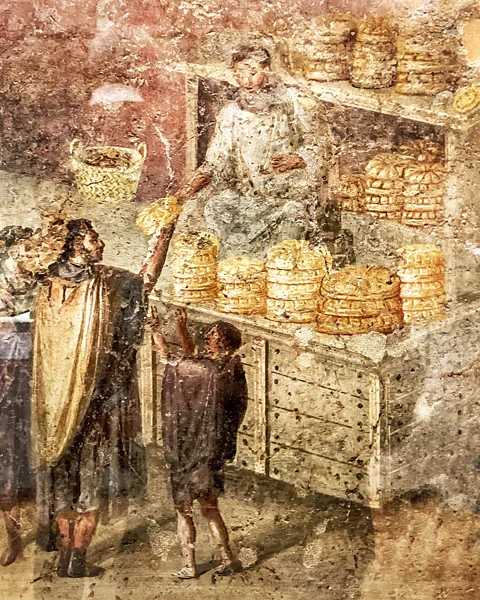
The popularity of these symmetrically proportioned loaves among 1st century Pompeiians is beautifully depicted in a fresco which once adorned a tablinum wall inside of the Casa del Panettiere, a Pompeian residence located near the bakery. While frequent debate continues over whether the fresco portrays an image of the sale of bread in a bakery or an image of a magistrate doling out bread to his constituents, few have noticed the large volume of small, ring-shaped rolls heaped into a basket behind the kiosk counter and away from the reach of those in front of it.
 Farrell Monaco
Likely sold on the streets by hawkers, such as the one in the story above, these little-understood rings were once overlooked as a minor archaeological find. However, I've set out to learn how they came to exist, how they were used, what they might have been called – and even what they might have tasted like (see recipe).
Decades before the 1862 discovery of the Bakery of Modestus, in September of 1821, a team of Italian archaeologists began another day at the Pompeii site by continuing excavation works along a small side street lying north of the town's main civic forum. On 5 September, the team excavated what they labelled as a bottega, or a common shop, which was located between the Bakery of Modestus and the town's forum. The archaeologists paused for a moment to marvel at something they had found inside the shop: a small, perfectly preserved, ring-shaped loaf of bread that was accompanied by a handful of chestnuts, dried figs and prunes.
Far la ciambella
Italian horse enthusiasts in the mid-18th Century also used the word "ciambella" to describe the gait of a horse when trotting in place: far la ciambella. This is similar to saying that a cat is "making bread" when it kneads a blanket or your belly.
Carbonised yet intact, the bread-ring resembled something they were familiar with in their own daily lives, and so they documented the find as a ciambella, a general name for breads, pastries and biscuits that were shaped in the form of a ring that has been present in recorded Italian culinary vocabulary since Renaissance-era cookbooks, such as L'Opera di M. Bartolomeo Scappi.
However, as the Pompeii discovery has clearly shown us, ring-shaped wheaten products go much further back in time than Renaissance Italy and weren't always called ciambelle (the plural of ciambella), leaving us with many unanswered questions: What was their original purpose? What were the bread-rings of Pompeii called in 79 CE? And are relatives of this bread still present in the Mediterranean region today?
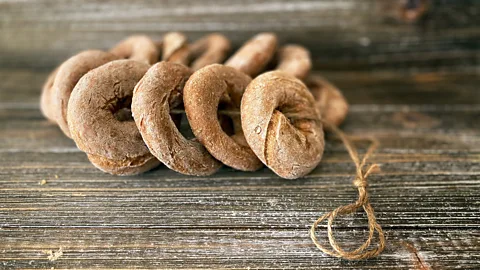
Measuring approximately 7cm in diameter, the carbonised ring – likely made of durum or common bread wheat flour – shines a bright light on the role that bread played in the lives of everyday Romans, and as I would discover, is a likely ancestor of some of the breads we see in Italy today.
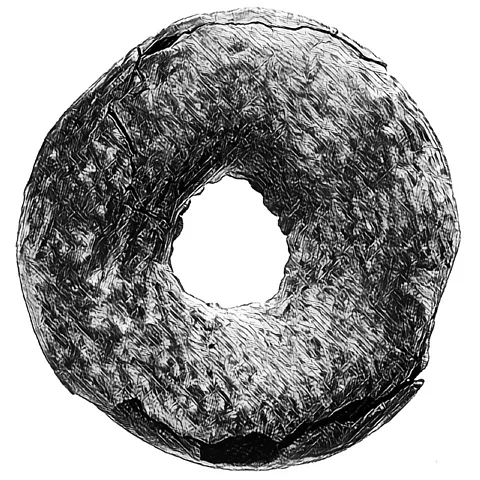
The fact that the ring was excavated alongside a small number of carbonised chestnuts, dried figs and dried prunes, meant the finds may have been acquired from one of the food vendors or bakeries in the vicinity. After all, the shop that the bread-ring was found in was located on a side street that was not only directly across from the Macellum (an indoor food market), but also located near several other food shops. Following the full excavation of the shop in the early 1800s, the side street was named the Strada dei Frutti Secchi (the Street of Dried Fruits) though later changed to Via degli Augustali. In retrospect, perhaps a more suitable name would have been the Strada dei Panifici, or "Street of the Bakeries", as continued excavations would eventually reveal that the street hosted the highest concentration of commercial bakeries at Pompeii.
In addition to general retail traffic, this "Street of the Bakeries" would have seen a great deal of grain, flour and bread being transported by porters and hawkers. This scene was depicted in a plaque found at the western end of the street showing two porters carrying a food transport amphora on their shoulders. And another depiction of a food runner at work on the streets of Pompeii was recently discovered during the 2020 excavation of a popina (stew-house) at Pompeii. This stew-house revealed a fresco of a porter carrying foodstuffs tied with cord to a pole that was balanced on his shoulders.
Clearly, food porters and hawkers were integral in 1st-Century Pompeii, making the bread-ring's discovery, mere steps away from several commercial bakeries and shops with cooking facilities, anything but random. Equally intriguing to me, though, was the bread's ringlike form, which suggested that the shape of the bread was related not only to culinary aesthetics of the day but to function as well. I then questioned if the shape of the bread was related to portability or easy storage.
 Farrell Monaco
I initially entertained the idea that the ciambella may be the archaeological remains of buccelatum, a desiccated biscuit believed to have been corded together with twine and made for Roman military consumption. However, in addition to the very minimal active military presence at Pompeii, there was no solid evidence that buccelatum was a ring-shaped bread prior to the 10th Century CE when the Byzantine Emperor, Constantine Porphyrogennetus, stated: "boukellos is the name of a ring-shaped loaf".
Thus, I questioned whether the bread was at all intended for transport, and I dug further.
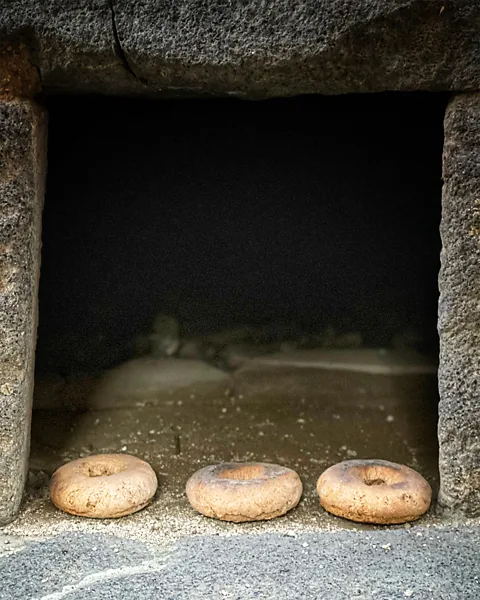
The earliest-known evidence of bread-rings in the archaeological record come from a prehistoric site situated on the Austrian-Slovakian border. Dating to the 10th Century BCE, three grain-based rings, along with an additional 14 rings made of clay, were intentionally buried together at the base of a pit in a ritual offering fashion. European bread history pioneer, Max Währen, recorded the first archaeological evidence of small ring-breads in the Mediterranean region as being discovered on the Aegean Island of Crete: a 4,000-year-old Minoan terracotta offering bowl which features a series of small terracotta rings lining the inside base of the vessel, symbolising the votive offering of real bread.
Furthermore, archaeologists Nicholas Verdelis and John Salmon have noted archaeological evidence of terracotta, ring-shaped sacrificial breads at 6th-Century BCE temples located at the Corinthian settlements of Solygeia and Perachora in Greece. Verdelis and Salmon explained that the offerings were believed to be associated with the worship of Hera: the Greek goddess of women, marriage, family and childbirth. And in southern Italy, archaeologists Marina Ciaraldi and Milena Primavera have drawn attention to a 6th-Century BCE site and five charred bread-rings that were deposited as offerings at a sanctuary located in Monte Papalucio, Oria, which was once a part of the former Greek colonies of southern Italy known as Magna Graecia. Archaeological evidence from the sanctuary also shows that milled wheat was used to create small, ring-shaped breads as sacrificial offerings to Demeter (the Ancient Greek goddess of the harvest).
 Farrell Monaco
The archaeological remains of bread-rings in Greek settings are fascinating for two reasons: their association with female deities, and their presence in sanctuaries in southern Italy. You see, Pompeii wasn't always a Roman town: long before the Roman General, Lucius Cornelius Sulla, installed his retired military veterans as the first Roman colonists of Pompeii, the town was heavily influenced by Oscan, Etruscan, Samnite and Greek cultures. As such, the practice of offering sacred ring-breads observed in 6th-Century BCE Greek ritual settings begins to emerge, centuries later, in Roman settings and writings as well.
For instance, in the 1st Century BCE, the Roman poet Varro tells us of liba, a general term for sacrificial cakes that were offered as "libations" to the gods, and by the 1st Century CE, relief sculptures of blood sacrifices in Roman settings depict ring-breads as another form of sacred bread. In Roman culture, the practice of offering "cakes" to the gods to please them and request favours was commonplace. The cakes themselves were made of wheat or barley, with fresh cheese or honey sometimes added, and they were comparable to a modern biscuit or sweet-bread.
In the 1st century CE, Roman poet Ovid tells us of the Roman festival of Vestalia, which was held annually in June in honour of Vesta, the virgin goddess of the hearth. During the festival, milling donkeys were garlanded with bread and wreaths. In the 2nd Century CE, in his work titled De verborum significatione, Roman grammarian Sextus Pompeius Festus speaks of the October Equus, which was a war horse sacrificed annually on the 15th of October in the Campus Martius in Rome. Festus explained that the head of the horse was wreathed with bread as a part of the rite.
As the Roman Empire edged closer towards collapse and Christianity was slowly emerging as Rome's new state religion, the ring-bread maintained its steady role as a sacred bread well into the era of early Christianity in ancient Rome.
 agefotostock/Alamy
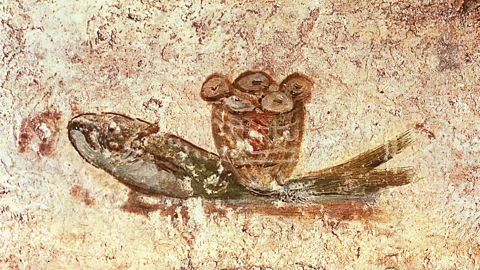
For example, a fresco dating to the 3rd Century CE in the Christian Catacombs of St Callixtus portrays the miracle of the "Loaves and Fishes", as recorded in the New Testament (Matthew 14:13-21), with two fish and a basket containing five ring-breads. This was the exact number of fish and breads that was multiplied by Jesus during the "Feeding of the Five Thousand" community meal that is often interpreted as foreshadowing the Eucharist. The presence of these historically sacred loaves in early Christian iconography may also reflect the role of these breads in the early church, as referenced by the 3rd-Century Roman pope, Zephyrinus, who called sacred bread corona consecrata (consecrated crown).
With such rich representations of ring-breads in ancient archaeology and literature, we are finally left wondering: what were these sacred ring-breads, and the ring-breads of Pompeii, actually called in antiquity?
Festus states that "rings made of flour for sacrifices are called arculata", which follows his definition for arculum, "a crown-like headpiece worn when carrying sacred vessels at public sacrifices". To the Greeks, arculata may have been known as kollyra, which is believed to be the etymological root of the modern Greek ring-bread known as koulouri, and its southern Italian counterpart, cuddura.
As explained by Ally Kateusz, senior research associate at UK-based Wijngaards Institute of Catholic Research, Greek Cypriot orthodox bishop, Epiphanius of Salamis, documents a so-called heretic sect of female priests called the Kollyridians in the 4th Century CE. These women made small sacrificial wheaten cakes called kollyris and offered them to Mary, the mother of Jesus, much in the same way that ring-breads were offered to Hera and Demeter in Greek sanctuaries 800 years previously. If kollyris followed the form of other cakes historically offered to female deities in ancient Greece, then it too would also take the shape of a ring.
 Farrell Monaco
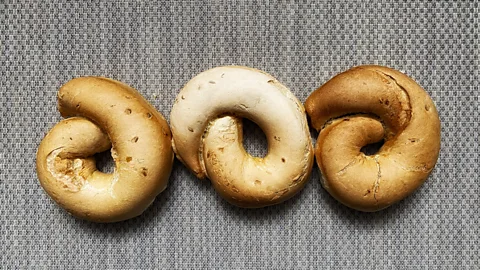
By the Early Modern period, the ring-bread had slowly migrated from the realm of the sacred to that of the profane, as a common snack sold on the streets to everyday passers-by. Twenty-one years after the excavation of the first ring-bread of Pompeii, a second bread-ring was excavated at Pompeii from a house along the Via dell'Abbondanza in 1842. This time it would be identified more specifically by archaeologists as a tarallo, a twice-baked, ring-shaped bread biscuit typically made with flour, lard, and black pepper, that was readily available from hawkers on the streets of Naples (about 23km north-west of Pompeii) during the time of its discovery.
A family friend of mine, Vito Somma, remembers the bread hawkers well in his Neapolitan neighbourhood of Vasto in the 1960s. Not so long ago, the tarallàri would walk along the Via Ferrara below the apartment that he and his brother Antonio grew up in. Carrying a basket, or pushing the cart up the street, they could be heard crying out "'nzugna!" ("taralli made with lard and pepper!") as they drew nearer. The families who lived in the apartment buildings that lined the street would take to their balconies and lower a basket on a rope that contained enough lire to buy as many taralli as they needed for the day. When the basket came back up, the money was gone and fresh, warm taralli were delivered in its stead.
This tradition of hawking ring-breads on the streets of Naples carried on for three more decades until the last tarallàro of Naples, Fortunato Bisaccia, retired his cart in 1995. But, just as the graffiti adorning the buildings in modern Naples is a feature of the cultural landscape that the city shares with its former self, deep-rooted and historical bread forms also remain in the current cultural fabric.
On any given day, a stroll off the beaten tourist paths of Naples will still reveal a staunch, traditional bread and bakery culture, alive and well at the street markets and family-run bakeries that carry forward the descendent bread forms of arculata and other Graeco-Roman breads.
You see, the majority of the 10,000 people who lived at Pompeii during 79 CE fled the Vesuvian eruption and survived. And the continuity of those lives, and their customs and traditions, is something that is often overshadowed by the emotion and devastation associated with the destruction of the town. Those who escaped the disaster, be they bakers who abandoned their bread, or street hawkers who abandoned their posts, started life anew, integrating into surrounding towns and cities dotting the coasts of the Gulf of Naples. And life, and bread, carried on.
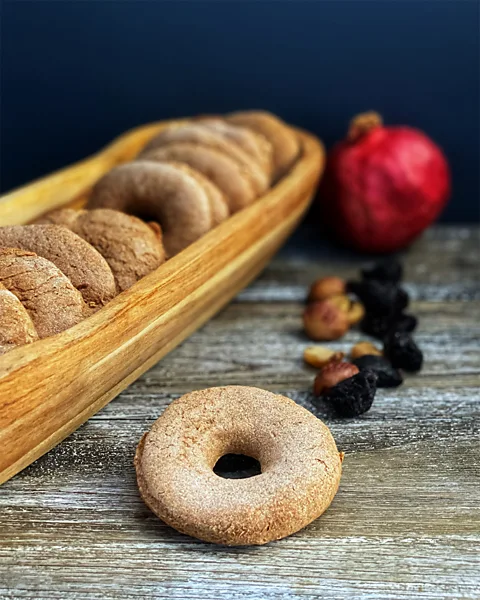 Farrell Monaco
By Farrell Monaco
This recipe yields 13 arculata rings: 12 for serving and one for offering. Each ring will be approximately the same size as the archaeological specimen.
Ingredients
350g (2 cups) white bread flour
300g (2 cups) whole wheat flour
80g (¼ cup) honey
335g (1½ cup) water
50g (¼ cup) sourdough bread starter
10g (2 tsp) coarse sea salt
additional flour for dusting
sesame seeds (optional)
nigella seeds (optional)
glaze comprised of 80g (¼ cup) honey and 60gm (¼ cup) hot water (optional)
Preparation Considerations
This is a leavened bread product. Begin by feeding your bread starter the day before you start the dough. If you do not have a starter, you can create a sponge the same day that you make the dough by mixing 15g flour (⅛ cup) with 30g water (⅛ cup) and adding 2g (½ tsp) of active dry yeast. Stir, let it activate, and set it aside until it doubles in size and is ready for use in the dough.]
Method
Step 1
Combine the water, honey and starter and gently blend it together.
Step 2
In a large mixing bowl, add the flour to the liquid and fold it together until it's shaggy and begins to form a cohesive mass.
Step 3
At this stage, begin to sprinkle salt into the dough as you knead and fold the dough. Dust with flour if the dough is tacky. Once the salt has been gradually added and the dough has become a more cohesive mass, place the dough back into the bowl, cover it with a damp towel and let it rest for 1 to 2 hours.
Step 4
After the dough has fully rested, knead, stretch and fold the dough for 10 minutes on a flour-dusted surface.
Step 5
Once kneaded, form the dough into a ball, cover it again to rise until it doubles in size. If your kitchen is is on the cooler side, place the dough in a warm area of the kitchen next to the oven or a light source.
Step 6
Dust a clean work surface with flour and gently tip the dough out of the mixing bowl onto the work surface. The dough should be airy, light and flexible. If the dough is still heavy and firm, allow it to rise longer.
Step 7
Preheat your oven to 220C (425F).
Step 8
Gently flatten and spread the dough out on a flour-dusted work surface until it is about 2½cm (1in) thick.
Step 9
Form the dough into a long rectangle by folding the longest edge of the dough into the centre, then the opposite edge over the first stretch of dough. Use a bench scraper or large knife to cut off 13 linear strips of dough. Using a scale as you work, try to make sure each strip of dough weighs close to 85g. If you don't have a scale or scraper, this process can also be done using the mouth of a cup or a circular cutter that is approximately 7cm (2¾in) in diameter.
Step 10
Take each strip of dough and gently roll it into a tube with the palm of your hands. Use a bit of flour on your hands if the dough is tacky. Take the ends of the tube and cross them over each other, as if tying a knot. Press the seam together and gently form the shape into an evenly proportioned ring. If using a cup or cutter, simply press a hole in the centre of the disk with your finger and expand the hole with your fingers until it is approximately 3cm (1in) in diameter.
Step 11
Place the formed rings into a mixing bowl of flour and lightly dust them with a coating of flour, pat off any excess flour, and gently place them onto a baking sheet at an inch or more apart.
Optional: You may wish to dress the rings with sesame seeds, as Greek koulouria and middle eastern ka'ak are, or with Nigella seeds as Turkish simit are. If so, lightly glaze the rings of dough (using the glaze recipe above) after forming the rings and gently spin them inside of a bowl containing the seeds so that the top and bottom are covered. Do not dust the rings with flour if dressing them with sesame or Nigella seeds.
Step 12
Bake the rings for 20 to 25 minutes or until the crust of the rolls begin to bronze.
Tasting and pairing:
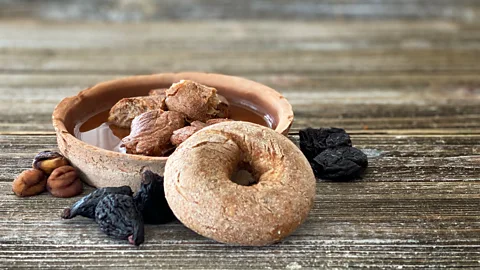
To serve, place 12 arculata on a platter or on single-serving plates alongside some dried figs, prunes and chestnuts. This represents a meal – or perhaps an offering – abandoned by one Pompeian resident at a shop on the Via degli Augustali during the eruption of Mount Vesuvius in 79 CE.
Lastly, place the 13th roll aside as an offering to Hera or Demeter, the virgins Vesta or Mary, the grandmothers of Greece and Italy, or the bakers and street-hawkers of past and present.
(Farrell Monaco is a Classical archaeologist, baker and writer. She is currently an honourary visiting fellow at The University of Leicester's School of Archaeology and Ancient History. She is the 2019 winner of Best Special Interest Food Blog Award by Saveur Magazine and author of the forthcoming book: Panis: The Story of Bread in Ancient Rome.)
BBC.com's World's Table "smashes the kitchen ceiling" by changing the way the world thinks about food, through the past, present and future.
---
If you liked this story, sign up for the weekly bbc.com features newsletter called "The Essential List". A handpicked selection of stories from BBC Future, Culture, Worklife and Travel, delivered to your inbox every Friday.
