Berbere-cured salmon with mustard seed and buckthorn

 Hav & Mar
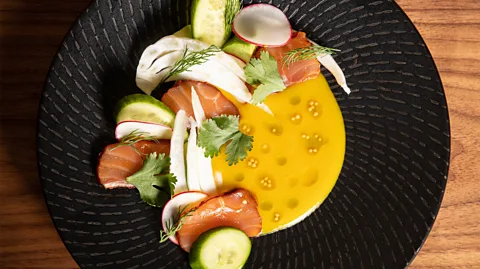
In the Swediopian, a signature dish at Hav & Mar, celebrity chef Marcus Samuelsson blends his Swedish and Ethiopian heritage, reflecting a contemporary expression of Black cuisine.
"For me, it starts with the name," said chef Marcus Samuelsson, whose restaurant Hav & Mar recently debuted in New York City. Samuelsson, the James Beard Foundation award-winning chef and TV personality (featuring on Food Network's Chopped and Netflix's Iron Chef) behind Harlem's acclaimed Red Rooster and other restaurants worldwide, pays homage to his Swedish and Ethiopian heritage in this new endeavour.
Samuelsson was born in Ethiopia and raised on Smögen Island off the west coast ofSweden, eventually settling in New York City. "We all have different dualities. Mine is Swedish meets Ethiopian in New York," Samuelsson said. His cultural influences shaped his culinary path and inspired the name of his newest restaurant: Hav translates as "ocean" in Swedish and mar means "honey" in Amharic. "Mar means 'water' in so many Latin languages, too," he added.
Hav & Mar's seafood-focused menu, created in collaboration with chef de cuisine Fariyal Abdullahi, highlights globally inspired small plates and family-style dishes. Samuelsson wanted the restaurant to reflect a contemporary expression of Black cuisine in Manhattan.
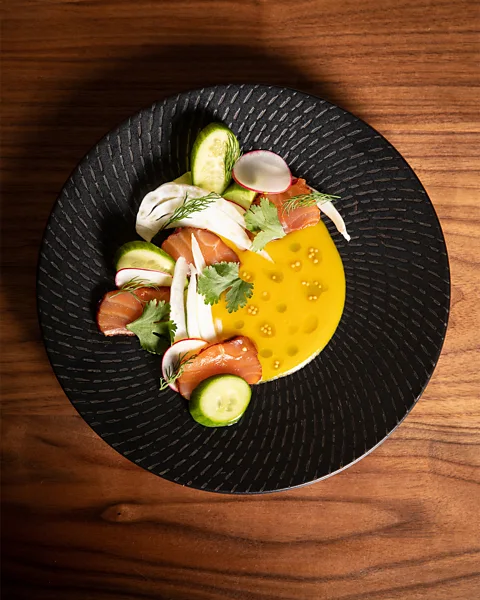
The Swediopian, a riff on gravlax, features berbere-cured salmon, mustard seed and buckthorn. Berbere – a traditional Ethiopian spice blend – is sourced from Workinesh Spice Blends in Burnsville, Minnesota, part of Samuelsson's effort to work with places honouring people of colour. Ingredients in berbere vary, each blend like a fingerprint individual to its maker. Workinesh Spice Blends' berbere features red peppers, onions, garlic, salt and "spice" – a proprietary secret. (Berbere typically includes chillies, garlic, ginger, nutmeg, allspice, coriander, cumin, fenugreek and cloves.)
"Berbere for an Ethiopian is as important as salt and pepper is for a Swede," Samuelsson said. "For berbere, it's not about spicy, it's about flavour."
Samuelsson's food reflects his cultural identities. "Being a Swede, I grew up with gravlax and cured fish. I prefer eating it closer to a crudo or a sashimi," he said. "It's not about creating what gravlax was back in the day. That was a 48-hour cure, it was basically rubbery, but you could have it forever. This is not that." He explained that the Swediopian is comprised of quick-cured salmon rolled in berbere, accompanied by a root vegetable salad and a sauce made from Ethiopian coffee and buckthorn ("which is very Swedish") with a touch of passionfruit for sweetness and topped with injera, an Ethiopian flatbread. "So, it's this dance, back and forth, back and forth. A lot of our dishes come from that back and forth."
 Marc Baptiste
"The soul of that dish tells so many stories for me," Samuelsson added. "It starts with my grandmother being a maid. It talks about, for me, coming from Ethiopia. It's not a backwards-looking dish, it needs to be delicious in this moment."
And it is delicious. The Swediopian bursts with umami, combining a melody of flavours and textures: savoury salmon with a hint of heat is balanced by tangy-sweet passionfruit and a satisfying injera crunch.
Samuelsson seeks to honour Black culture not only through his food, but in the restaurant aesthetics. The artwork at Hav & Mar is a collaboration with critically acclaimed artist and creative partner Derrick Adams and creative partner Thelma Golden, director and chief curator of The Studio Museum in Harlem. Hav & Mar's original art installations include We Are From The Water, Too – a series of vibrant Black mermaids commissioned by Samuelsson that adorn the restaurant's walls.
This concept of Black mermaids has shaped the entire restaurant, from the artwork to how they name their dishes (another menu standout is Mermaid Black Rice, featuring djon djon mushrooms with crab, lobster and green peas).
With the idea of mermaids in mind, Hav & Mar became curvier in its design, from irregularly shaped dining tables to an oblong bar that takes centre stage. "Of course, mermaids should have curves," Samuelsson said. During the pandemic, swimming became an escape for Samuelsson and his young son, and the restaurant reflects an underwater theme. "It was the only time when both him and I could disappear from everything," Samuelsson said, explaining that the tonality of the greens, from the lighting to the bar stools in the restaurant, emulate different types of kelp and seaweed. "I will always be able to tell my kids: We can push through. So, the joy comes from that."
The joy also derives from Hav & Mar's celebration of Samuelsson's cultural roots and the struggle that is part of his immigrant story. "When I came here as a 23-year-old with 300 bucks to this country, there was not a restaurant for me – I had to carve that space out," he said. "But I have to hold on to that dream."
 Hav & Mar
By Marcus Samuelsson and Fariyal Abdullahi
(serves 1-2)
Ingredients
For berbere-cured salmon:
2oz (about 57g) salmon
salt, to cover
berbere, to cover
For squash puree:
3 cups kabocha squash puree (or substitute any winter squash)
Start with 1 ½ cups vegetable stock and continue to add until puree is nappe (thick enough to coat a spoon) consistency
3 tbsp passionfruit puree
1½ tbsp honey
2½ tbsp water
2 tbsp yuzu juice
1¾ tbsp mirin (or rice wine vinegar)
1 tsp salt
For honey mustard vinaigrette:
¼ cup shallots, minced
4½ tbsp garlic
¼ cup Dijon mustard
1 egg yolk
1 tsp salt
1 cup champagne vinegar
⅓ cup honey
3¼ cups blended oil (mixture of 90% canola oil and 10% olive oil, or use 100% canola oil)
2¾ tsp cracked black pepper
fennel, apples and cucumbers, thinly sliced (optional)
Method
Step 1
Generously salt the salmon until all sides are covered. Refrigerate for two hours.
Step 2
Remove any excess salt from the salmon. Cover all sides with berbere and cure overnight.
Step 3
Remove any excess berbere.
Step 4
Slice into ¼ inch (about 6.5mm) thick squares
Step 5
Roast kabocha squash in a 425F (about 220C) oven until soft enough to puree. Blend with vegetable stock while still warm. (Alternatively, for home use, you can use canned squash).
Step 6
Whisk squash puree together with remaining ingredients until well incorporated.
Step 7
Blend all ingredients for honey mustard vinaigrette together minus the oil.
Step 8
Once thoroughly blended, slowly incorporate the oil in a thin stream.
Assembly:
Toss some thinly sliced fennel, apples and cucumbers in the vinaigrette. Salmon is shingled and placed on top of bed of 1 tbsp squash puree. The salad is dressed and placed directly next to it.
BBC.com's World's Table "smashes the kitchen ceiling" by changing the way the world thinks about food, through the past, present and future.
---
If you liked this story, sign up for the weekly bbc.com features newsletter called "The Essential List". A handpicked selection of stories from BBC Future, Culture, Worklife and Travel, delivered to your inbox every Friday.
