The last of Ireland's rare wild salmon

 Kate Ryan
Sally Ferns Barnes' wild smoked salmon is beloved by epicureans, yet the dwindling numbers of the fish in Irish rivers mean it becomes rarer with every passing year.
This year, Sally Ferns Barnes will take just 225 wild Atlantic salmon into her tiny smokery in West Cork, Ireland. Last year it was 370. She is the last person in Ireland to exclusively smoke wild fish.
The salmon will be fished from the Blackwater River by Mikey Walsh and Eamon Uniacke, who continue a tradition laid down by generations of their families. Walsh is a fifth-generation salmon fisherman, but low quota means less income, so he also drives the local school bus and tends a farm. Uniacke rents out bouncy castles and has a coach hire business.
Barnes smoked her first fish in 1979: mackerel, over an old tea chest with wood chippings and a damp sackcloth. Her then-husband, Colin, was a fisherman; he'd bring home mackerel, crayfish, lobster, crab and salmon. Some of the catch would feed them and their two children; whatever remained, Barnes preserved to sell or barter with neighbours in exchange for potatoes and seasonal gluts. Life in Ireland's coastal villages was hard, and these communities sustained each other by sharing food.
The last year Colin fished for salmon at sea, in 1979, he didn't get paid. His buyer, after negotiating a price for the salmon, took the entire catch, prepared, smoked and sold the lot, and then drank every penny away. After paying for crew and provisions, Barnes and Colin were left hopelessly in debt. The buyer eventually handed over a kiln in partial restitution for the money owed, which Barnes used to teach herself how to cold-smoke salmon.
Cold smoking is a delicate method of preserving fish. Unlike hot smoking, which cooks the fish and results in a product with a short shelf life, cold smoking is more akin to dehydration, extending shelf life for months. Wood is set to smoke at a low temperature away from a chamber where salt-cured fish is hung. Smoke travels along a pipe into the chamber, gently enveloping the wild fish in a preserving vapour of smoke, forcing out moisture and preserving flavour. Cold-smoking fish is a labour-intensive process, from the preparation of the fillets to salt curing and smoking. It results in a food of high skill, high regard and high value, and is an ideal income generator for fisher-families during leaner winter months when harsh weather frequently rolls in off the Atlantic Ocean forcing small fishing boats to tie up and wait it out.
 Kate Ryan
Over time, Barnes' Irish Wild Smoked Salmon drew acclaim by chefs and caught the eye of food award judges. In 2006, it was selected as Supreme Champion at the Great Taste Awards from more than 6,000 entrants; and in 2013, renowned Irish chef Richard Corrigan praised it in Daily Telegraph Magazine as "the best food present anyone had ever given him".
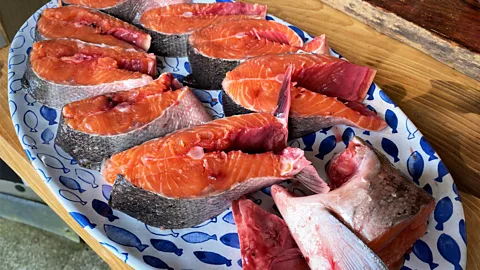
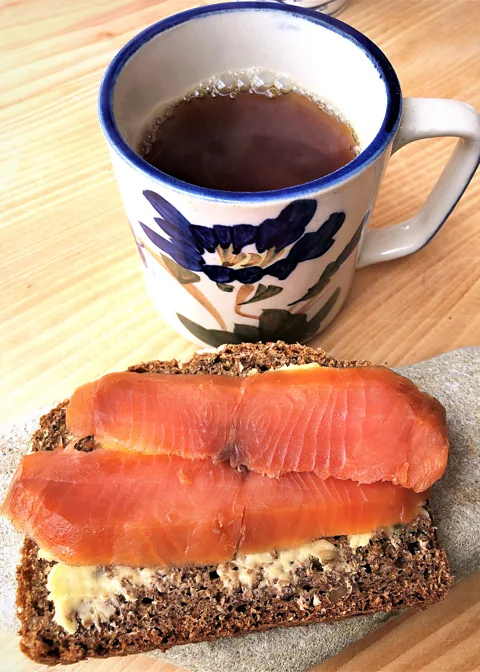
Salt, smoke and time are the only ingredients Barnes uses to transform the wild salmon into a much-desired food. It's meltingly butter-soft in the mouth, lightly licked with beech smoke and sea salt. Glossy with hues of pale coral and barely-there marbling are hallmarks of true wild salmon. It lacks a pungent fishiness; the delicate, floral aroma belies an elegant and gently lingering flavour. It's best eaten on well-buttered brown soda bread with a strong cup of tea.
It's a perennial favourite artisan product beloved by epicureans, yet the dwindling numbers of salmon under Barnes' hands mean her Irish Wild Smoked Salmon becomes rarer with every passing year.
As the only fish whose lifecycle demands a transition from salt to fresh water, over-fishing at sea coupled with poor environmental land management practices polluting inland waterways, have wreaked untold damage to both habitats. Decimation of terminal moraine gravel beds, which were formed in the last ice age and are essential to the spawning habits of salmon is another factor.
In Ireland, a total ban on sea fishing of wild salmon was imposed in 2007, restricting fishing to rivers where salmon return to spawn. However, between 2007 and 2017, Barnes didn't want to take fish from the often-polluted Irish rivers and the corrupted quality of the salmon there. Instead, Barnes sourced her salmon from Usan Fisheries in the town of East Montrose in her native Scotland, for 10 years until that fishery closed, too.
 Kate Ryan
In that time, regulation of Irish rivers had improved, but there was still no salmon quota in rivers local to her in Skibbereen, County Cork. One hundred kilometres east of her Woodcock Smokery, where the mighty Blackwater River divides County Cork and County Waterford on the south-east coast, became Barnes's new salmon hunting ground. Using draught and snap nets, Walsh and Uniacke fish their quota of salmon – which is just 225 this year – and every fish goes to Barnes.
"I'm very protective of them," she said of Walsh and Uniacke, but also of the fish they net for her.
The commercial salmon fishery opens from mid-May. Weeks before, Barnes feels an intuitive call to the salmon – a trigger for her own migration from the smokery to the Blackwater. "I get a frisson. I can smell 'em; they're coming," she said.
Every salmon that arrives to Barnes' door is precious. "I touch every single fish. It's a very physical relationship we have. I have a reverence for them, and I treat these beautiful creatures with the greatest of respect when they're under my hands."
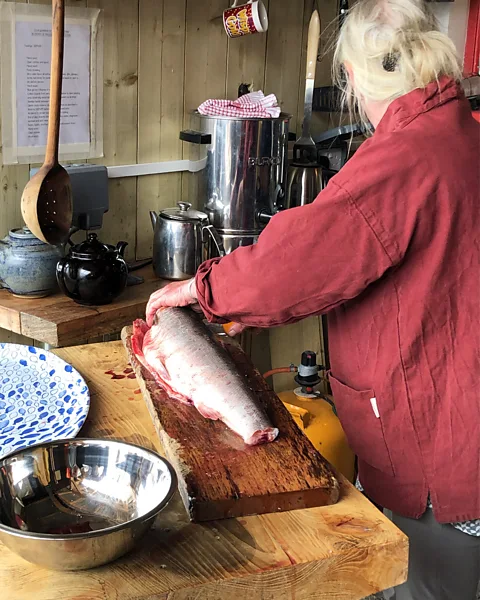
Barnes lays sides of salmon into a dry salt cure, and then massages each piece. There's a practical reason for this: to work out any last remaining traces of blood that could spoil the fish. But the motions afford an ethereal moment of connection, too.
"I get stories of where the salmon has been and what he's seen; and I know that sounds weird, but I do revere them as a fellow species. I'm observing it and I think, you've had such a long journey but I'm giving you respect, and I hope I'm doing justice to you having given up your life for me to live."
Barnes is as rare as the salmon itself; her craft is now utterly wedded to the existence of wild Irish salmon. When asked what's more important – the salmon or her craft – her response is unequivocal. "Oh, the salmon – every time," she said. "We lose our souls if we lose the salmon."
Barnes' commitment to only work with wild fish has drawbacks, such as never knowing how much fish will arrive. If she were to work with farmed salmon, she could order it up like people order ribs of beef or legs of lamb.
 Kate Ryan
"I did work with farmed fish once, when we had very little money," Barnes said. "I did the same process as with wild fish, but it was no good… the fat content is too high and it's not the same as the wild fish. In the wild, look at how many thousands of kilometres those creatures swim – that's a lean, mean machine. In salmon farming, this exquisitely beautiful, precious, extraordinary creature is stuck in a cage, pumped with chemicals, dyes and all sorts of nasty things to try and make food for humans – and they call that sustainable."
Despite there being left with little alternative, Barnes feels she has a right to work with rare wild salmon.
"When I started, I said I would only work with wild fish, and that automatically precluded me from chasing bigger contracts with bigger retailers because I couldn't guarantee quantities regularly. So, I learned to cut my cloth. Because I'm small, I'm sustaining myself as an individual, so I think what I am doing is a sustainable practice… I'm just able to feed myself, keep a roof over my head, run the car."
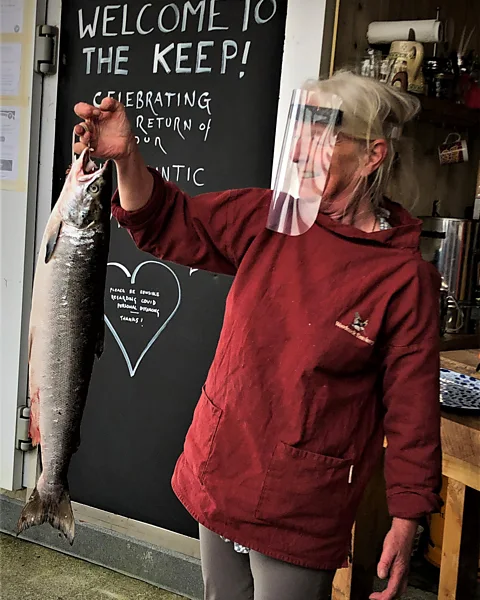
While Barnes would happily never work with wild salmon again if it meant preserving wild stocks and conserving the fishery for generations to come, the Keep is her insurance policy. Established in 2020, this learning centre for wild fish, particularly salmon, is open to anyone and everyone. It doesn't matter if you fillet fish once a month at home, are a chef, activist or educator, the Keep is for anyone wanting to tap into Barnes' lifetime's worth of knowledge.
 Kate Ryan
"That keeps the craft alive. The skills are not entirely ancient, but they are on the same page. I must pass the knowledge on – what else am I going to do with it?" she said.
This desire to share knowledge and skill resonates with others who tirelessly campaign for more and better understanding of the interconnectedness of food systems. Darina Allen, co-founder of the world-famous Ballymaloe Cookery School in East Cork, author and slow-food advocate, said: "Sally is a force of nature, passionate, knowledgeable. We so need artisans like her to continue to educate us on the plight of wild Atlantic salmon and to advocate for a more enlightened way forward to protect the species from possible extinction."
Once a year in July, Barnes hosts a celebratory salmon dinner. The salmon, a marine keystone species, is the topic of conversation, the dinner companion and the meal itself. Salmon comes smoked, of course, but it's the salmon steaks boiled in seawater with floury new potatoes and lakes of butter – the old Irish way – that stirs memories of childhood and meals shared with loved ones.
Over the meal with her guests, Barnes honours the salmon but doesn't shy away describing the perils of overfishing, aquaculture, environmental mismanagement and elitist attitudes to fishing rights, all ingredients of catastrophe for the last of the wild Irish salmon.
"We've done awful things," she said. "I must talk about it because it's not being addressed anywhere."
 Kate Ryan
And that's exactly what she's doing. Recently, Barnes spoke with BBC journalist and broadcaster Dan Saladino, who included her story in his award-winning 2021 book Eating to Extinction that profiles foods and food culture under threat around the globe.
For Saladino, her knowledge aptly demonstrated there was more to the story of humans and food than just relentless destruction of land, crop variety and culture.
"This is what's Sally's work shows us, her knowledge and skills are the legacy of thousands of years of humans solving problems and perfecting processes. These are being lost at frightening speed, but because of Sally's determination to hold onto this knowledge and her refusal to compromise, she has become the last person in Ireland to exclusively smoke wild fish. This is why she told me she feels like a wild salmon herself, a creature swimming against the tide."
When the wild Irish salmon returns to the freshwater of the Blackwater, it's the culmination of a 3,000km journey to the exact same spot where its life began. As it leaves the salty waters of the ocean, it begins a complete metamorphosis: a physical and biological transformation. With eggs laid and milt deposited, a few will survive to return to the ocean where they will feed, fatten and prepare to make the journey again.
"They're mesmerising, and there's so much about them we don't know," Barnes said of this magnificent and mysterious king of fish.
---
 Kate Ryan
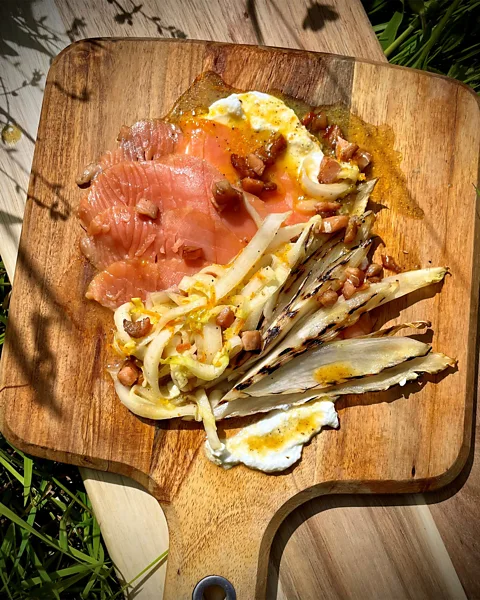
Wild Irish Smoked Salmon and Chicory Salad (serves 4)
By Caitlin Ruth
Caitlin Ruth was head chef of the former Deasy's Seafood Restaurant in the small fishing village of Ring in West Cork for 16 years. A locavore and supporter of small artisan producers, Ruth has long championed Barnes as a skilful artisan, regularly featuring her smoked fish on her restaurant menus and is now working with her on her new venture, Caitlin Ruth Food. This recipe is an original creation for BBC World's Table and is a joint celebration of Ruth's respect for Barnes' craft and love of bitter vegetables.
Ingredients:
200g Woodcock Smokery Wild Irish Smoked Salmon (50g per serving, thinly sliced)
2 large white chicory (1 for slaw, 1 griddled)
Zest of 1 medium orange
120ml of freshly squeezed orange juice
1 tsp coriander seed, toasted and ground
2 tsp Dijon mustard
90ml good quality extra virgin olive oil
Juice of ½ lemon
4 heaped tbsp local ricotta
Pepper, 2 large pinches; salt to taste.
Instructions:
Preheat a griddle pan to a high heat. Trim the base off one chicory, quarter lengthwise, brush spears with olive oil and lightly salt. Place chicory spears flat side down on griddle until dark char marks appear. Flip chicory over and repeat on the other flat side. Turn down heat and let chicory grill until cooked through.
Put orange zest and juice into a bowl.
Toast coriander seed, grind in a pestle and mortar. Add to orange juice and zest, along with Dijon mustard, olive oil, lemon juice, salt and pepper. Whisk to combine.
Take the other chicory, trim base and cut in half lengthwise. Use a knife to finely shred both halves. Place in a clean bowl and toss with half the orange and coriander dressing. Set aside.
On a plate, spread a generous amount of ricotta and top with slices of Wild Irish Smoked Salmon. Pile chicory slaw alongside and add spear of charred chicory. Dress with reserved orange and coriander dressing.
Optional garnish: fry scraps of smoked salmon in butter for 30 seconds. Tumble over salad.
BBC.com's World's Table "smashes the kitchen ceiling" by changing the way the world thinks about food, through the past, present and future.
---
If you liked this story, sign up for the weekly bbc.com features newsletter called "The Essential List". A handpicked selection of stories from BBC Future, Culture, Worklife and Travel, delivered to your inbox every Friday.
