The nation finding peace underwater

 Daniela Daines/Cape Town Freediving
For many South Africans, the quiet and calmness that can be found in the water – one of the rare places with few, if any, human-related threats – has been transformational.
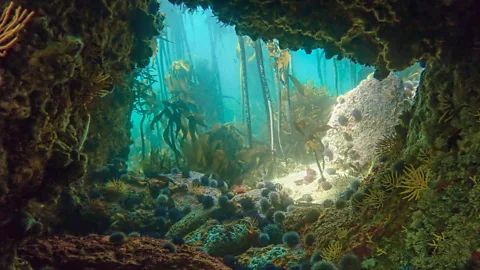
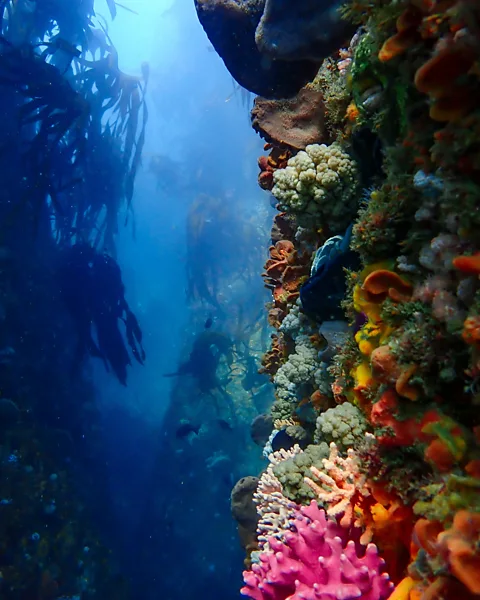
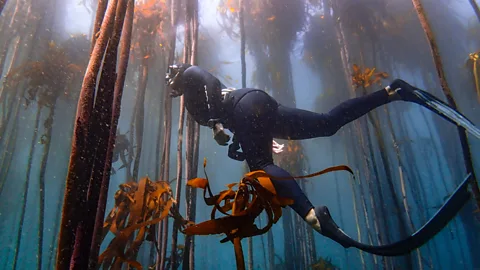
Break the surface of Cape Town's coastal waters and you'll find a golden forest. Thickets of sea bamboo kelp sway in the cold ocean swell, amber ribbons rippling out from tall limpet-clad stems anchored to the seabed. To the human ear, it's quiet. A shoal of silvery seabream wiggle past. Rays of sunlight dart through the briny turquoise water, gilding the dancing kelp fronds. An octopus lies almost hidden under a rock; boulder walls are encrusted with orange starfish and amethyst-toned sea urchins. Slinky pyjama sharks glide between the kelp.
This dynamic marine forest is mere steps from the beach and can be visited on just one breath.
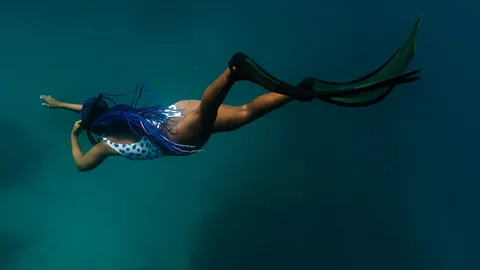
Freediving – diving on a breath-hold, without scuba gear – has boomed in popularity in Cape Town over the past decade, even before the Oscar-winning documentary film My Octopus Teacher showcased the Great African Seaforest, which extends along South Africa's west coast to Namibia. On a day with decent water visibility, freedivers can be seen wading in and out of the shallows, their extra-long fins – for energy-efficient movement – tucked underarm. Cold water enthusiasts brave the ocean in just a bathing suit and weight belt, while most opt for thick wetsuits, gloves, socks and hoods. Some divers can hold their breath for seven minutes, others are building up from a few seconds.
I've struggled with scuba diving in the past, finding it uncomfortable, sometimes stressful. A few years ago, someone recommended I try freediving. Sure enough, when I finally did so, I found the experience simpler, less cumbersome and more relaxing. I'm certainly not alone in that.
For many, the quiet and calmness that can be found in the water – one of the rare places with few, if any, human-related threats – has been transformational.
 Jacki Bruniquel
"My friend Juneid Petersen invited me for my first freedive," said Mogamat Shamier Magmoet, whose film Rise from the Cape Flats was awarded the Sylvia Earle Ocean Conservation Award in 2021.
Though he loved swimming, Magmoet had never been more than waist-deep in the ocean. "I was scared," he admitted. He floated, anxiously watching his friends disappear into the kelp. But after a while, the others reassuring him each time they resurfaced, he realised nothing was coming for him. "Everything just opened up. I fell in love, right there and then."
A journey through the kelp can be different on any given day. Divers might encounter the sevengill cow shark, related to Jurassic-period species; be joined by a little African penguin; or spot a short-tail stingray on the sandy seabed. Photographers capture ethereal jellyfish or take macro pictures of flamboyant nudibranch molluscs. Sometimes the visibility is so bad, it's like swimming through a snowstorm. Other days, simply watching sunlight flicker through the water is just the tonic.
"If you're stressed, go lay in the water," Magmoet said. "[You don't] have to swim or do anything. Just be there. I literally feel like something just slips off my shoulders."
Alongside his newfound joy, Magmoet feels a sadness: "Why was I only getting this experience now, after 33 years living 40 minutes away from the ocean?"
 Daniela Daines/Cape Town Freediving
Magmoet is from Heideveld on the Cape Flats. During apartheid, people of colour were forcibly removed from Cape Town's urban centre and onto the Cape Flats. The best beaches were whites-only; others were segregated. Apartheid only ended in the early 1990s and Cape Town remains largely, albeit informally, divided by race, with people of colour living in underserved and often unsafe areas. Parts of the Cape Flats experience extreme gang-related violence; Magmoet himself has been shot twice. But he's quick to note that "there's also a lot of good happening that doesn't really get seen".
Growing up, Magmoet never saw people of colour snorkelling or diving. "People say: 'It's not for you, the ocean is not for us.' I would just think, but why?"
You may also be interested in:
"Our ancestors used to live off the water," he said. South Africans of colour have diverse backgrounds from parts of Africa and Asia; many Muslims in Cape Town, like Magmoet, have Southeast Asian heritage. "[We were] removed from whichever islands we came from – Indonesia, Malaysia – and brought here as slaves. Then we lived here [by the ocean] again. Again, we were removed… With apartheid, we were literally told that this is not for you, don't come here. I think that got fixed in our brains."
Seeing even children in his community carry a wariness about the ocean, Magmoet wasted no time introducing youth groups to snorkelling, at first independently, then with non-profit Sea the Bigger Picture, which he co-founded with Chris Krauss in 2018. Their programme guides 24 children, aged between 13 and 16, on a year of marine and citizen science learning.
Magmoet recently resigned to focus on filmmaking and quarterly ocean "open days" for people who have never snorkelled – and he still works a day job as a handyman.
 Daniela Daines/Cape Town Freediving
Among the individuals and organisations that have supported Magmoet is Cape Town Freediving (CTF), which offered him a free course to learn safety elements for his youth programmes.
When CTF opened a decade ago, it was the first official freediving centre in the country. They had 21 students over the entire year. Now, it's common for them to teach 20 divers a week during the summer.
Co-founder Daniela Daines says that prior to around 2014, freediving was mostly a competitive sport in South Africa. She and her husband John created the Adventure Freediving course to broaden its appeal.
"The majority of people don't care about records," she said. "What they want are the skills and confidence to safely explore the ocean, encounter marine animals, to disconnect from the daily grind of city living and connect with like-minded people."
In 2020, I took CTF's two-day Adventure Freediving course. Our time was split between their studio in the False Bay suburb of Muizenberg and the ocean; on the final morning, we went to play with Cape fur seals in the Atlantic, Table Mountain's 12 Apostles standing as a dramatic backdrop.
As well as dive techniques and safety guidance, we learnt what happens to our bodies during a breath-hold – perhaps most usefully, that the initial urge to breathe is not triggered by running short on oxygen, but an impulse to exhale carbon dioxide build-up. CTF provides gear rentals and dive site recommendations, and adds students to a community Telegram group where no question goes unanswered: you can find a dive buddy or ask for visibility reports.
 Jacki Bruniquel
Daines says their students range widely in age, body type and background. "If you can breathe and swim, you can freedive."
The relative lack of discrimination in freediving as a sport, said Daines, may be why so many women are drawn to it – something that seems apparent in Cape Town – alongside certain similarities to meditation and yoga, and that sense of "safety and freedom in the water".
Daines has often seen freediving be a catalyst of change, not least for herself. Within two months of learning, she married, quit her "respectable, professional job", moved hemispheres and co-founded CTF.
"For some, these changes are subtle, for others they are truly life changing," she said.
"It's a healing, I think," Magmoet said of the freediving effect. "In Islam, we are taught that all creatures of God say praise to him every day. And that's why we feel the way we do when we are in nature, whether it's on a hike or in the ocean. It's because of creatures sending their gratitude and praise to the one that made them. You feel that tranquillity is always there.
"I think that's why I love just being underwater, as still as possible," he continued. "Everything is moving in the ocean. So why must you move? Once you stop, everything just comes to check you out… It's an important lesson. Just pause. Observe. We live fast-paced lives. But with a pause comes learning."
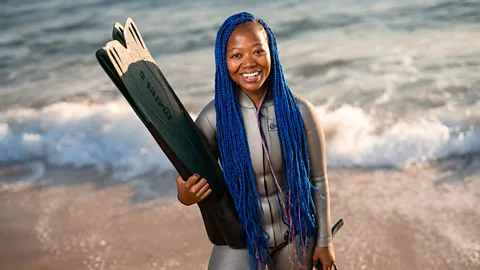
Zandile Ndhlovu has a similar relationship with the mindfulness that freediving requires. She qualified as an instructor in a water-filled quarry in Johannesburg. "It gets dark quickly," she said. "There's nothing to see. So, it's a beautiful release."
 Daniela Daines/Cape Town Freediving
Ndhlovu grew up miles from the coast, in Soweto, outside central Johannesburg. In 2016, on the heels of a divorce, she quit her corporate job and flew to Bali where she learnt to snorkel and then scuba dive, before taking up freediving back in South Africa. It wasn't without difficulty – to dive beyond 23m, she had to let go of fears and learn to be present. With freediving, she says, "the journey is so inside".
Like Magmoet, Ndhlovu became passionate about equal access to the water. "I've always been the only black guest on the boat," she said. "I just wanted to change that."
She founded the Black Mermaid Foundation through which she leads snorkelling trips in False Bay for children from Langa on the Cape Flats. "We always go from terror to crazy joy," she laughed. She aims to dismantle a sense of not belonging in the ocean, but acknowledges barriers still exist for many, such as a lack of leisure time and access to transport.
Ndhlovu, Magmoet and Daines all credit social media with recreational freediving's rapid gain in popularity – in Ndhlovu and Magmoet's cases, it's how they were first introduced to freediving. Now all three inspire others to experience the beauty of the underwater world for themselves.
"Lots of people ask me to describe it, but I can't," said Magmoet. Instead, he extends an invitation: "Come with me. Let me show you."
---
If you liked this story, sign up for the weekly bbc.com features newsletter called "The Essential List". A handpicked selection of stories from BBC Future, Culture, Worklife and Travel, delivered to your inbox every Friday.
{"image":{"pid":""}}
