India's town that's too wet for the British

 Santanu Das/500px/Getty Images
Water is everything in Sohra, where rain drove the British to the point of insanity, inspired ingenuity among the Indigenous people and spawned a thriving tourism industry.
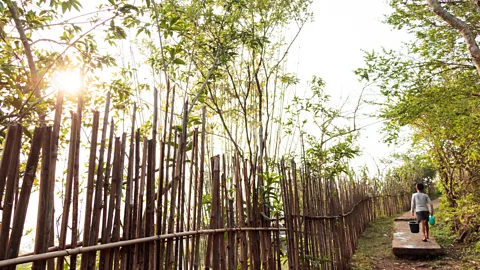
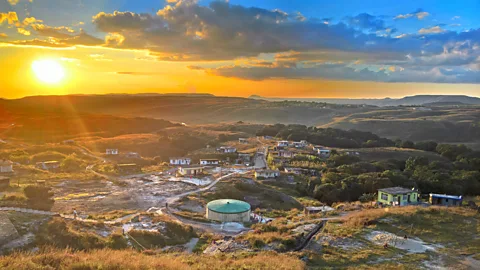
At 06:00, armed with buckets, 11-year-old Alphon walked down the hill while rubbing the last vestiges of sleep from his eyes. Like many children from his village, Alphon performs a sacrosanct ritual before heading to school: collecting water for drinking and household purposes from the community water tank.
Only three days earlier, Alphon and his family were toiling to keep water out of their house as a slap 'erïong (rainstorm) cascaded down the roof and walls, submerging ankles and belongings. In the town of Sohra (historically and still sometimes known as Cherrapunjee) in the north-east Indian state of Meghalaya, water oscillates alarmingly between two polarities – paucity and profusion.
Famed as one of the world's wettest places, water has long shaped life in Sohra. The rain drove British colonisers to the point of insanity, inspired remarkable ingenuity among the Indigenous Khasi tribe and even spawned a thriving modern tourism industry. But now, nature's bounty might be drying up after a record-breaking run.
 Trishna Mohanty
"We have had almost incessant rains and mists here since the 28th last [May 1827]," wrote David Scott, an agent to the Governor General on the North-East Frontier, in a letter dated 10 June 1827, in one of the earliest references to the rains in Sohra.
Plagued by the oppressive, tropical heat of the subcontinent, British colonials were often in search of cooler climates – it was a widely-held belief among the British of the time that colder temperatures were salubrious and could aid in curing disease. In search of a location that offered both cool weather and tactical advantages, Scott turned to the tribal hamlet known as Sohra.
Home to Khasi people who, according to an account written by British agent T C Robertson in 1832, were seen as relatively amicable to imperialist British forces, Sohra's location atop a plateau promised cooler temperatures. In 1831, on Scott's recommendation, the British government in India established a hill station in Sohra as their headquarters in north-east India, unaware that the cool, calm mountain weather would soon take an ominous turn.
Each year between May and September, Meghalaya is inundated by rain-bearing monsoon winds moving north from Bay of Bengal across the humid floodplains of Bangladesh. Here, halted by the steep Garo, Khasi and Jaintia hills of Meghalaya, the air currents squeeze through gorges, rapidly ascend steep slopes, condense and shed their moisture as rainfall.
 Focus Redefine Photography/Getty Images
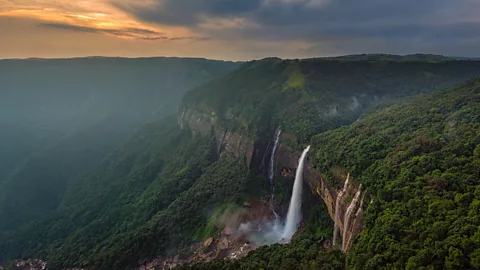
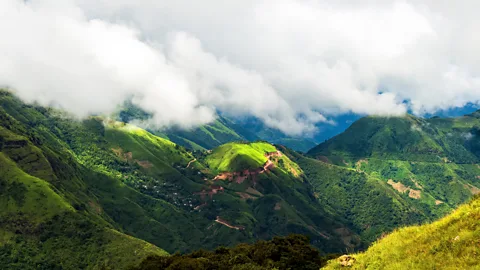
Sohra occupies a spur of flat tableland, the southern limits of which drop sharply into Bangladesh's plains. As monsoon sets in, the limestone cliffs gush to life with the thunder and foam of innumerable waterfalls – including some of the highest in India. Enshrouded in deep fog and mist, the falls are often accompanied by gossamer rainbows. Set against the velvet green Khasi hills, these waterfalls have long played a part in local Khasi legends alongside fairies and giant serpents.
Year after year, rain hurtles down these cascades, unleashing floods in the plains below but leaving behind parched land in the hills. "If you look at the Cherrapunjee plateau, hard rocks lay exposed in most places. There is barely an inch of topsoil or less. As a result, water is unable to percolate down and is instead discharged as sheet run-off," said Tapan Chakraborty, a hydrogeologist at the Central Ground Water Board. "The lack of topsoil also explains the town's paradoxical barren look."
Soon after arriving in 1831, Scott's British military unit experienced unrelenting downpours lasting weeks at a time. Even when it was not raining, Sohra was almost always cloudy. Catholic missionaries in the region around the time reported that, "Tables, chairs, benches etc must be fixed with bolts. Otherwise they fall to pieces. Iron bolts cannot be used because they rust and become loose." They spoke of books that disintegrated and constantly damp clothing that carried unpleasant odours. The moisture melted salt, spoiled medications and made food storage nearly impossible. Staples like flour and rice needed to be kept in "air-tight containers or kept in a heated room," they noted.
Administration became increasingly difficult for the British in Sohra. Robbed of daylight and confined to their rooms, soldiers grew depressed and took to liquor, with alcoholism becoming a major problem. In the throes of depression, several officers ended their lives. Things spiralled out of control so quickly that the patients and soldiers had to be recalled in 1834 – just three years after Sohra was established. In 1864, the headquarters was transferred from Sohra 54km north-east to the city of Shillong, making the British retreat official.
 Trishna Mohanty
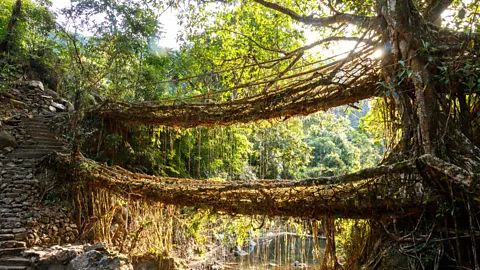
The local Khasi people, on the other hand, long ago adapted to the extreme precipitation. They build corrosion-resistant bridges using the roots of the Indian rubber tree (Ficus elastica), feeding them through hollow canes of Areca nut palm and training the growth for decades until the banks of a stream become connected. Since umbrellas are often rendered futile by strong winds, locals craft knup – knee-length carapaces made from bamboo and broom grass – that allow double-handed work even in rainstorms. In nearby Mawsynram, a village that has long competed with Sohra for the title of the world's wettest place, villagers use grass to sound-proof their huts against the battering of rain.
Today, Sohra receives an average annual rainfall of 11.43m, a modest figure compared to 1861 when the town had a record-breaking year of 26.46m of rain – enough to submerge the Statue of Liberty in waist-high water. That same year, it set a record for the most rainfall in a calendar month. Then, in 1995, Sohra broke another record when it received a staggering 2.49m of rain in 48 hours.
During winter, however, Sohra faces acute water shortages, compelling locals to fetch water from the nearest shared water tank or community tap. Homemade contraptions are used to ease the Herculean task of heaving several hundred litres of water every day on foot. Containers can be seen wedged under pipeline leaks everywhere, and people walk for miles to the closest spring for water-intensive chores such as washing clothes.
"My mother carried water when she was a child, I followed her footsteps, and now, my children follow my suit. They begin early in life – sometimes as young as four or five years of age. What can be done? It's unfortunate but everyday life for most children in Sohra can't be all fun and games – they have to share the burden of this land with the grown-ups," said Lakynti, a resident of Sohra.
During the May-to-September rainy season, however, leaky roofs and flooded rooms aren't unheard of. In many Khasi households, mornings mark the commencement of the crucial act of salvaging waterlogged belongings, a task reminiscent of the experience of Welsh missionary Thomas Jones, who wrote in 1841, "Most of my time is occupied in saving our goods from being ruined by the rain."
 Faizan Shaikh/EyeEm/Getty Images
The future, like the past, appears fragile. More than a century of rainfall measurements from rain gauge stations across north-east India reveal a decreasing trend in summer rainfall since 1973, a pattern set in motion by changes in the Indian Ocean temperature, reduction in vegetation cover and an increase in cropland areas. Rainfall patterns have changed, and the world's wettest place title has already shifted from Sohra to nearby Mawsynram.
For Sohra's thriving tourism industry, which is driven entirely by its rainy claim to fame, this could mean trouble. Oral accounts and rainfall data from the India Meteorological Department Observatory in Sohra indicate that the arrival of monsoon has been getting later for the last few years, shortening the life of the town's popular rain-fed waterfalls. "Tourism in Sohra has to look beyond waterfalls and tap into its rich culture, root bridges and adventure sports if it has to sustain itself," said boutique tour operator Julie Kagti.
You may also be interested in:
In the chasm between the states of too much water and too little, life continues to play out in Sohra. Stunning one moment, precarious the next, water has been a juggernaut navigated by generations of Khasi people who have painstakingly learnt survival by adaptation.
But not even the locals, who understand water's many whims, could have imagined that the rain would oust the British from this humble town more than a century before imperialist forces were compelled to leave India. Rain has been the gatekeeper of Sohra's destiny in the past and the present – and as an uncertain future looms, it remains to be seen if Khasi ingenuity will find a way yet again.
---
If you liked this story, sign up for the weekly bbc.com features newsletter called "The Essential List". A handpicked selection of stories from BBC Future, Culture, Worklife and Travel, delivered to your inbox every Friday.
{"image":{"pid":""}}
