Coronavirus: Zero Covid strategy 'would be risky' for Republic of Ireland

 PA Media
A senior member of the Republic of Ireland's National Public Health Emergency Team (NPHET) has rejected the "zero Covid" strategy advocated by opposition politicians.
Those supporting the measure point to Australia and New Zealand.
Those countries have had much stricter lockdowns and rules on inbound travel.
Professor Philip Nolan said it was a "false promise" to say Ireland could go from Level Five restrictions to Zero or One "in the space of weeks or months".
He said it "won't happen".
Professor Nolan, who chairs NPHET's epidemiological modelling advisory group, said it "would be an incredibly risky thing to do because we will inevitably be a leaky country and get re-introduction of the disease and that could easily be new variants".
The Irish government has always cited the open border with Northern Ireland and the lack of restriction on travel between Northern Ireland and Great Britain as reasons why a zero Covid policy would be unlikely to work.
But there is evidence of growing public and political support for the Australia and New Zealand models, although both countries are relatively sparsely populated states, big distances from other countries.
Both countries have mandatory quarantine in hotels for the limited number of people allowed to travel inwards.
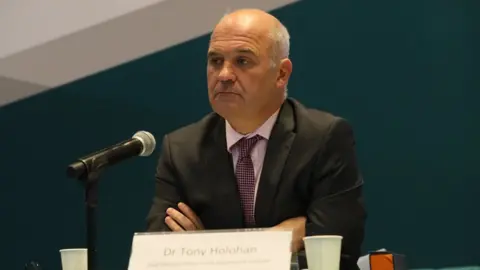
Ireland's Chief Medical Officer Dr Tony Holohan told the same news conference that zero Covid would be difficult to apply "in a realistic way in an environment like ours".
"We simply couldn't realistically seal the borders of this country and stop movement of people in and out," he added.
He said it was "far more reasonable to pursue the present policy of driving down community transmission and getting people vaccinated as quickly as possible".
 PA Media/Brian Lawless
Professor Nolan said the current "R" number - the rate at which the virus reproduces itself - is estimated to be between 0.4 and 0.7.
Earlier this week, Taoiseach (Irish Prime Minister) Micheál Martin said the Irish government had decided to extend the Level Five restrictions until 5 March.
Ireland has been operating on a five-level plan for dealing with Covid.
The Level Five restrictions include a ban on all household visits, the closure of non-essential retail and a 5km limit on travel.
Other restrictions include the closure of sports including golf and tennis, with the exception of professional or elite sports like Gaelic games and horse racing behind closed doors.
On Friday, another 48 Covid-19-related deaths were recorded in the Republic of Ireland, taking its total to 3,214.
The Irish Health Department also recorded another 1,254 confirmed cases of the virus.
Fewer vaccines
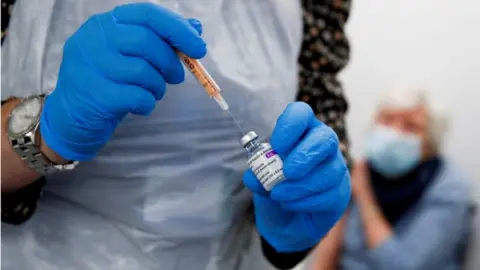
It comes as Ireland is expected to receive 300,000 fewer doses of the Oxford-AstraZeneca vaccines as a result of a shortfall in deliveries to the EU.
Ireland might not receive the full number of doses which had previously been agreed.
The 600,000 doses were due to be delivered by the end of March, but its Department of Health has been informed that this will now be around 300,000 instead.
A deal had been made between pharmaceutical company AstraZeneca and the European Union.
Instead of getting the 1.4 million vaccinations being delivered in total for the first quarter, it might be about 1.1 million instead.
However, the final figure could change as Irish broadcaster RTÉ reports that sources stress that negotiations and discussions are still ongoing with the company.
The Irish government target is to vaccinate 700,00 people by the end of March, and it was contingent on the arrival of the AstraZeneca batch.
Irish Minister for Health Stephen Donnelly said at the Dáil (Irish Parliament) on Thursday that "robust discussions" were ongoing and Ireland nor any EU member state, was in a position to say what the final amount would be.
 Reuters
The AstraZeneca doses are expected to arrive in Ireland a week earlier than was planned, due to the commitment from the minister to seek early deliveries.
The Irish government does not expect this shortage to impact its start date for the vaccine roll out to over 70s.
It is working on contingency plans in case they are unable to administer the vaccine to people over the age of 65.
AstraZeneca vaccines are due to begin arriving a week earlier than planned, following a commitment from the minister to seek early deliveries.
It is expected that the over 70s could receive their vaccines from mid-February, due to the supply of Pfizer vaccines that Ireland has.
Meanwhile AstraZeneca vaccines could be given to the younger frontline workers when they arrive.
On Friday, First Minister of Northern Ireland Arlene Foster had a meeting with AstraZeneca to discuss the supply of the vaccine.
"I think there is very much a case for us to look at how we can help the Republic of Ireland in the roll out of the vaccine," she added.
