Kashmir unrest: Clashes at protest after Friday prayers

 Abid Bhat
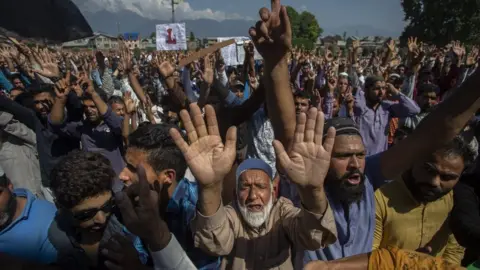
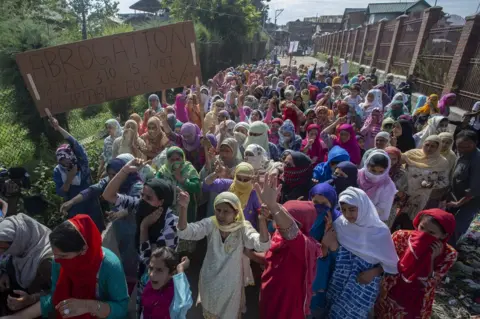
Security forces in Indian-administered Kashmir have clashed with protesters in the city of Srinagar.
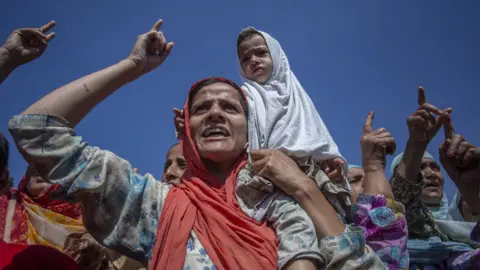
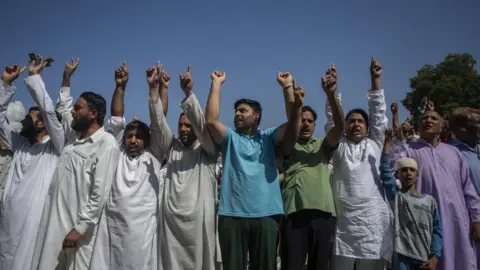
Hundreds of people took part in a demonstration after Friday prayers in the Soura neighbourhood.
The march turned violent as protesters threw stones at security forces, who retaliated with tear gas and pellets. At least two were injured.
Tensions have been escalating since the Indian government removed the region's partial autonomy three weeks ago.
Information has also been scarce, as internet and mobile networks have mostly been blocked.
 Abid Bhat
 Abid Bhat
BBC correspondent Aamir Peerzada at the scene says one man was seen bleeding from his eye and another had suffered a neck injury.
The final number of wounded protesters may remain unclear. Many people who are injured with pellets do not go to hospital for fear of being arrested.
 Abid Bhat
 Abid Bhat
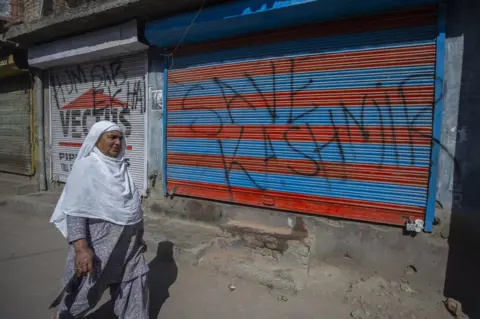
The Soura neighbourhood is fast becoming the epicentre of the resistance to Delhi's removal of the Indian-controlled region's special status.
What is happening in Kashmir?
Kashmir is a Himalayan territory which both India and Pakistan say is fully theirs. Each country controls part of the territory.
The Indian-controlled side - the state of Jammu and Kashmir - was the country's only Muslim-majority state, and until recently had partial autonomy under Article 370 of the Indian constitution.
On 5 August the government in Delhi revoked Article 370. Prime Minister Narendra Modi and his ruling Bharatiya Janata Party argued Kashmir should be on the same footing as the rest of the country.
The government also said it would break the state up into two smaller, federally-administered territories.
One region would combine Muslim-majority Kashmir and Hindu-majority Jammu. The other is Buddhist-majority Ladakh, which is culturally and historically close to Tibet.
Since then hundreds of people have been detained, and mobile networks and the internet have been shut down - although a partial restoration of connectivity recently has enabled some landlines to start working again.

