Korea talks: The intricate theatrics of a historic meeting

 BBC
BBCThe historic summit between South and North Korea has been a carefully staged affair of intricate theatrics.
There is symbolism in almost every aspect of the meeting, from food to flowers and from table diameter to the planting of a pine tree.
It is all designed to "signify the arrival of peace on the Korean Peninsula and the era of co-operation and prosperity," according to the South Korean committee in charge of preparing the summit.
The venue
The meeting takes place in the Panmunjom village in the Demilitarized Zone (DMZ). This in itself is already quite symbolic.
For the two previous summits, it has been the South's political leader who travelled to Pyongyang, the North's capital.
 EPA
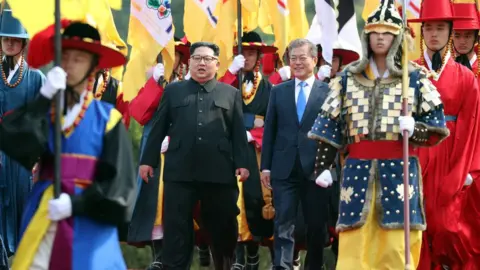
EPAThis time, the two sides' leaders meet at the military demarcation line and then walked to the Peace House for the actual talks.
 AFP
AFPThe house is south of the border and it's been the first time a North Korean leader has ever crossed that line.
An honour guard of South Korean soldiers dressed in colourful traditional garb - rather than South Korean military uniform - lined the path of the two leaders.
The flowers
For decoration, their meeting room features flowers in traditional white porcelain vases.
But not just any flowers: peonies to symbolise greetings, daisies to stand for peace, and wild flowers picked in the DMZ.
The table
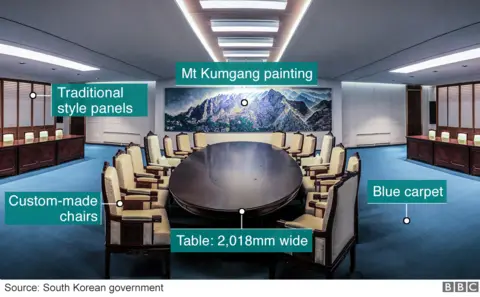
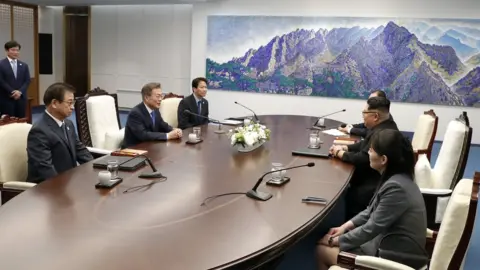
The two leaders sat down at an oval table exactly 2,018mm wide, a diameter to reference the year the summit takes place.
 Getty Images
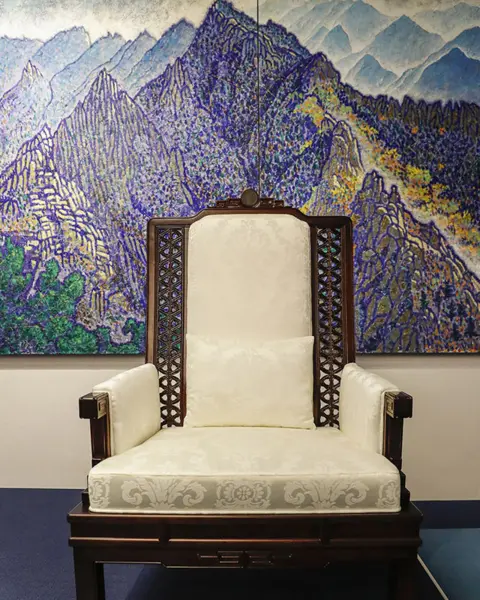
The chairs were also custom-made for the summit and they include a little dig at Japan.
Featuring a map of the whole Korean peninsula they also show the disputed group of islands known as Dokdo by South Korea and Takeshima by Japan. The islands are controlled by Seoul but also claimed by Tokyo. Both Koreas are united in their dislike of Japan.
The decor
The symbolism in the room extends beyond the table and chairs.
 South Korean government
The room is designed to feel like a traditional Korean Hanok house - with panelled windows made of paper.
The blue carpet is meant to represent the mountains and streams across the Korean peninsular.
And the large landscape painting on the wall is of Mt Kumgang, in North Korea. A South Korean government spokesperson said it was a mountain that many Koreans aspired to visit.
"Mt Kumgang is a symbol of reconciliation and co-operation between the South and the North."
 KCNA
KCNAThe pine tree
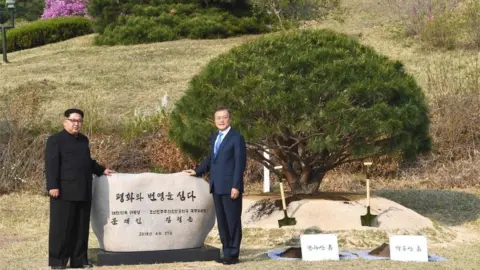
The afternoon featured a commemorative tree planting. The pine tree dates back to 1953, AFP reports, the year the Korean War armistice was signed.
 AFP
AFPBoth leaders picked up shovels to ceremoniously plant the tree in soil brought from mountains in both the North and South. It was then watered by water from rivers in each of their halves of the peninsula.
There's a plaque by it saying: "Planting peace and prosperity."
The food
The dinner served to both delegations this evening will again be loaded with symbolism; every bite carries significant weight.
Produce and recipes will be from North and South Korea, from the two leaders' hometowns, and even sourced from the DMZ.
 Getty Images
There will, for instance, be Pyongyang Naengmyun, famous cold noodles from the North, Swiss potato rosti because Kim Jong-un spent his youth in Switzerland, seafood from Moon Jae-un's hometown and the traditional bibimbab rice dish, with vegetables grown in the DMZ.
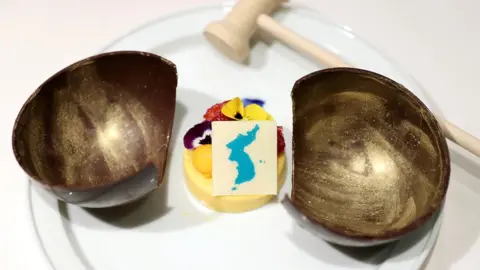
One of the desserts will again feature a map of the two Koreas - again with the disputed islands. The symbolism did not go unnoticed in Tokyo.
Japan's foreign ministry issued a "strong protest" over of the controversial mango mousse.
