On patrol with Kenya's locust hunters

 Georgina Smith/BBC
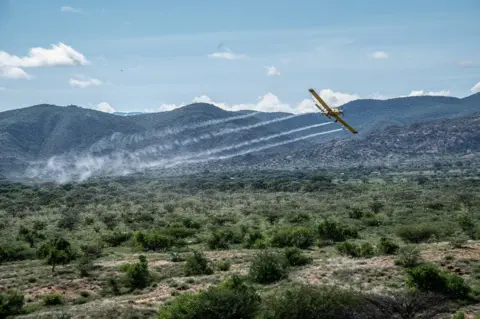
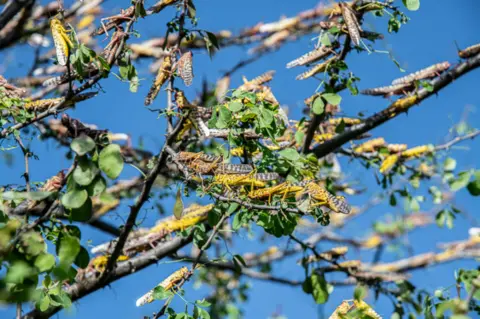
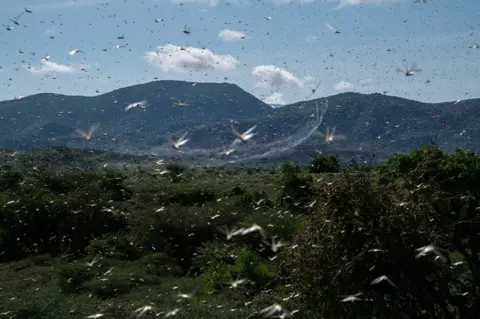
Desert locusts in their millions are devouring their body weight in vegetation every day in Kenya. As spring breeding draws to a close it is now a race against time to kill their eggs before they hatch.
Tracking the insects is an art in itself, with daily surveillance operations across the country scrambling to confirm the latest coordinates of swarms before deploying spray planes to destroy them with pesticide.
 Georgina Smith/BBC
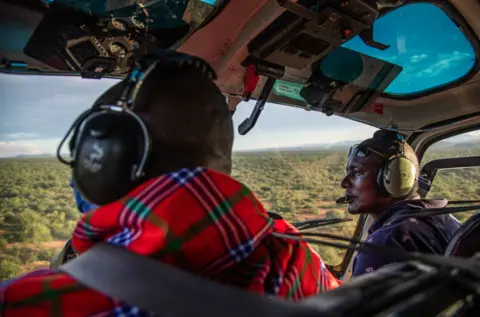
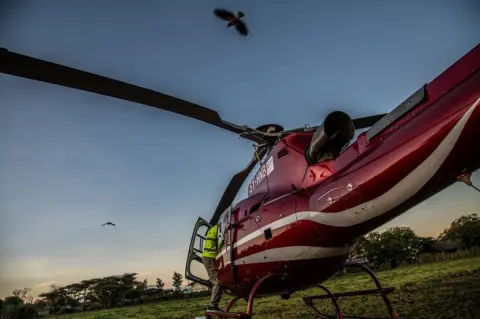
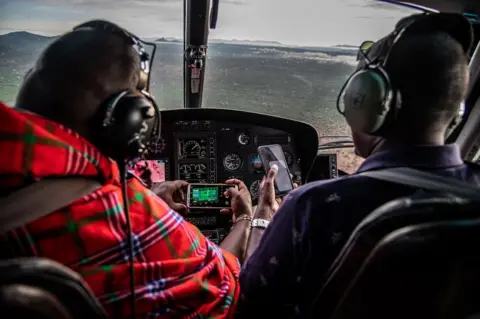
Every morning, Ambrose Ng'etich (left) from the UN's Food and Agriculture Organization (FAO) boards a helicopter with Captain Iltasayon Neepe to locate the locust swarms in northern-central Kenya.
 Georgina Smith/BBC
The migratory pests, which carried on the wind can cover 150km (95 miles) a day, have devastated crops, pasture for livestock and livelihoods in recent months.
 Georgina Smith/BBC
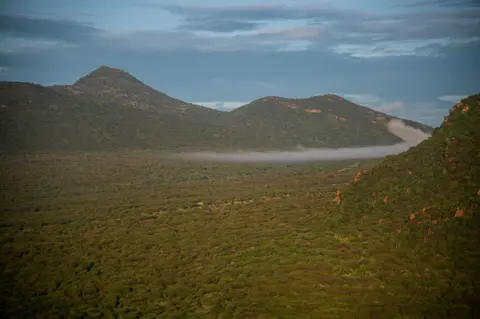
Mr Ng'etich's job is to manage desert locust control efforts over the vast plains of Samburu, Isiolo, Laikipia and Meru. The sandy soils in this area are ideal for desert locusts to lay their eggs.
"When the sun is warm enough, then you will know the quantity you are dealing with, they are spread all over. You can even have swarms covering up to 100km," says the FAO official.
 Georgina Smith/BBC
Before the coronavirus pandemic struck, it estimated that locust invasions would push more than 25 million people across East Africa into food insecurity.
Last month, emergency financing to the tune of $43m (£34m) was approved by the World Bank for Kenya's desert locust response.
 Georgina Smith/BBC
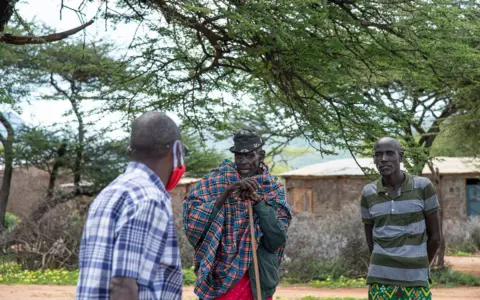
On their daily rounds, Captain Neepe and Mr Ng'etich land the helicopter and talk to community members, gathering information about the locusts' possible whereabouts.
 Georgina Smith/BBC
"We have already trained a number of scouts that are going to help the community understand," says Mr Ng'etich.
Residents are to identify the size of swarms and relay this information back to FAO surveillance teams.
The next step in "recovery efforts and building resilience" will include cash transfer schemes when families are expected to be worst hit by food shortages.
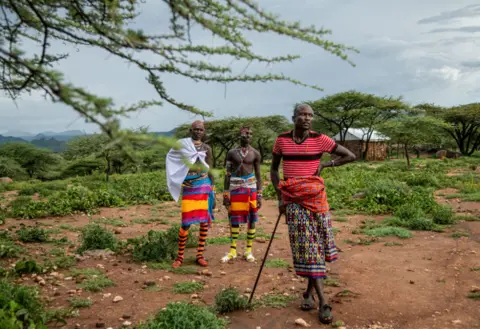
Pastoralists are being worst affected.
 Georgina Smith/BBC
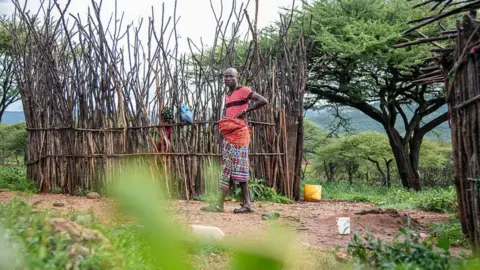
Standing outside his empty goat pen in Samburu County, a three-hour drive north-east of Isiolo town, 32-year-old Tiampati Leletit explains that he lost 80 of his goats after the locusts came.
He gave his four remaining goats to a neighbour, so they could be part of a herd.
 Georgina Smith/BBC
Mr Leletit had planted some maize, beans and other crops to feed his family in the meantime, but the locusts ate them too.
"They cleared everything," he says. He has planted yet more crops, and hopes the locusts will not come back.
But now the fear is that a new wave could hit this month, when crops are ready for harvest.
"With the desert locust situation developing as it is, we are anticipating higher levels of food insecurity in the coming months," says Lane Bunkers, of Catholic Relief Services, working on acute malnutrition with mostly pastoralist communities in northern Kenya.
 Georgina Smith/BBC
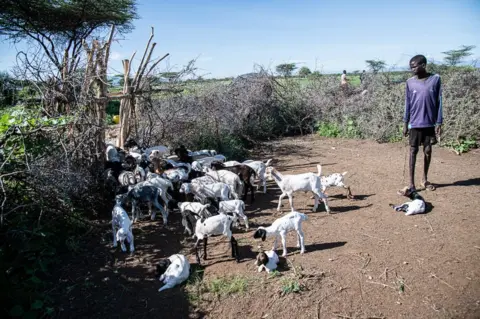
Erupe Lobun, a 40-year-old Turkana herder and father of 13, says the recent wave of desert locusts has decimated the amount of food available for his herd of 60 goats.
He believes pesticides have also affected his animals, but with Covid-19 restricting people's movements, he cannot summon the vet.
Underfed mother goats are being kept apart from their young because they don't have enough milk to suckle them.
"It means we have nothing to eat," Mr Lobun says. "Livestock are our strength."
 Georgina Smith/BBC
Grazing land is also under strain.
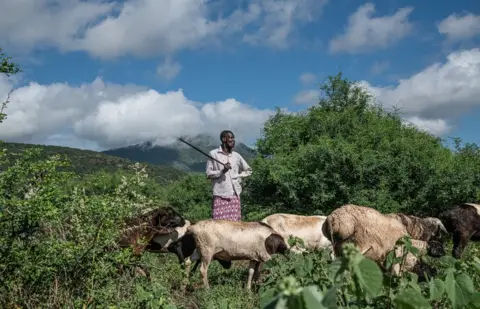
"This is my first time to see the locusts. My father used to tell me stories about the locusts a long time ago," says Moses Lomooria, 34.
"What we are used to is drought," he says, which has reduced his herd of cattle from 60 to 24.
"We are worried," he says, adding that if herders on the other side of the mountain also run out of food, they will start coming for their pasture.
 Georgina Smith/BBC
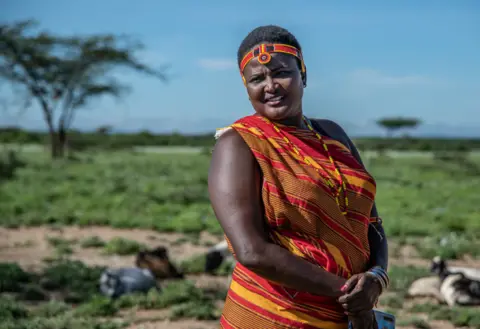
"Resource-based conflict will increase," warns Josephine Ekiru, a peace-building co-ordinator for the Northern Rangelands Trust and herself a member of northern Kenya's Turkana pastoralist community.
"Our people - we only depend on livestock," she says. "When there is no pasture, there is conflict."
Her advice is that that everyone should be prepared.
 Georgina Smith/BBC
You may also be interested in:
All pictures subject to copyright
