Six Nations: The Wales rugby international 'shot by a poison arrow'

 Cardiff Rugby Museum
"I could tell immediately that he was going to be a fascinating story."
In 1908, Norman Biggs was reported to have been shot by a poison arrow while in northern Nigeria working as a district superintendent.
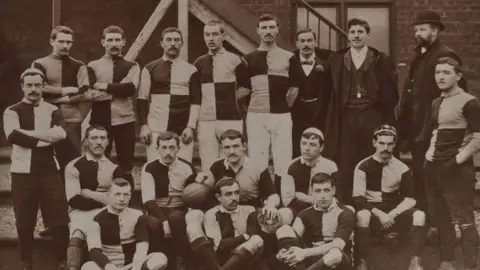
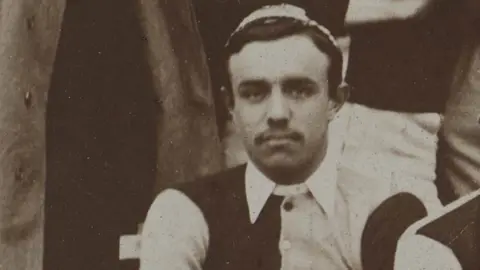
But Biggs was not from Nigeria, he was born in Cardiff and was Wales' youngest rugby international, said local historian Ted Richards.
He explained that Biggs first appeared in the newspapers aged about 12, with a story about his rugby talent.
He later played for Cardiff aged 16, before joining the Welsh team aged 18.
"That record stood for 120 years," said Mr Richards.
Mr Richards, a former toxicologist, was researching people killed by poison when he stumbled onto Biggs' story in an old newspaper article.
"The more I researched him and his family, the more interesting the story became," he said.
Biggs' first international game was against the New Zealand Natives, which later became the All Blacks, in Swansea.
"He had a very bad game - he was 'pooh pooed' the Western Mail said, which is a great expression, because he played for Cardiff," said Mr Richards.
"There was this rivalry between Swansea and Cardiff, and there still is."
 Cardiff Rugby Museum
 Cardiff Rugby Museum
After becoming injured, he took up running while studying at Cambridge University, where he became an excellent sprinter.
In Biggs' obituary, it was said he could run 100 yards (91.4m) in 10 seconds.
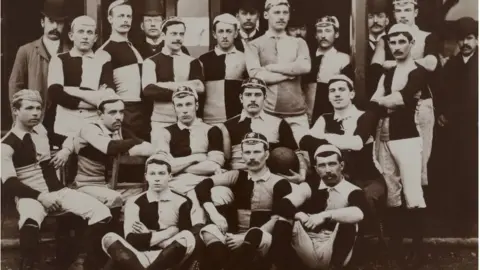
He later returned to rugby, playing multiple games for Wales and becoming Cardiff's captain in 1893, playing for them until 1899.
But in 1900, Biggs decided to fight in the Boer War and joined the Glamorgan Imperial Yeomanry, said Mr Richards, travelling to South Africa.
He was injured and shipped home for treatment.
"The reports of that… you pick up a bit of Norman's maybe impetuous type of behaviour," said Mr Richards.
Biggs returned to South Africa as a captain for a different unit and returned home in 1902.
Mr Richards said newspapers reported Biggs later travelled to Nigeria in 1907, and was a district superintendent.
But in 1908, in response to local pilfering, he was sent to help calm things down.
"There was a skirmish and a number of Nigerians were shot," explained Mr Richards.
'Thirst for knowledge'
"Norman, if we are to believe the newspaper reports, went off to the neighbouring village to warn them.
"But the people he went to warn misunderstood him, and they attacked him with this poison arrow."
Mr Richards said that although he does believe Mr Biggs was shot by a poison arrow in northern Nigeria, he does not think it is what killed him.
"I think a poison like that works pretty fast; now the newspaper reports said he didn't die for four days," he explained.
"It was probably a haemorrhage that didn't heal or something like that."
Mr Richards said that in Nigeria, poison could be taken from a vine that used to grow on the outside of a tree.
The fruit would be picked, dried and used as poison, he explained.
It affected the enzyme that transports sodium and potassium out of the cell, influencing the muscles and causing the heart to give up, he went on.
Mr Richards said newspaper reports claimed Biggs pulled the arrow out his leg and his friend cauterised the wound with a hot knife.
A grave for Norman Biggs is still in Nigeria.
Despite international rugby not having perhaps the same level of celebrity, Mr Richards said "the Welsh public had a thirst for this knowledge of what happened to a famous person like Norman".
He said Biggs' letters were published in the Western Mail, Wales' national newspaper.
Mr Richards researched Biggs for about a year, through genealogy, newspapers and even speaking to descendents.
He said: "There's a bit about him on the internet. Not a huge amount for someone who's achieved quite a lot sporting wise, I find that quite strange."
