From miner to minister: Exhibition for Wales' forgotten MP

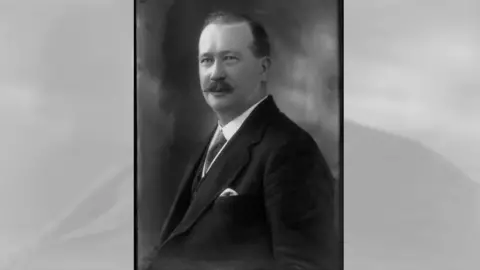 National Portrait Gallery
He inspired the welfare state ideas of both Aneurin Bevan and Clement Attlee, yet today remains largely forgotten.
Vernon Hartshorn OBE broke the mould as the first Welsh collier to become a Cabinet minister.
Appointed Postmaster General in Ramsay Macdonald's first Labour Government of 1924, he went on to serve as Lord Privy Seal five years later.
Now his life and work is to be honoured in an exhibition at the South Wales Miners' Museum, Port Talbot.
Born in Risca, Caerphilly, in 1872, Hartshorn began working in a colliery from the age of 14.
He grew interested in miners' rights and welfare when, as checkweighman at Aberaman Colliery, he oversaw the amount of coal extracted in order to calculate his colleague's pay.
In 1905 he was elected as a district miners' agent on the South Wales Miners' Federation and by the time of the 1912 strike he was already being described as among the most prominent and capable of the workers' leaders.
 South Wales Miners' Museum
However it was during World War One that Hartshorn earned respect from all political sides.
"Coal supply was critical to the war effort but it faced threats, from the loss of manpower, profiteering mine owners and the risk of strikes," said William Sims, collections officer of the South Wales Miners' Museum.
"Hartshorn played a vital role in calming discontent amongst his men and cooperating with the government and owners to ensure things ran as smoothly as possible.
"He was able to demonstrate to the miners that they could achieve more through cooperation than industrial action.
"And he earned a reputation amongst those in power for being a sensible and rational man who they could do business with."
 South Wales Miners' Museum
Awarded an OBE, it was this sense of pragmatism and practicality which characterised Hartshorn's career after he was elected MP for Ogmore in 1918.
As Post Master General he was handed the daunting task of modernising the nation's vast and complex post, telephone and telegraph services.
In 1928 he was appointed as one of only two Labour representatives on the Simon Commission investigating Home Rule for India.
The other, fortuitously for British history, was Clement Attlee and the pair became firm friends.
"Some of the papers in the exhibition show how, 17 years before Attlee's landslide election victory of 1945, the two of them were discussing many of the issues which would form the basis of that, and later Labour governments," said Mr Sims.
"They included nationalisation, a national health service, the minimum wage and the welfare state."
 South Wales Miners' Museum
However, back in government in 1930, Hartshorn had more immediate worries.
Made Lord Privy Seal - in effect a minister without portfolio - he took responsibility for tackling the Great Depression which followed the Wall Street Crash of 1929.
As Mr Sims explains it was a thankless and ultimately fatal task.
"Hartshorn was left trying to balance falling taxation revenue and increased expenditure on unemployment benefit," he said.
"Combined with this, his own constituency in south Wales was particularly badly hit.
"He spent most of his time shuttling between government meetings in Westminster and relief efforts back home.
"Eventually it became too much for him and on 13 March 1931 he collapsed and died. You could say he literally worked himself to death."
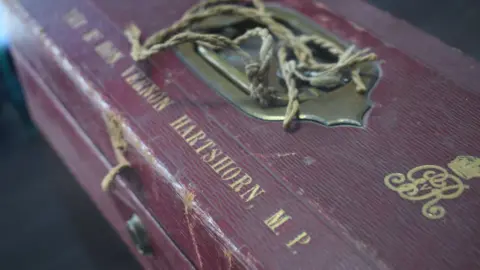
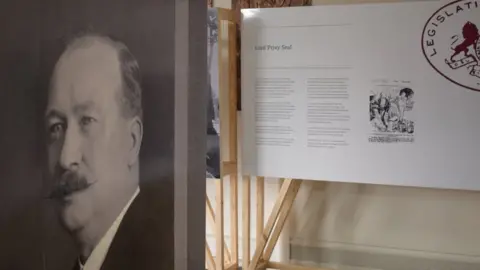
The exhibition outlines Hartshorn's story through photos, letters and newspaper articles, as well as personal artefacts such as his ministerial box.
It launches this week at the South Wales Miners' Museum in Port Talbot before visiting significant places in Hartshorn's life.
There will then be a month-long exhibition at the Senedd in Cardiff Bay, before finishing at the Houses of Parliament in London.
