DSS discrimination: Mum on benefits faces housing 'stigma'

 Getty Images
A single mother is sleeping on her parents' sofa after being refused private rental properties because she claims housing benefit, she said.
Christine, 33, is one of six members of her family living in a three-bedroom house in Cardiff, and claims the situation is making her ill.
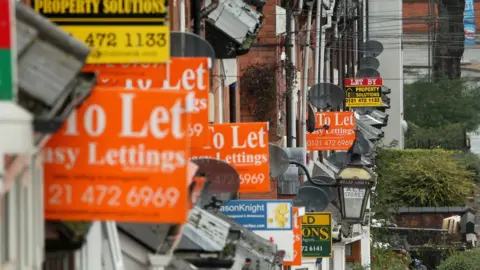
A fifth of lettings advertised in Wales explicitly excluded people in receipt of housing benefit, a study has found.
Shelter Cymru labelled the practice "completely discriminatory".
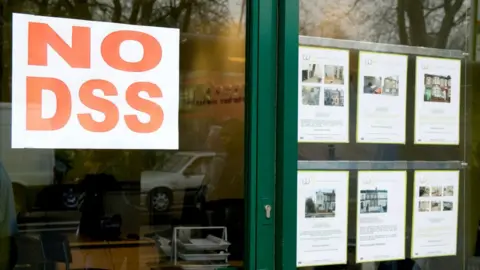
In a snapshot study carried out jointly by the National Housing Federation (NHF) and Shelter, of the 2,780 Welsh property adverts examined, 576 were so-called "no DSS" which exclude housing benefit claimants.
The term "no DSS" refers to the acronym of the now defunct Department of Social Security, which was formerly responsible for distributing welfare.
Abusive relationship
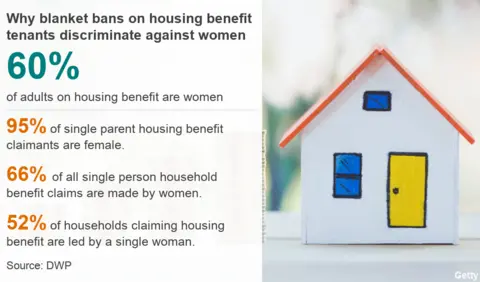
A separate survey by Shelter found that more than a third of housing benefit claimants have experienced DSS discrimination, and 10% of all private tenants felt discriminated against.
Christine had to flee an abusive relationship when she was 10 weeks pregnant with their daughter, who is now seven years old.
After more than eight years on Cardiff council's waiting list for social housing, Christine, who has a number of physical and mental illnesses including fibromyalgia, anxiety and depression, has still not been offered a suitable home.
A Cardiff council spokeswoman said it has a "very long" social housing waiting list which prioritises based on highest need, and that the council is "doing everything we can" to provide more homes.
And Christine's attempts to find a home in the private market have been frustrated by the unwillingness, she says, of landlords and letting agencies to accept her as a tenant because she receives housing benefit.
"I've spent four hours every day contacting people and no-one would even look at me," she said.
"I don't smoke, I'm tidy and I pay my rent on time.
"I have been sleeping on the settee for five years which causes problems for my stomach and makes me sick."
Christine said she got "so excited" last August when she found a property which accepted tenants on housing benefits - her family even changed the date of their holiday to help her move in, she added.
But after being accepted by the letting agency, she said she was contacted the next day to say the landlord would not accept housing benefit claimants.
'Extremely stressful'
"It is extremely stressful - you blame yourself," she said, explaining how it felt to be turned down again and again.
"I think it is disgusting. It is wrong. It is discrimination and it stigmatises people on benefits."
She added: "It feels like I'm talking to a brick wall to be honest. It is making me feel desperate."
Landlords are more likely to accept potential renters who own pets than people claiming benefits, a BBC investigation found.
Jennie Bibbings, campaign manager at Shelter Cymru, said helping people facing discrimination takes up a lot of their time and resources.
"We have seen DSS discrimination for many, many years. It is completely discriminatory," she explained.
"You can have good tenants and bad tenants from any walk of life.
"We have had a couple of landlords who wanted to let to benefit claimants but this one woman had to go to three different agencies who suggested they ask for 'a nice working family'."
 Alamy
AlamyThe National Landlords Association (NLA), the Residential Landlords Association (RLA) and the UK Association of Letting Agents (UKALA) all agree that blanket restrictions should not be used.
Zoopla became the first of the big online property listing sites to announce it would ban "no DSS"-type adverts, with rival Right Move under pressure to follow suit.
Some buy-to-let mortgages are sold on the condition that the property is not rented to housing benefit claimants, a practice Ms Bibbings said "appeared to be contrary to the Equalities Act".
The NHF's chief executive, Kate Henderson likened it to the racial discrimination from private landlords in the 1950s and 60s.
"Today's discrimination is hardly any different and we refuse to turn a blind eye," she said.
Although equality law enforcement and consumer protection law are not devolved, the Welsh Government said it wants to "see an end to adverts which discriminate against tenants" on welfare.
A spokeswoman added: "We are examining ways to eradicate the 'no DSS' barrier."
