WW1: New memorial for Pembrokeshire's Japanese dead

 BBC
BBCA new memorial has been unveiled in a Pembrokeshire churchyard to the crew and passengers of a Japanese merchant ship sunk by a U-boat in the last weeks of World War One.
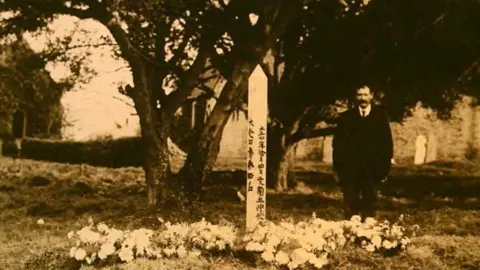
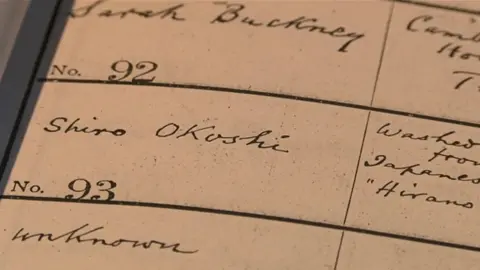
More than 300 died aboard the Hirano Maru and 10 of the bodies washed ashore are buried at Angle Church.
The original wooden memorial rotted away and local people have helped to raise money for a replacement.
The unveiling, held earlier, marked 100 years to the day since the disaster.
Around 100 villagers joined descendants of those who died, officials from the Japanese embassy and representatives of the shipping line which owned the vessel to watch the Duke of Gloucester unveil the granite stone.
Guest of honour was 74-year-old Yoshiko Nakamura, the granddaughter of Lt Col Shintaro Yamamoto who died in the attack.
Mrs Nakamura is convinced he is one of the nine unidentified casualties buried at Angle.

You might also like:
Local historian David James, who started the campaign for the new memorial, said he felt "humbled that my efforts should have such and impact on so many people".
The sinking was the worst maritime loss of life for Japan in the war but Mr James said: "I'm surprised at the strength of feeling in the country.
"I always thought someone ought to do something about it, but then realised that someone was me."
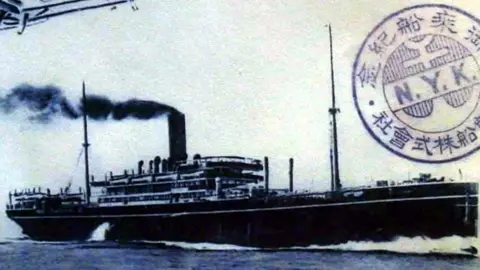
The Hirano Maru sailed from Liverpool on 1 October 1918 heading for Yokohama via South Africa with 320 people aboard, carrying mixed cargo and passengers.
You might also be interested in these:
Japan was a staunch ally of Britain and the Hirano Maru's skipper was actually Scotsman Hector Frazer, a long term employee of owners the NYK line.
The following morning, she joined the south-bound convoy OE-23 and sailed into the deadly U-boat hunting ground formed by the triangle of Pembrokeshire, Cornwall and Ireland.
UB-91 was one of the latest class III German submarines, fast and heavily armed, and on her second tour after being launched in March, commanded by Wolfgang Hans Wertwig.
Only days earlier it had used a single torpedo to sink the US coastguard cutter Tampa which had been on its way to Milford Haven. All 131 officers, crew and passengers died.
 PAPERS PAST
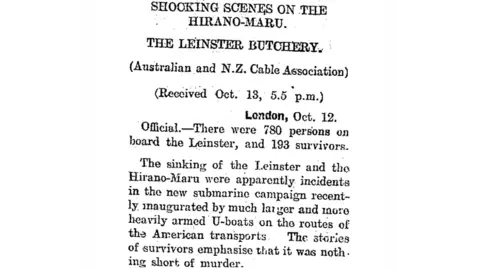
A news agency reported: "The seamen hurriedly attempted to launch the boats, but they were smashed against the sides.
"The passengers realised the disaster and rushed up on deck to find huge waves sweeping men, women and children into the sea.
"Soon a couple of hundred were fighting for their lives in the waves, piteously shrieking for help."
The escort USS Sterret arrived two hours later and stopped to pick up survivors.
UB-91 though was lying in wait and launched a second attack.
The US warship spotted the torpedo tracks and took evasive action before responding with depth charges.
But it was forced to abandon the rescue.
 US Navy
Sterret returned within 50 minutes but most of those in the water were already dead from hypothermia.
UB-91 and her crew escaped to surrender at Harwich after the armistice.
But in a strange twist the German U-Boat, albeit with a British crew, subsequently went on a fund-raising tour of Welsh ports including Pembroke Dock.
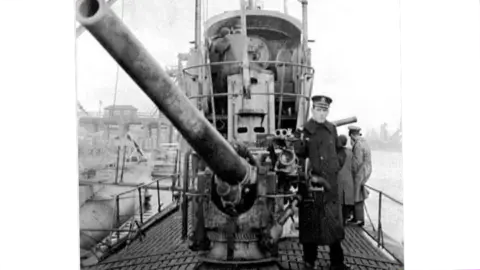 Brian Rendell
It was reported to have raised £33 while at Swansea's North Dock Basin in January 1919.
Thousands of people had to be turned away, so many that a return visit was promised.
UB-91 was finally broken up for scrap at Briton Ferry in 1921.
But its deck gun became part of Chepstow's war memorial. It still survives today.
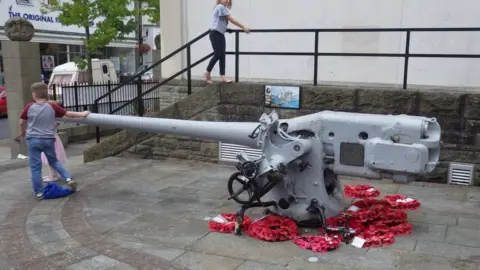 CROWN COPYRIGHT RCAHMW