Queensferry Crossing work unfinished two years after opening

 Trransport Scotland
Work on the Queensferry Crossing is still not complete - two years after it first opened.
The £1.34bn bridge across the Firth of Forth was opened in August 2017, coming in under budget but completed eight months later than first estimated.
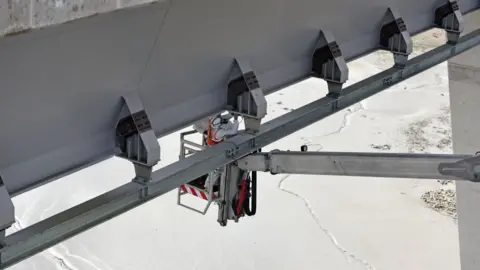
Snagging work that still needs to be finished includes painting, mechanical and electrical work.
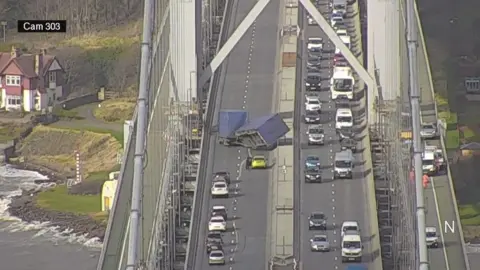
However, wind barriers have kept it open 34 times when its predecessor, the Forth Road Bridge, would have closed.
Officials said they expected the snagging work to be completed by the end of the year.
Transport Scotland said newly-published wind speed threshold data suggested that the new structure had saved the economy and hauliers millions of pounds in fuel costs, diversions and missed appointments.
Contractor FCBC (Forth Crossing Bridge Constructors), is carrying out snagging work before handing the bridge over to Amey, which will then look after its future maintenance.
 Traffic Scotland
Visitor numbers to the Forth Bridges viewing platform near the Forth Education Centre have reached almost 170,000 in two years.
Further data from separate pedestrian and cycle counters on the Forth Road Bridge, show that more than 186,000 pedestrians and cyclists have used the east and west footpaths across the bridge in the last 12 months.
Analysis shows that the crossing has, on average, reduced the journey time from the M90 junction 2 Admiralty, to the M90/M9 junction by up to five minutes at peak times, compared to the same route which previously used the Forth Road Bridge.
The free-flow journey time remains as it was before, being a slightly longer route, but offering a higher speed limit.
Hard shoulders on the new bridge have also reduced delays resulting from accidents and breakdowns.
'Increased resilience'
Officials said the typical duration of an incident on the Queensferry Crossing was about one hour from the start of an incident through to restoring normal traffic conditions.
On the Forth Road Bridge the typical duration of an incident ranged from one hour up to five hours.
Transport Secretary Michael Matheson said: "The primary benefit to road users is undoubtedly the increased resilience of the Queensferry Crossing.
"On over 30 occasions in the past two years when previously hauliers, businesses and the delivery chain would have been disrupted using the Forth Road Bridge, the crossing has stayed open.
"When incidents do occur on the bridge, the availability of a hard-shoulder has often allowed 'business as usual' journey times to be restored much faster than previously seen."
 Getty Images
Martin Reid, policy director at the Road Haulage Association, said: "There is little doubt that the Queensferry Crossing has been of huge benefit to the Scottish logistics sector and by extension, the whole Scottish economy.
"We have seen over the past few years that we are increasingly at the mercy of weather events, some of which have been without precedent.
"It did not take long for shelves to become empty during 'The Beast from the East' and businesses of all kinds have been affected by recent flooding events and storms.
"The fact that the crossing has remained open 34 times in weather conditions that would have closed the Forth Road Bridge has allowed freight to keep moving and supplies arriving to those most vulnerable and to communities who are often isolated."
'Reliable route'
Mark Arndt, account director for Forth Bridges operating company Amey, said: "The Queensferry Crossing now provides a reliable route for cross-Forth motorway traffic, and this has allowed us to make good progress on major maintenance projects on the Forth Road Bridge at lower cost and without any of the severe disruption these works would have caused previously.
"The truss end links that caused so much disruption when they failed in 2015 have now been replaced by completely redesigned and improved components, and to replace the main expansion joints we've been able to close a carriageway on the bridge for nine months without causing any delays.
"Without the Queensferry Crossing available to carry traffic, the replacement of these joints would have caused severe disruption and economic impact over an extended period."
