How women stopped the Scottish police being a man's world

 BBC Scotland
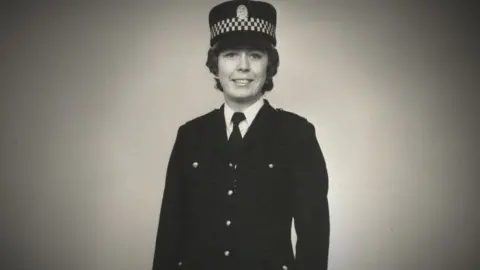
Carina Webb joined the police in 1963 but soon had to make the choice between a husband or a career.
Until as late as 1968 women in Scotland had to leave the police force as soon as they got married.
While Carina's career ended after just three years her husband Eric rose to the rank of superintendent and enjoyed 33 years on the force.
 BBC Scotland
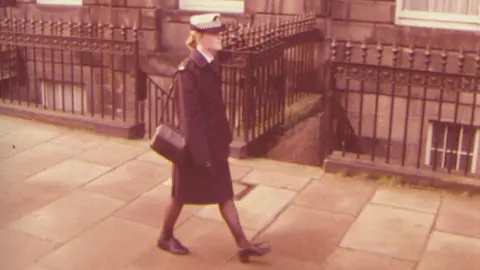
Carina tells the BBC documentary The Force: The Story of Scotland's Police: "When I got engaged I knew that when I got married I would be leaving the police.
"I could have had a good career there but I did not get the opportunity.
"I must admit I thought it was rather short-sighted to put everyone through training and then just says 'bye now, you are getting married'."
 BBC Scotland
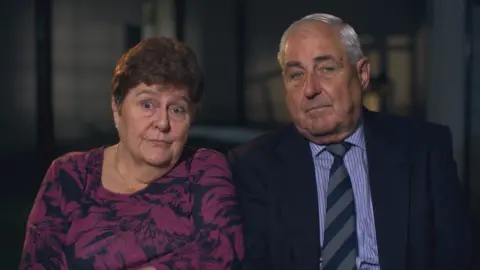
The Scottish force's enduring marriage bar, which had been lifted in England and Wales in 1946, meant that most women in the 1950s and 1960s served for only three years or four years.
In 1970 the entire Scottish police service still employed only 382 women, less than 4% of all officers.
Carina Webb says the attitude was "it was a man's world and we should not have been there".
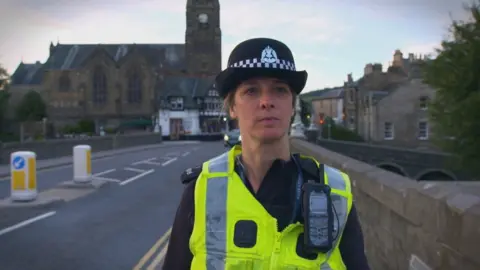
Nanette Pollock signed up for the police in the early 1970s.
She says: "When I was 26 I decided to change my career and I went into the recruiting office.
"If anything was ever going to put me off it was the person I spoke to."
 BBC Scotland
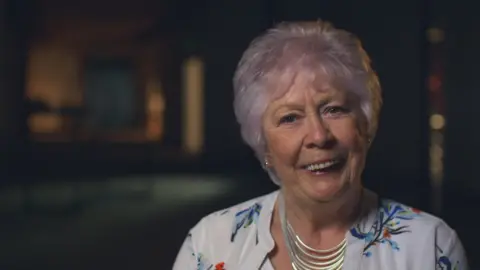
Nanette, a retired detective chief inspector who served for 30 years, says she told the man in the recruiting office she had seen a sign in the window.
"He said 'wait a wee minute, hen, have I got this wrong here?'," Nanette says.
"He said 'does that sign say anything about women?'."
 BBC Scotland
Until 1975, when the Sex Discrimination Act put men and women on an equal footing, female officers could only join as part of a "completely separate" unit known as the Policewomen's Department.
Nanette Pollock says: "We did the same training at Tulliallan, and some of us did quite well in exams, yet we came back and it was totally different policing.
"We were really like a nursery."
She says the women were given the job of looking after children.
"If anyone was arrested and they had their children with them, guess where they went?," Nanette says.
"The laugh was most of the officers handling the children were married men and fathers, who had experience with children, which we didn't have."
 BBC Scotland
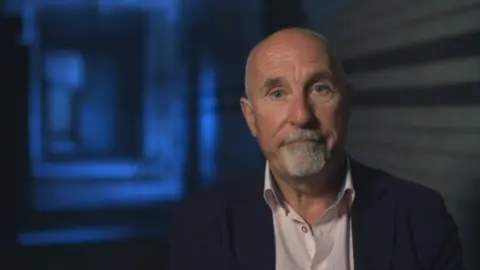
Retired detective chief superintendent John Carnochan says the Policewomen's Department was seen as a "support" for male officers.
He says: "They were separate. They did not do shifts, they did not walk the beat, they were in the office, they did admin stuff.
"A policewoman sergeant would be in charge of the women but she would have no authority over the guys."
 BBC Scotland
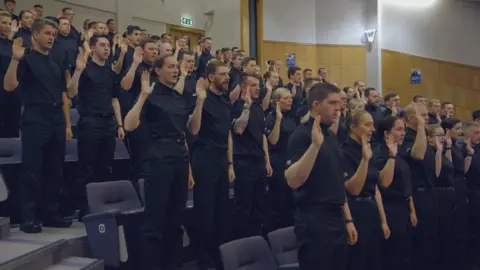
Nowadays women make up about 30% of Scotland's police force, some 5,000 officers.
It is more than a century since the first woman was "added to the police establishment" in September 1915.
Emily Miller had been a member of the Glasgow Vigilance Association, a branch of the Suffrage Movement, who took it upon themselves to patrol the streets during World War One, when there was a shortage of male officers.
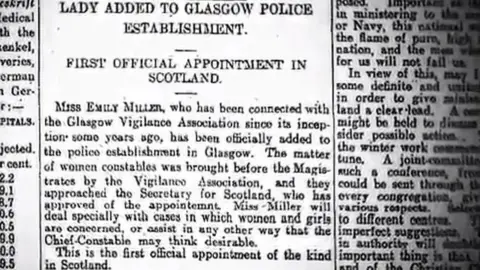
She did not wear a uniform and had no powers of arrest.
Emily Miller was classed as a "lady assistant" with a very specific brief to take statements from women and children in cases of sexual assault and abuse.
Scotland's first paid, uniformed, policewoman was Jean Thomson in Dundee in 1918.
"It was a role that was very much shaped by gender, more similar to social work actually, rather than what was seen as proper policing which was thief-taking and chasing after criminals" says University of Edinburgh historian Louise Jackson.
Both world wars brought significant social change for women and by the time WW2 came around numerous women officers were wearing uniform and had the power of arrest.
Louise Jackson says: "The genie was out of the bottle really. There had been this experiment and actually it had gone really well so quite a lot of chief constables around Scotland acknowledged that women had played quite an important role."
The Sex Discrimination Act may have finally given women equal status but changing the culture of the police was still a long way off.
 BBC Scotland
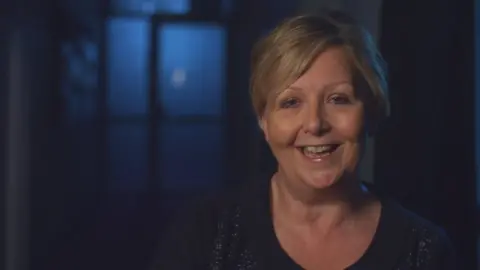
Retired officer Rona Grimmer says: "Some of my colleagues would be date-stamped on their bums. That was still the culture that we came in to."
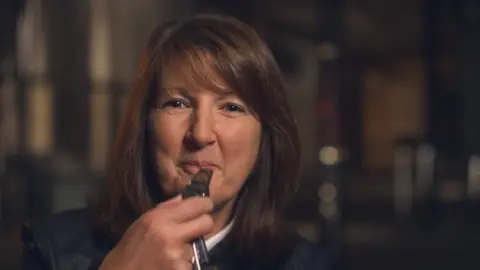
Retired sergeant Cameron Shanks admits that some of the practices "would be frowned upon now" or even attract a criminal prosecution.
"Basically they used to stamp the female's backside," he says.
"The female became the property of that particular station."
 BBC Scotland
And then there was the uniform.
Female officers recall the police woman's handbag for keeping their radio in, the pillbox hat and the whistle for attracting help.
Retired inspector Joe Craig says: "I remember a policewoman in Ayr and one day the chief constable called for her.
"He said 'how are you getting on with your new uniform?'
"She said 'it's fine but there is too much cloth in this skirt. I had to chase a guy up the high street last Saturday and it impeded me running after him.
"The chief constable said: 'What? You were running up the high street after someone? Please remember you are a lady."
