Cervical cancer: Trust registers 12 serious screening incidents

 Getty Images
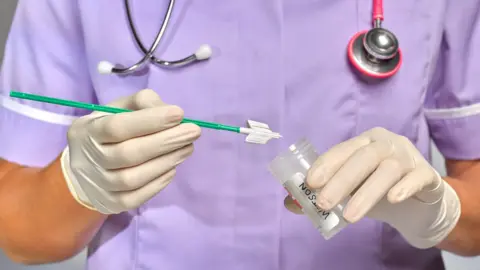
There have been 12 serious adverse incidents (SAIs) registered within the Western Health Trust since 2017 in relation to cervical screening, BBC News NI has learned.
It comes as the Southern Health Trust has launched a major review of cervical screening involving 17,500 women.
The Western Trust is not included in this review.
SAIs are declared for events or circumstances that could have led to harm or damage, including loss of life.
With the spotlight firmly on cervical screening in Northern Ireland, a woman treated within the Western Trust has told BBC News NI about how her "world fell apart" when she was diagnosed with cervical cancer in 2021, after abnormalities were not detected in several previous smear tests.
The case is a separate development from the Western Trust SAIs but Mary, which is not her real name, said it was "such a shock" to receive the diagnosis as she had "no indication about cervical cancer".
"I was traumatised," she said.
'Very hard to go through'
The 43-year-old from Londonderry said her smear tests had been up to date for the last 10 years and nothing was flagged until her last smear in 2020.
It showed borderline changes and HPV (human papillomavirus), which can cause cervical cancer.
After her cancer diagnosis the Western Trust asked if her history could be looked at "to see if there was anything missed".
Mary agreed but did not think much more about it as she was more worried about her cancer diagnosis, treatment and whether she was going to live.
 Science Photo Library
She had major surgery - a radical hysterectomy - in December 2021.
"They have removed basically every girl organ that you have - your womb, your ovaries, your tubes, your cervix," she said.
"I had parts of my private area removed as well, which was very hard to have to go through."
'It just got too much'
Mary was told the surgery went well but that she "may go into early [surgical] menopause".
"They should have warned me that I was already in [surgical] menopause because as soon as your ovaries leave your body, that's you in menopause," she said.
Mary added that menopause was "really hard" and that nothing was explained to her about the symptoms she would experience.
She was also not put on hormone replacement therapy (HRT), which is commonly used to treat women going through menopause.
All of this seriously affected Mary's mental health and she ended up in a mental health hospital for a few weeks.
The menopause, cancer diagnosis and recovery from major surgery "just got too much", she said.
"To be honest, I'm shocked I'm sitting here today. I couldn't see a way out back then," she said.
"I thought, this is me I'm ready to go. I'd everything planned."

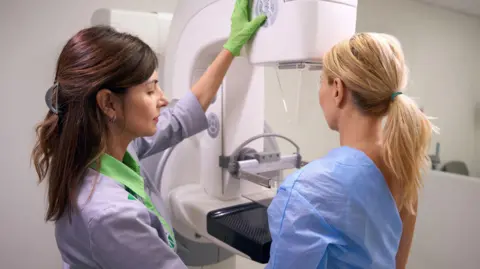
What is cervical screening?
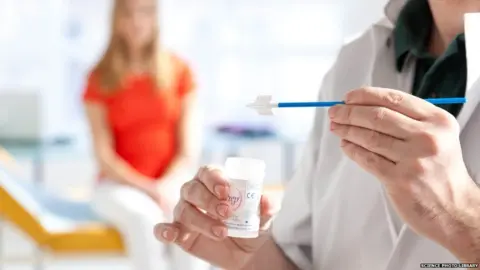
It aims to prevent cervical cancer - by identifying and treating abnormalities that could develop into cancer if left untreated.
But screening cannot identify every single case of cancer or pre-cancer - it is not a diagnostic test for cancer.
In Northern Ireland, screening is offered to women between the ages of 25 and 64.
Four months after being discharged from hospital, Mary attended a meeting to discuss her smear test history.
Her case has been described by the Western Trust as "category 2" and not an SAI.
This category includes "false negative cases (where a smear test is reported as negative but does contain abnormal cells) and which are considered to be within the limitations of the screening programme due to the difficulty of correctly identifying the cells".
In a statement, the Western Health Trust said it records any cervical screening process issues, including "false negatives or minor process or management shortcoming", in line with a framework called the Audit of Invasive Cervical Cancers and Disclosure of Findings.
The Trust said it had full confidence in its screening programme and that the public "should be reassured that quality control and quality assurances systems are in place".
It added that some results which constitute a patient safety incident were identified and taken through the appropriate SAI process.
Mary's case highlights the ambiguities within the cervical screening programme.
While screening is not a diagnostic tool, abnormal cells when detected can lead to treatment and prevention of cancer.
However, in some cases, detection through a microscope can be difficult.
Sources have told BBC News NI that there could be as many as five other women in the Western Trust who went on to develop cancer after abnormalities in smears were missed.
The smear test review findings
Mary had three smear tests - in 2011, 2014 and 2017 - which showed changes, but she said in each case she was told at the time that "everything was normal, your smears are perfect".
A review into Mary's smear history showed she had been given three false negative results from 2011 when her smears had shown cell changes.
The review team felt that these changes would not have been identified by most screeners at that time.
When her last smear in 2020 was reviewed, it was found that high-grade changes were also present but had not been included in the original result.
The review said that "if high grade changes had been seen at this time it would not have affected Mary's management as she was referred to colposcopy".
Mary's account of what happened between 2020 and her cancer diagnosis in 2021 differs from the Western Trust's. When asked about her account, the trust said that it cannot comment on individual cases due to patient confidentiality.
"I was shocked. I was hurt. I was so angry," Mary said.
"I started questioning myself. Is it my fault that this has happened? My blood was just boiling."
After being told abnormalities in several smears had not been detected, Mary said she asked one of her health professionals would she have gone through the cancer diagnosis, surgery and menopause if she had been given the right results.
"The answer I got was no - you would not have got cancer if we'd given you your right results," she said.
This, Mary said, made her "more upset" and things got worse, including her mental health.
"I didn't even get an apology," she said.
"I am not the same person physically or mentally since this all happened."
The biggest impact, she said, was not being able to have children or her own family.
"Just knowing that all your girl organs are removed and there's not much left inside you and you're trying to learn how to grieve the loss of not having your own children," she said.
"There's so many mixed emotions, so many physical and mental health issues that I'm still struggling with - after everything.
"I still feel like I'm on a rollercoaster and I can't get off.
"It's just been crazy - one very long journey and I still have a long way to go."
If you have been affected by any of the issues in this story, you can contact the BBC Action Line for support.