Bath University students create portable water quality monitor

 University of Bath
A group of students have created a portable water quality monitor that they hope will increase access to clean water around the world.
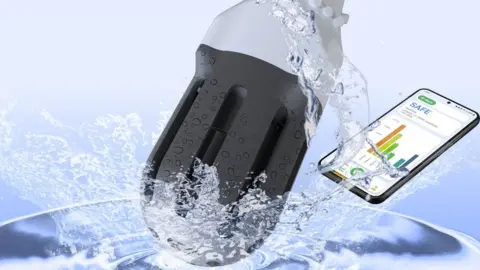
The On-site Aquatic Safety Inspection System (OASIS) uses sensors to quickly detect contamination.
The University of Bath team said it is "designed to benefit and empower isolated communities".
Team leader Alexz Farrall said it could also be used by water companies, wild swimmers or home owners in the future.
The OASIS works by analysing water quality with sensors which detect potentially harmful elements, including chlorides, fluorides, nitrates, pH level, temperature and clearness.
It provides "rapid detection" when placed into water, compared to testing in a lab which takes longer, and could help track safe water sources, Mr Farrall said.
'Immediate risk detection'
"It can empower users to be aware of how harmful or safe a water source is and share it with their community," he added.
"When you submerge the device in water, it can instantly give feedback on how clean and drinkable a water source is.
"This could work in areas where water is scarce, potentially contaminated, or where agricultural work can cause quite rapid changes to water quality.
"It can provide a form of immediate detection of risks, or for situations such as a Cholera outbreak."
 University of Bath
The water diagnostic results are displayed on the device, and if a smartphone is connected, it can be uploaded and shared online on a global map.
The team of students said they were inspired by the university's links with Stellenbosch University in South Africa to explore how the device could benefit communities around the world.
The team is currently sending the device out to some communities in Africa where people need access to clean water.
While portable water sensors have previously been developed, the team said the OASIS device's distinction lies in its affordability and that they aim to work with NGOs to bring the device into full production.
Dr Despina Moschou, a senior lecturer from the university, said: "The device is sophisticated and addresses a major global problem in a simple and potentially very affordable way.
"The work the team has done to find out how to apply their knowledge to this problem, building their skills and real-world problem solving is truly impressive."

Follow BBC West on Facebook, X and Instagram. Send your story ideas to: [email protected]