'Pariahs in the street': WWI objectors who refused to fight are commemorated

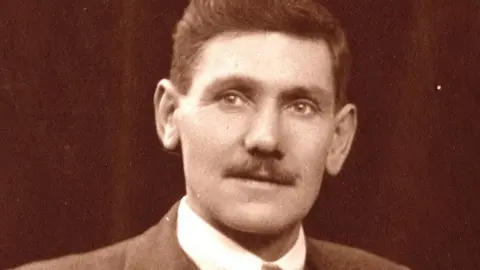 Cathy Dyer
Men who refused to fight in World War One and were treated like "pariahs in the street" are being recognised in a new exhibition to mark 100 years since the last conscientious objector was released from prison.
Five million men were enlisted in the military during World War One - most of them conscripted without choice.
But some 20,000 British men refused to put on their uniforms and hold a gun, facing terrible consequences.
Alfred James, a 39-year-old stonemason, who was called up in 1916 in the second wave of conscription, was one such man who refused to fight for his country.
His story is being told at the event in Bristol, which had one of the greatest numbers of conscientious objectors in the country, with nearly 580.
Alfred, a proud and principled socialist from the Bristol area, who had already lost two brothers in the war, did not meet any legal criteria for being exempted from war.
He was told to he had to join the Gloucester Regiment but when he arrived at the barracks he refused to wear a uniform or carry a gun.
"They were treated like pariahs in the street but I was proud of what he did," said his granddaughter, Cathy Dyer, from Bradford-on-Avon.
"He didn't want to be involved and said wars weren't won by fighting," she said.
'Hunger strike'
Cathy was 11 when Alfred died and is now aged 70. She said her grandfather was an absolutist, who did not want any part in the war effort.
"Some people would have called him a coward. He had a very strong mind and stuck to his principles.
"I don't think that's something a coward would have done, a coward would have given up," she said.
Following a court martial, Alfred was sentenced to hard labour in prison and spent a total of two years and seven months in jail as a result of several incarcerations.
Every time he was released, he went through the process of being enlisted into the military, then to a court-martial, to being sent back to prison.
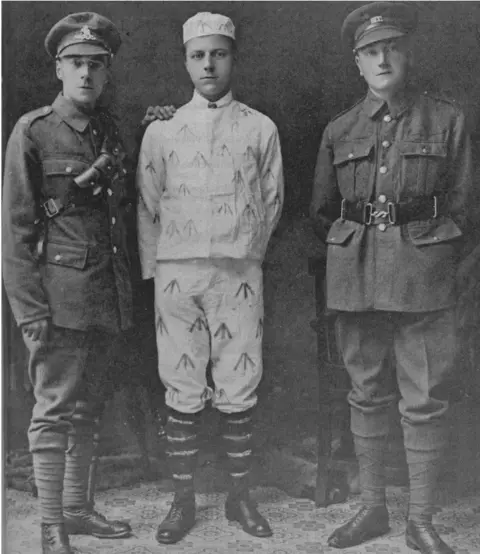 Bristol Radical History Group
At the end of the war he was sentenced to two further years for misconduct.
"He went on a hunger and thirst strike, but they force-fed him and by April 1919 he was very ill," said his granddaughter.
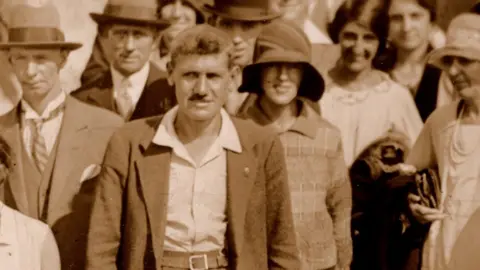 Cathy Dyer
Alfred was fully discharged a month later.
After being released, he managed to get work again as a stonemason, despite being shunned by many for being a coward, and became the union secretary for Bristol's building trades workers - a job he did for 24 years.
Event organiser Professor Lois Bibbings from the University of Bristol, said: "These conscientious objectors deserve to be commemorated.
"These men braved social ostracism, with communities and families rejecting them.... with their masculinity called into question and branded as cowards."
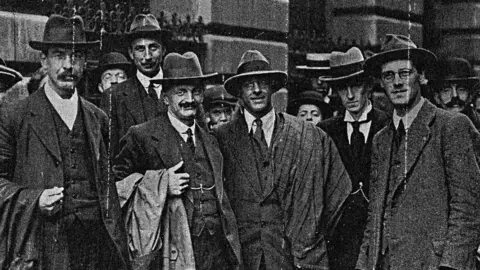 1916 Nation Labour Press
Commemoration, Conflict & Conscience is being held on 27 and 28 April at M Shed and the SouthBank Club in Bristol.
