Newspaper headlines: 'Deadlock at dinner' as Brexit trade talks 'go badly'


 Etienne Ansotte/European Commission/PA Media
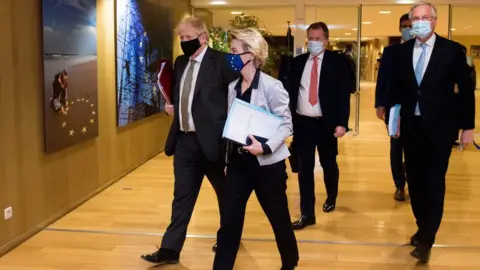
Boris Johnson's make-or-break meeting with European Commission President Ursula von der Leyen dominates the morning papers.
Most of the front pages carry a photo of the two leaders standing two metres apart as they pose for the cameras before dinner.
For the Daily Telegraph, last night's talks in Brussels "went badly", with the prime minister "downbeat" about the likelihood of an agreement. Sources close to the talks tell the paper that Mr Johnson has "not lost hope" but the chances may be "diminishing".
With no breakthrough, the paper says Brexit negotiators now have just four days to avoid a no-deal.
"Deadlock at dinner" is the headline in the Daily Mail. After a "dramatic night", the paper says Sunday is now the "final" deadline for reaching a trade deal.
Describing Downing Street's statement on the outcome of the meeting as "gloomy", the paper says the two sides will have to make a firm choice on the future of the talks.
For the i newspaper, it was "fudge for supper", after the two leaders agreed to push back a decision until the weekend.
The stage is now set for a "dramatic final act" of the negotiations, the Guardian says. The paper highlights Downing Street's description of the talks as "frank" - a diplomatic expression, it explains, for a heated discussion between leaders.
The Guardian adds that any deal must be sealed by Sunday, with pressure building on both sides to find time for parliament to ratify an agreement before the end of the year.
Ultimately, according to the Independent online, Mr Johnson left Brussels "empty-handed" - after failing to win any concessions from an EU still happy to play hardball.
But for the Times, the prime minister was "refusing to back down". The Daily Express agrees he was standing firm - while the EU tries to punish Britain for leaving. Its headline reads: "Take it or leave it".
With fishing quotas one of the key obstacles to a deal, last night's dinner menu of scallops and turbot provokes plenty of comment in the papers.
For the Express, "EU chefs" were "mocking Boris" by dishing up a double helping of seafood. The paper notes that EU officials declined to reveal exactly where the ingredients were sourced.
In its editorial, the Express says the menu will have reminded the two leaders exactly "what is at stake". "Fish-ticuffs" is the headline in the Sun.
Food stockpiling
The Daily Mirror leads on the news that Tesco has begun stockpiling food amid fears the Brexit trade negotiations will collapse without a deal.
Warehouses are being loaded up to prepare for potential shortages in the New Year. The paper says the supermarket's chairman, John Allan, is warning of "empty shelves and soaring prices" if the UK defaults to World Trade Organization terms.
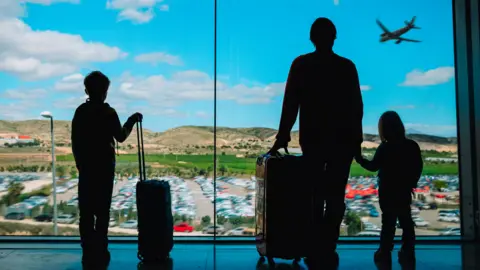
And according to the Financial Times, British holidaymakers will be banned from visiting countries within the EU from 1 January - when coronavirus safety rules which allow free travel within the bloc stop applying to the UK.
The end of the Brexit transition period means the UK will come under a system which only allows non-essential travel from a handful of countries with the lowest rates of infection.
The European Commission has said there are no plans to add the UK to the "safe" list, which currently includes Australia and Singapore.
 Getty Images
Under the headline, "Gloom at the Inn", the Sun uses its front page to highlight the ongoing plight of the UK's pubs.
It reports that just one in five could be open this Christmas, because of "crippling" coronavirus restrictions.
According to the paper, the impact of the latest lockdown - and ongoing uncertainty in the run-up to the festive season - might mean as many as 10,000 pubs are forced to shut for good.


Both the Times and the Telegraph report that academics at Cambridge University have scored a victory in a row over free speech.
Earlier this year, officials at the university tried to introduce new rules which would require all students, lecturers and visitors to "respect" opposing views.
Dons feared the plan would stifle debate, and make it difficult to criticise a viewpoint without fear of disciplinary action.
Following a campaign, academics have won a ballot on an amended version of the rules, which make it almost impossible to "no platform" a speaker by cancelling their invitation.
And a number of papers take a look at a the results of a survey by the Office for National Statistics on the changing habits of British households before, during and after the first national lockdown.
The Times notes that in late March and April we slept more, moved less, watched too much TV and drank 20% more alcohol than usual.
The Guardian points out that childcare and housework were shared more evenly during those first months - but any change appears to have been temporary.
Data for September and October shows women were doing an hour more unpaid work around the house every day compared to men.


