Church attended by Wilfred Owen celebrates repairs

 BBC
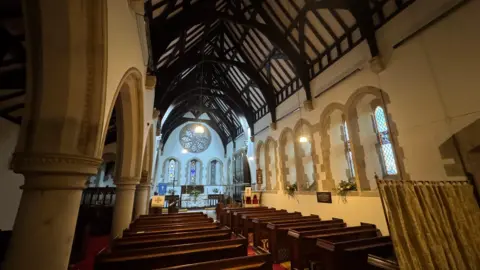
BBCA 12th Century church that war poet Wilfred Owen used to attend is celebrating a total roof overhaul, after a number of roof panels were deemed a hazard.
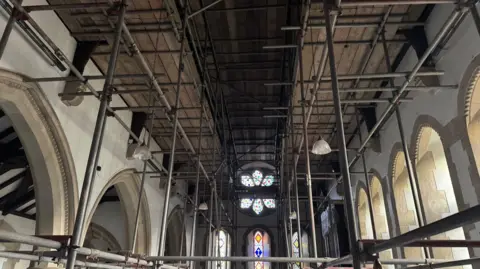
All of the internal roof panels in Holy Trinity Church, Uffington, near Shrewsbury were replaced, through the church's community raising £50,000 to fund them.
The work meant the church had to close, with key services carried out in the local village hall and other regular services stopping completely.
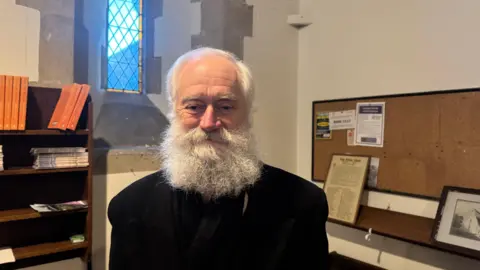
"We identified about 30 [roof panels] which we thought were suspect but if we just replaced those 30, you couldn't guarantee another one wouldn't come down, and you'd have to start again," said Chris Huss from the Parochial Church Council.
"It was an awful lot of money and an awful lot of work."
Huss said he was "in awe" at how the money was raised.
"The community really pulled together and raised the money by direct donations, by joining in with various events…obtaining money from grants…that was a real help, that put together just about half the money," he said.
"We did so many different things, from danceathons to race nights, bric-a-brac sales, it was endless, it just didn't stop - we just kept thinking of different ideas and it just went on and on and on," said Samantha Wallbanks, the fundraising manager for the project.
"Obviously it was a huge target but the four people on the committee, we were so committed to this.
"Without the people throughout the village and the grant bodies, we wouldn't have been able to do it."
When the scaffolding came down late last year, Huss said the scene that faced them was still "quite scary" because "the place was absolutely filthy, plaster dust everywhere".
"It was superb to look at the ceiling and see it back as it used to be, it was amazing," he said.
On Sunday, the church will hold a free event from 16:00 GMT to celebrate the works being finished and services beginning to resume at the site.
"It's going to be a very special way to say thank you to the local community," Huss said.
The event will include guest speakers, the Shawbury Military Wives and other singers, followed by snacks.
"We'd like anybody and everybody to come through that door and just have a look at this phenomenal building, it's phenomenal what we've done," said Wallbanks.

The war poet connection
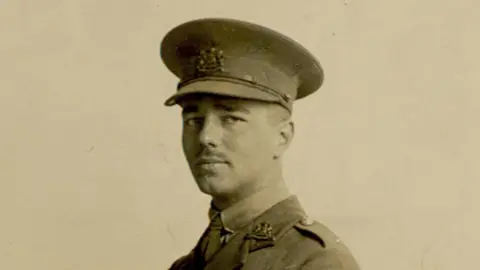
Born in 1893 in Oswestry, Shropshire, Wilfred Owen enlisted in the Army in 1915 and witnessed the trench warfare of World War One firsthand.
Injured in 1917, he was sent home, but returned to France in 1918 as a company commander, only to be killed a week before Armistice Day.
Biographers have recorded how, after his death at the age of 25, he came to represent a generation of young men who lost their lives in the conflict.
The Poetry Foundation describes how just five of Owen's poems were published in his lifetime, and others appeared posthumously.
His work recorded the horrors of flooded trenches, poison gas, machine gun fire and intense shelling. Two of his most well-known poems were Dulce et Decorum Est and Anthem for Doomed Youth.
 PA Media
Owen attended Holy Trinity, crossing the river from Shrewsbury in a coracle, the church says on its website.
When the poet's Oswestry home was listed in 2014, Owen's nephew, Peter Owen, said that, on one of these journeys to church while walking with his family, Owen's younger brother Harold was lagging behind.
He called out to the others that his boots were covered in gold from where they had been walking through the buttercups.
That idea was used in one of Owen's poems - Spring Offensive.
The site has been a church since the 12th Century and the current church has stood there since 1856, built by S. Pountney Smith.
It replaced a medieval building and was constructed with sandstone ashlar from Grinshill.
The churchyard is a conservation area and has won awards from the Diocese of Lichfield.
Follow BBC Shropshire on BBC Sounds, Facebook, X and Instagram.
