How Lawrence of Arabia escaped to Lincolnshire

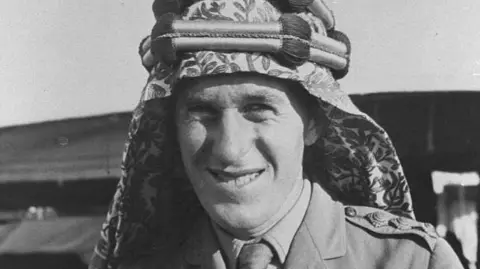 Pierre Perrin/Sygma via Getty Images
In the wake of World War One, he was one of Britain's most famous men, but rather than revel in his celebrity status, TE Lawrence – better known as Lawrence of Arabia – actively embraced a more humble life, as an RAF recruit in rural Lincolnshire.
"Another bend and I have the honour of one of England's straightest and fastest roads. The burble of my exhaust unwound like a long cord behind me. Soon my speed snapped it, and I heard only the cry of the wind which my battering head split and fended aside," wrote Lawrence in his book The Mint.
The road Lawrence was referring to is the A15 near Lincoln, and he was describing riding his Brough Superior motorcycle in a race against a Bristol fighter plane in 1925.
"The cry rose with my speed to a shriek: while the air's coldness streamed like two jets of iced water into my dissolving eyes. I screwed them to slits, and focused my sight two hundred yards ahead of me on the empty mosaic of the tar's gravelled undulations."
Lawrence was famous around the world for his exploits during World War One, when, as a British intelligence officer, he helped lead the 1916 Arab Revolt against the Ottoman Empire.
He became known as Lawrence of Arabia and his story is told in the 1962 film of the same name. One of the famous scenes showed Lawrence returning to the British camp dressed in traditional Arab clothing and head wear.
However, despite ending the war a full colonel, Lawrence seemed keen to escape the limelight. He spent several spells in the 1920s in the RAF as a humble aircraftman and was posted to RAF Cranwell, the officer training college.
This is how he came to be riding his beloved "Boa" motorcycle across the Lincolnshire countryside.
Michael Lock, who works at the Cranwell Aviation Heritage Museum, says Lawrence did not want fame.
By the end of the war, "he was absolutely exhausted," Michael says.
"He'd been taken prisoner of war, he'd been severely brutalised and tortured; I think he was totally worn out, mentally and physically."
He also felt betrayed by Britain's leaders over the Sykes-Picot Agreement - a secret deal between the country and France to divide the Arab world.
By 1925, he was serving in the RAF under the alias Aircraftman TE Shaw.
Michael says Lawrence enjoyed his time in Lincolnshire, where he had plenty of spare time to ride his motorcycle on the rural roads.
"I think his passion for Brough Superiors is very well known. After work, he would like to get on his bike and just ride out into the Lincolnshire countryside. It gave him a lot of peace."
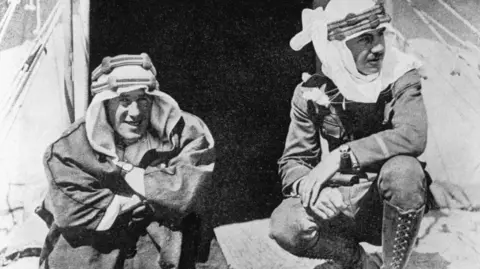 Bettmann via Getty Images
In his book The Mint, Lawrence writes about his scenic rides from Cranwell through beautiful scenery.
He would make the journey to Lincoln twice a week, where he had lodgings at the top of Steep Hill.
"They were somewhere he could go to be on his own and relax and perhaps to write some of his memoirs and other books. It was peace and quiet and anonymity that he so wanted," says Michael.
In The Mint, he describes sluicing his head with water outside the White Hart hotel.
He would have coffee and chocolates or muffins at the cafe on the corner, says Harriet Brand, who lives in Sleaford and has a collection devoted to Lawrence.
He would ride his motorbike over to Newark and then "ride down to Nottingham and then from Nottingham across to Sleaford," she adds.
"He used to call in on farms and places on the way that he knew he could get a good deal."
According to Michael, Lawrence would "pick up eggs from a farm, and bacon, and then he'd come back to what he called 'our squalid, purse-proud local village', which is Sleaford."
Harriet says: "It was a good excuse to get out on his bike, do 100 miles an hour. The adrenaline, the speed, he clearly liked the speed and the challenge of it."
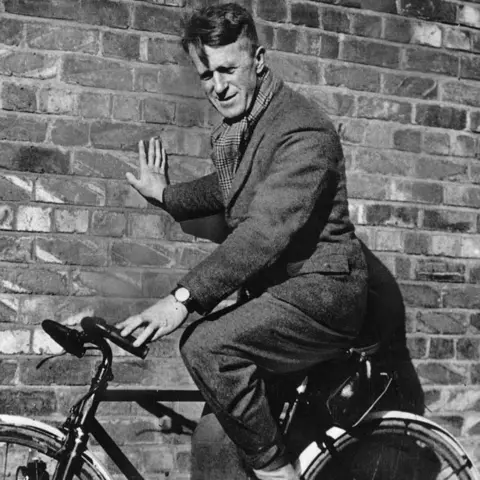 Hulton Archive/Getty Images
After 16 months at Cranwell, his identity was uncovered and he left Lincolnshire.
"It was a really good time in his life, and he really enjoyed being at Cranwell and especially the camaraderie and the teamwork that happened within his own flight," Michael says.
"Churchill enjoyed his writings.
"What he'd been through in his life was quite horrendous and he had to get through that and I think all his things like writing, music and the bike were very important to him in his life."
Harriet says that while Lawrence left a big legacy, he remains a mystery, despite publishing so many books and memoirs.
"He's kind of your hero character, although he didn't want to be a hero," she explains.
"He just had this focus on his bikes. I think that's where he found his spirit of freedom. I don't think we'll ever get to the bottom of him."
Lawrence retired to Clouds Hill, in Dorset, in 1935. He lived there for a few months before his life came to a tragic end, aged 46, when, while riding his motorcycle, he swerved to avoid two boys on bicycles. He was thrown off the bike and died from serious head injuries.
As for his race against the Bristol fighter plane on the A15 in 1925, of course, he won.
"We drew near the settlement," he wrote. "A long mile before the first houses I closed down and coasted to the cross-roads by the hospital. Bif [the plane] caught up, banked, climbed and turned for home, waving to me as long as he was in sight."
Listen to highlights fromLincolnshire on BBC Sounds, watch thelatest episode of Look Northor tell us about a story you think we should be covering here.
Download the BBC News app from the App Store for iPhone and iPad or Google Play for Android devices
