Commuting four hours and 140 miles a day for a better quality of life

 BBC
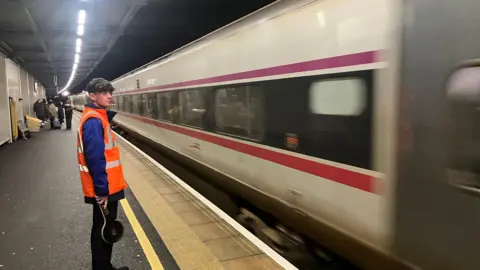
BBCIt's 18:10 and Conor Murtagh gets off the train, nearly 12 hours after he left the house.
He works about 70 miles away in Dublin, but it's too expensive to live where he works.
Murtagh is one of a growing number of commuters from the Republic of Ireland who now live along the border in Northern Ireland.
There are no definitive figures of just how many Dublin workers have moved to Newry but ask any estate agent or builder and they will tell you it is happening in significant numbers.
Murtagh moved to Newry five years ago. Originally from Drogheda, 35 miles away in the Republic of Ireland, he said it made more sense to base his family in Northern Ireland.
"I get the 06:30 train so I'm up at 05:30 every day," he said.
"It's grand. I get on the train, have a kip on the way and wake up in Dublin.
"What I'm paying now for a house would have been double in Drogheda. I'm happy here. I've joined a football team here and the young lad is starting too."
House prices in Dublin are high.
According to recent statistics the median asking price for a house in Dublin is €475,000 (£411,540); in Newry it is £207,000 (€239,000).
And for renters like Murtagh, rent is high in the Republic of Ireland and supply low.
According to property website Propertypal rents in Newry range from £750 to £1,500 depending on the property, where in Dublin Daft.ie research shows that the average rent is approximately €2,476 (£2,145).
Murtagh said he can see the train getting busier and busier.
"They're going to need more trains and housing and infrastructure. You can just see Newry becoming a bigger city as time goes on."

Cathal McArdle is from Newry but works in financial services in Dublin.
He has commuted to Dublin for years but said the hourly service, which takes around 1 hour 20 minutes, and hybrid working have made things significantly easier.
"Obviously lots of people commute to Dublin from Wicklow, Wexford, Kilkenny and Carlow so Newry is very comparable in terms of commuting time," he said.
"Before Covid you were doing it four or five times a week. Now its two to three times a week which isn't bad."

And it's not just Dublin workers that are basing themselves in Newry.
Michelle Wallace is originally from south Dublin, but found it difficult to get a mortgage in the city after returning from working on cruise ships.
So she decided to look elsewhere.
"I was able to buy a nice apartment without a mortgage [in Newry]," she said.
Michelle currently works at a creche in Lisburn and does special needs assistant subbing in County Louth.
"Newry allows me to look at work from Belfast to Dublin," she said.
"I think I've got the best of both worlds."
Housing demand in Newry
But how does the city meet the growing demand?
Earlier this month a 64-page document called Newry Next was launched.

Written by businessman Paschal Taggert and AI strategy adviser Ger Perdisatt, it proposes building 6,000 new homes.
However, housebuilding in Northern Ireland has been limited due to a lack of investment in the wastewater infrastructure.
There are currently three major housing developments on site in Newry, they're a mix of private and social housing and between them will deliver hundreds of homes.
But there are many other proposed developments, including more than 1,300 homes, caught in a backlog.

The local chamber of commerce says it is open to the Newry Next proposal but chief executive Michael Savage is realistic about the barriers, including infrastructure.
"The basics aren't here at the moment and we need them badly. Capacity in the wastewater system will unlock the potential in this region."
The Newry Next proposal suggests investing in that system, but Northern Ireland Water said it is likely to cost more than they envisage.
"This report refers to £107m investment to potentially unlock these 6,000 homes," an NI Water spokesperson said.
"Given the significant level of development suggested in this report there may need to be investment in excess of the £107m to support these ambitious plans."
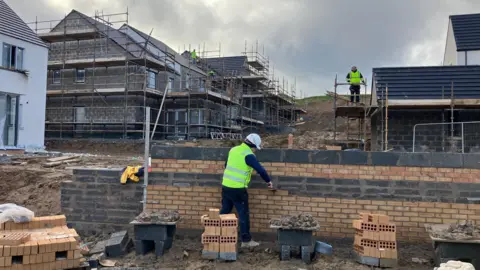
Stormont's Department for Infrastructure said it could be a positive development for the city.
"The department would be willing to work collaboratively with a range of partners to identify and consider any infrastructure upgrades that may be needed."
Newry Next proposes that its goals are achievable by 2035 using funding mechanisms such as PEACEPLUS, the Shared Island Fund and partnership between NI Water and Uisce Éireann.
As such, considerable political will is required.
Could commuting from Newry be the answer to Dublin's housing problem?
The Republic has seen years of spiralling house and rent prices.
Figures from the Irish Central Statistics Office (CSO) released last October showed property prices in Dublin rose by 5.4% compared with October 2024.
The problem is not just in the capital, with prices outside Dublin up by 8.9%.
While the Irish economy is doing well, with essentially full employment, buyers have the funds but are struggling to keep up with bidding wars.
The Irish government has promised to build some 300,000 new houses by the end of the decade, and ministers have said increasing the supply of homes will eventually drive down prices.
But with capacity issues in the construction sector and with Dublin's bustling suburbs already seeing rocketing house prices - perhaps the idea to move across the border may be the answer.
Even though commuting times may be offputting for certain workers - a drive from Newry to north Dublin takes over an hour, not accounting for rush hour traffic - cheaper house prices may be worth it for some.
