'I'm one of Birmingham's striking binmen - I work in a pub to make ends meet'

 BBC
BBCJanuary 2026 saw Birmingham enter its second year of a continuous bin strike. That's 12 months plus of loggerheads between the city council and union Unite, and a year and counting of residents not knowing a normal collection service.
For the striking workers - taking action over pay and conditions - they face yet more time on the picket line. And more time without their wages.
One of them has been talking to the BBC about what it's like to keep going amid the headlines, and how he makes ends meet while in a standoff that seems to have no end.
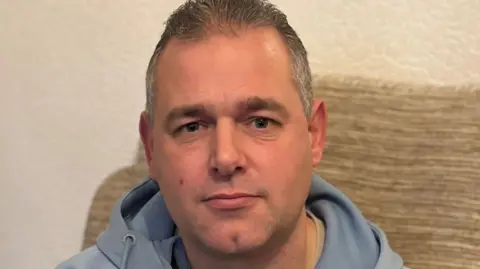
"It's draining," said Adrian Hyde, who explained he had worked for the council for 24 years and been a binman for 14 of them. "Mentally it's extremely tough and all you can think of is 'am I ever going to put another bin on the back of the lorry'?"
He said: "I literally come home from the picket line and sit here wondering what I'm going to do.
"You think a lot... what's going to happen, whether you'll go back, whether they'll get rid of us. None of us would have thought we'd be out this long."
The striking workers are given daily £70 hardship payments from Unite. That helped, said Hyde, but it did not cover his wages.
"To survive", he is now working 20 hours a week in a pub during evenings to help make ends meet.
"[That] means more time away from my family, which isn't good at all," he said.
"People are getting second jobs, others are going to food banks.
"If [the public] thinks this is a holiday for us, it isn't."
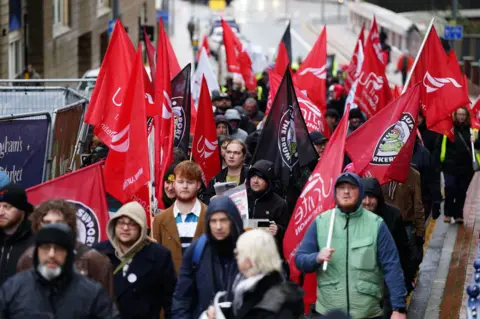
Hyde joined Unite after the last Birmingham bin strike in 2017.
The union is in dispute with Birmingham City Council over several changes the local authority is making, including getting rid of a job role within the refuse operation and cutting another role's pay.
The council said it was "forging ahead" with transformation of the waste service which had been "poor" for too long.
Hyde said: "The job itself is great. But what we've always said is the issues that go on around the job are the problem, we don't seem to be left alone."
The council has employed extra agency staff to cover waste collections amid the disruption.
Before Christmas, some short-term agency workers joined permanent staff on the picket lines.
The industrial dispute is becoming one of the most significant in modern history.
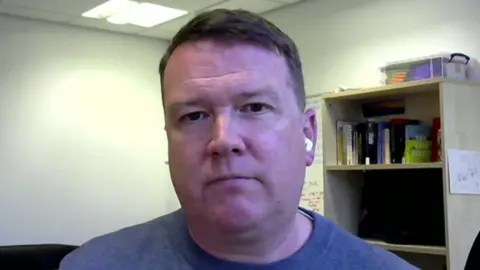
Dr Jonathan Lord, an expert in labour law at the University of Salford, said it was a strike that would be studied in the future.
"You're looking at between 150 and 350 workers involved in Birmingham, and while as a singular workplace that number is relatively small in comparison to, say the miners' strike, in terms of the length it's already one of the longest pieces of industrial action in this country."
He said that while it was difficult to see a resolution at the moment, eventually one must come.
"Something happens, something breaks, it always does.
"Whether it's the union saying 'back to work' or a government resolution, something always appears on the horizon."
Unite claims that the council is now refusing to negotiate, but the local authority maintains the union has rejected "fair and reasonable" offers.
The union states additionally that the council faces more than 400 legal claims from bin workers whose pay has been "unfairly attacked". That in turn raises the prospect, according to Unite, of the council bearing financial liabilities higher than sums outlined in a prospective deal from last year.
"Unite will use every tool available to defend and protect its members and that includes legal action," said Unite general secretary Sharon Graham.
She said the council needed "to return to negotiations and offer a fair deal to its workers - every day this dispute continues is seeing the council's costs climb ever further".
In the meantime, Hyde said the workers would remain on strike for as long as it took.
"You have to stand up and fight for what you believe in," he said.
"I don't think anyone would accept a pay cut of thousands of pounds lying down.
"We're not going to be pushed over and we'll fight it to the very end.
"[This] is a fight. Not just for us, but for future people that want to [do] this job."
Follow BBC Birmingham on BBC Sounds, Facebook, X and Instagram.
