Does King Charles' 'Toy Town' find its soul at Christmas?

 BBC
BBCAn experimental town in Dorset and a passion project of King Charles III has long been a lightning rod for criticism.
Since construction began at Poundbury, on the outskirts of Dorchester, in 1993, architects and commentators have taken aim at its neo-Georgian façades and detailed design rules, dismissing it as "soulless" and a "toy town".
Last month those debates resurfaced after it was widely reported that Grand Designs tv presenter Kevin McCloud, speaking at a lecture at the V&A Museum, questioned whether the town's rules undermined the liveability of its homes.
At Christmas, when wreaths hang from front doors and neighbours gather over coffee, residents say judgements like these miss the point.
"When we first arrived we were told you won't get a conservatory," laughs Gerry Cook, who has lived in Poundbury for four years and is part of a regular coffee morning at the Pavilion in the Park café. "But there are loads of conservatories everywhere."
Between caffeinated sips, the group discuss the town's much-talked-about covenants - the rules governing everything from building changes to decorations.
Because Poundbury sits on Duchy of Cornwall land, residents must seek permission from the Duke of Cornwall, Prince William, before making alterations to the exterior of their homes.
"I think some of these rules are a bit of a fallacy," Mr Cook says, adding that changes are usually approved as long as they fit with what residents refer to as the "Poundbury ethos".
When the conversation turns to Christmas, the group becomes animated, insisting the town is no different from anywhere else.
"There are streets full of decorations," says Judy Tate, a local artist who has lived in Poundbury for a decade. "From classy white twinkling lights to giant Father Christmases, polar bears, you name it."
Helena Conibear agrees. "The tackier the better," she laughs.
Ms Conibear has lived in the Dorchester area for most of her life and runs the charity which operates the Pavilion in the Park café. She admits she had reservations when Poundbury was first being built.
"I worried it would take business away from neighbouring towns and villages," she says. "But that hasn't happened."
Instead, she says she has watched the development grow "from a building site to an incredible community".
"What makes it different is that it puts people first," she says, pointing to the way doctors' surgeries, schools and shops were built early on. "People weren't left living on a housing estate in the middle of nowhere."
Now home to more than 5,000 residents, Poundbury was designed as an 'integrated' rather than 'zoned' development, with an emphasis on walkability and easy access to local services.
Just a stone's throw from the garden centre sits Dorchester Community Church, where a parent and toddler group is meeting.
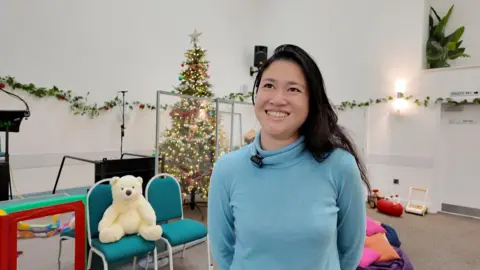
"We spend a lot of time in the evenings walking around and looking at the Christmas lights," says Azura Charles, who has lived in Poundbury for seven years and is one of the mothers at the group.
She says she values the town's accessibility and sense of safety: "We all know our neighbours. It's a place where people really look out for each other."
"I've heard the criticisms about it being a bit soulless," she adds. "But when it's time to come together, we come together really well."
The town is also home to about 260 businesses, many of them independently run.
"I love the community, it's very friendly and supportive," says Sahil Dalvi, who runs several businesses in Poundbury, including the Post Office.
He says the town has been "great" for both his business and his family over the past decade.
Mr Dalvi shrugs off some of the criticisms he hears most often. "People say you can't hang your clothes out," he says. "Of course you can't on the main streets but if you've got a garden, no one's stopping you."

For residents like Mary O'Flaherty, it is the town's mix of housing that matters most.
She and her son were previously living in sheltered accommodation before moving into affordable housing in Poundbury. This Christmas will be her third in the town.
"Every day I feel blessed," she says. "It's a beautiful place to live and it's full of spirit."
She believes that was always the intention. "King Charles was very clear he didn't want any distinction between social housing and private homes," she says. "Here, there's no difference, we're all part of the same community."
Speaking ahead of the town's construction in 1991, the then Prince Charles said he wanted to re-examine how places were designed "on a traditional basis".
With ministers now indicating that elements of that vision could influence a new wave of towns planned across England, Poundbury continues to divide opinion.
But as Christmas lights glow across its streets, residents say the town's critics are still judging it by how it looks, not by how it feels to live there.
