Lost Cornish railway celebrated after 200 years

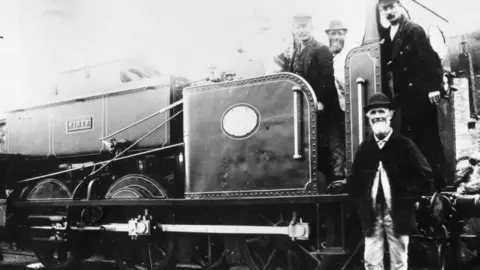 Tim Osborne's "Images of the Past" Collection
A special exhibition will be held to mark the 200th anniversary of the first train to run on the Redruth and Chasewater Railway.
The pioneering railway began operating on 31 January 1886 to serve what became known as "the richest square mile in the world" in terms of mineral wealth in the mid-19th Century.
It was mainly used to carry copper ore for export to south Wales at Devoran and bringing back coal to keep steam and mine engines running.
Historian Bob Richards is staging the exhibition at Kresen Kernow, the Cornwall archive centre, on Saturday from 13:00 - 16:00 GMT. He said: "It demised because the Cornish mining industry suffered a big slump from about the middle of the 1860s."
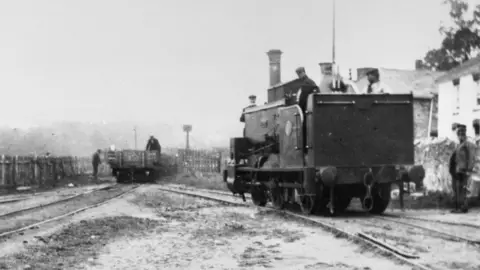 Tim Osborne's "Images of the Past" Collection
The line went from what was then a port in Devoran, up through the Bissoe Valley and through Carharrack.
It then skirted around Carnmarth, the big hill up through Lanner, and then went down into Redruth Town.
Despite the name of the railway, it never went to Chacewater because mines such as Wheal Busy were not productive enough to make it economically viable for the investment into the infrastructure of the railway.
Richards said: "Copper takes a lot more fuel to smelt than tin or lead but most of the copper smelting was done in south Wales because they had unlimited supply of coal.
"Initially for the first 25 years it was horse drawn but the company in early 1850s ordered two small locomotives from Neilson's in Glasgow. They named them Miner and Smelter."
A third engine called Spitfire was introduced because it was more powerful to cope with the upper reaches of the line before the railway closed in 1915.
"Some of the track ended up in Flanders for wartime use, most of it was sold off as scrap," said Richards.
The name of the railway has always been the Redruth and Chasewater Railway with an "s" although the village it was meant to serve has always been Chacewater with a "c".
Follow BBC Cornwall on X, Facebook and Instagram. Send your story ideas to [email protected].
