Hospital teams 'ready' for winter flu spike

 BBC
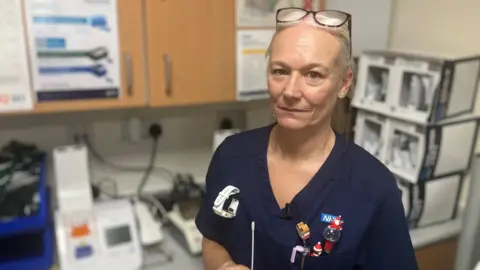
BBCFront-line NHS staff at hospitals in Derby and Burton-upon-Trent say they have been dealing with increasing numbers of flu cases - but are "well-prepared" to help more seriously ill patients over Christmas and the new year.
The highest number of flu patients staying in hospital beds was 56 on a single day recently at the University Hospitals of Derby and Burton (UHDB) NHS Foundation Trust.
The trust told the BBC it was prioritising rapid results testing of patients with flu-like symptoms to help control the spread of infection.
Clinicians have stressed the viral infection for most patients in the community is something that can be managed by themselves at home.

Experts have predicted this UK winter flu season could turn out to be one of the worst for years - after it arrived five weeks early and cases have been on the rise at NHS hospitals in Derby and Burton.
Latest figures show that on Sunday, there were 44 beds occupied by flu patients, a 38% rise on the previous week.
Dr Greg Fletcher, a consultant in anaesthesia and intensive care at the Royal Derby Hospital, said there were 28 patients across the trust admitted to intensive care with flu as a primary diagnosis last winter but the number could be higher this winter.
"If you have an underlying health condition such as diabetes, cardiac, renal or respiratory problems, the flu can become an overwhelming disease and can progress to needing intensive care," he said.
"You might need oxygen and, in the worst scenarios, you may need to go on to a ventilator.
"There is not a cure for flu. It is not a bacterial infection, so antibiotics are no good. We support people with their symptoms."

Dr Fletcher said he was all too aware of the alarming predictions for this winter but remained philosophical.
"We've seen bad winters before, and we have always coped," he said.
He stressed flu was a virus that usually gets better over time and most people can look after themselves at home.
The Royal Derby Hospital, which opened in 2010 as a modern replacement for the City General hospital, has more single rooms than many other hospitals in the East Midlands, which means there is scope to isolate patients who are infected rather than cohort them in ward bays.
A key measure to manage flu cases this winter is rapid testing of patients who display any symptoms that could be flu.
The medical assessment unit (MAU) is a ward where inpatients who arrive with flu-like symptoms throughout the winter will be checked.
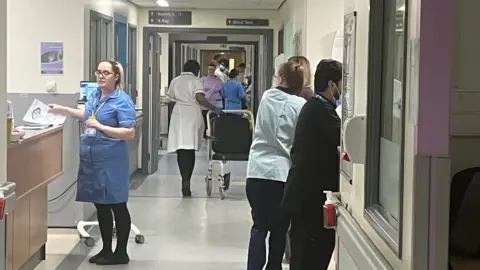
Ward sister Amanda Beard said testing was quick and simple.
"We put the nasal swab up both nostrils and then put the sample in a machine which gives results within 15 minutes," she said.
"That helps us to isolate potential patients that have the flu.
"There are two main types of flu - influenza A and B. The test can determine which a patient has and that helps us, because we would not put a flu A patient in a bed next to a flu B patient.
"In reality, the bulk of tests come back as influenza A.
"When we can't find a side room available for an infected patient, we would look to group flu patients together in a specific zone.
"I suspect the flu season will be bad. It is going to be a challenge. We have got plans to minimise the risk of spread."
The UK Health Security Agency (UKHSA) in the East Midlands monitors flu levels across the region.
Steve Barlow, a UKHSA consultant in health protection, said: "The demands on hospitals because of flu are increasing week by week."
He predicts flu cases will peak after the height of social mixing over Christmas and new year, and urged anyone entitled to a NHS flu jab to take up the offer.
Follow BBC Derby on Facebook, on X, or on Instagram. Send your story ideas to eastmidsnews@bbc.co.uk or via WhatsApp on 0808 100 2210.
