Why India's Aravalli hills are at the centre of growing protests

 Getty Images
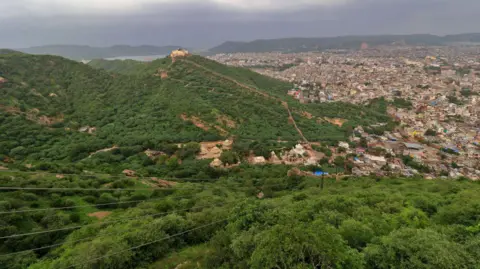
Protests have erupted across northern India after the Supreme Court redefined the Aravalli hills - one of the world's oldest geological formations spanning the states of Rajasthan, Haryana, Gujarat, and the capital, Delhi.
Under the new definition, accepted by the court following federal government recommendations, an Aravalli hill is any landform rising at least 100 metres (328 ft) above the surrounding terrain. Two or more such hills within 500 metres of each other, along with the land between them, are considered an Aravalli range.
Environmentalists argue that defining Aravalli hills by height risks leaving numerous lower, scrub-covered but ecologically critical hills unprotected from mining and construction.
The federal government, however, says that the new definition is meant to strengthen regulation and bring uniformity and not dilute protections.
 Getty Images
Why are people protesting?
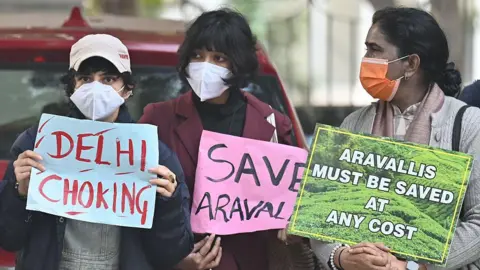
Peaceful protests have erupted in cities like Gurugram and Udaipur, led by residents, farmers, environmentalists, and occasionally lawyers and political parties.
Neelam Ahluwalia, founder member of the People for Aravallis group, told BBC that the new definition risks undermining the critical role of the Aravalli range in "preventing desertification, recharging groundwater and protecting livelihoods" in northwest India.
The lower, scrub-covered hills play a vital role in preventing desertification, recharging groundwater and supporting livelihoods according to experts.
"The Aravalli range should not be defined by height alone, but by its ecological, geological and climatic role," Vikrant Tongad, an environmental activist associated with the movement to save the Aravallis, told BBC.
He said, internationally, mountains and hill systems are identified by the functions they perform, not by arbitrary elevation thresholds.
"Any landform that is geologically part of the Aravalli system and plays a critical role in ecology or preventing desertification should be recognised as part of the range, regardless of its height."
Activists are demanding that the government define Aravalli areas using scientific criteria, including geography, ecology, wildlife connectivity and climate resilience.
Mr Tongad warns that the court's new definition could encourage mining, construction and commercial activity, increasing the risk of ecological damage.
Opposition parties have stepped up criticism, warning that the new definition could cause serious ecological damage.
Samajwadi Party chief Akhilesh Yadav said protecting the Aravallis is "inseparable from Delhi's survival." Rajasthan Congress leader Tika Ram Jully called the range the state's "lifeline," adding that without it, "the entire area up to Delhi would have turned into a desert."
What does the government say?
India's federal government has sought to downplay these concerns.
In a recent statement, it said the new definition is meant to strengthen regulation and bring uniformity, adding that a single, objective definition was needed to regulate mining consistently across states.
It added that the new definition covers the entire hill system - including slopes, associated landforms, and intervening areas - explicitly protecting hill clusters and their connections.
The federal environment ministry said it is wrong to assume that mining will be allowed on all landforms under 100 metres.
The government says areas within the Aravalli hills or ranges are excluded from new mining leases, while existing ones can continue if they follow sustainable mining norms.
It added that mining remains banned in core "inviolate" areas - protected forests, eco-sensitive zones, and wetlands - except for certain critical, strategic, and atomic minerals allowed by law.
Environment minister Bhupender Yadav said only about 2% of the 147,000 sqkm Aravalli range could potentially be mined, and only after detailed studies and official approval.
However, several of the protesting groups say that demonstrations will continue and that they are exploring legal options to challenge the court's new definition.
Follow BBC News India on Instagram, YouTube,Twitter and Facebook.
