Irish and Iraqi artists build bonds through shared musical journey

 British Council
At a time when increasing debates on cultural identity shape how communities see one another, the musicians of Macalla are quietly carving out a different kind of narrative.
The eight-piece ensemble connects musicians from Londonderry's North West Folk Collective with artists from Iraq's Mshakht Collective.
Their cross-cultural collaboration has been three years in the making and recently featured prominently at one of the UK's largest international folk and world music festivals.
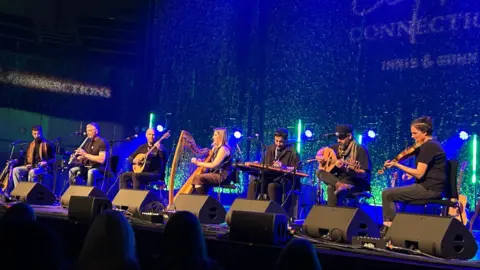
Performing at Celtic Connections in Glasgow this month, the group showcased traditional instruments that have survived displacement, colonisation and war.
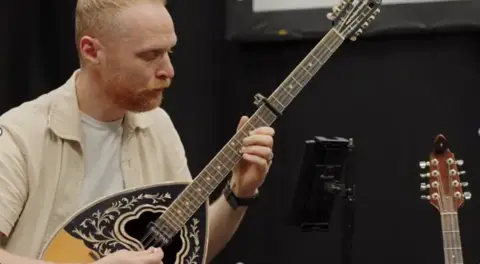
Composer and bouzouki player Martin Coyle, who directs the ensemble and is founder of the North West Folk Collective, explained the reason behind the group's name.
"Macalla actually means 'echo' in Irish, so we're trying to echo or mirror the instrumentation throughout the group," he told BBC News NI.
 British Council
Many of Macalla's tracks feature traditional Irish melodies that listeners will recognise, though the group have presented them in a new musical context.
The Iraqi repertoire also draws on very old songs, which the musicians have layered Irish elements over.
"What we've tried to do is respect those tunes and not overwrite them, the melodies stay central, but they're presented differently. That sense of respect is something people really seem to respond to," Coyle explained.
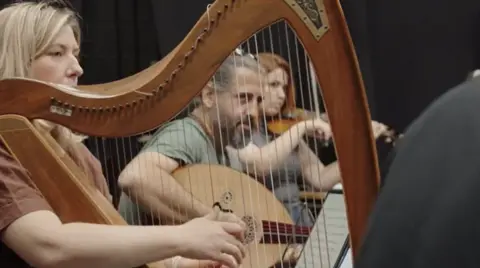
Central to the project are the Irish harp and the qanun, a 78-string Middle Eastern instrument that is played on the lap.
Irish pipes, bouzouki, violin and fiddle also feature in the performance alongside an oud - a stringed instrument often described as similar to the European lute - and Middle Eastern percussion.
"There's challenges, exciting challenges," Coyle said. "It's through an experimental lens, and it's a challenge for the possibilities of what our own instruments can do."
Allow Google YouTube content?
Supported by the British Council, some of the Irish musicians visited Iraq in the early stages of the project, and had hoped to perform at the Nineveh Peace Festival, but a fire in the region disrupted their plans.
"Even so, that visit was hugely important - it shaped the relationships and ideas that have guided the collaboration ever since," Coyle said.
During that trip, the artists where introduced to the Mshakht collective, who had formed in 2017 with the idea of exchanging cultural ideas across northern Iraq.
"We had lots of refugee camps in Kurdistan, so we practiced this idea and we named in Mshakt, that means 'the nomads or the travellers', so we created connections," oud player Saman Kareem told BBC News NI.
"It's amazing that the British Council created this initiative... It fits in the philosophy of our band to make bridges and exchange the culture throughout our music."
'The fruits of the collaboration'
Many new concepts were introduced to the Iraqi musicians, Kareem explained, "that affected not only music".
"The way that the [Irish] traditional music is formatted is a little bit different from ours... It made us look at the work in a different angle because each culture has its own deep history and its own heritage," he said.
"Personally, I got some inspiration for other ideas for the future. There's a composition between us that's a reflection of this experience [over] the last few years."
 British Council
Last weekend, the tunes were "well received by the audience", according to Coyle, and the musicians' minds are now firmly fixed on future collaborations.
Long-term, the group said it "would complete the circle" to bring the project back to Iraq, as well as exploring future opportunities in Ireland.
"It would be amazing to bring it onto a big stage at the Fleadh," Coyle said.
Macalla are "starting to see the real fruits of the collaboration", he added, as they start to write new compositions together with the possibility of future recordings.
"Those pieces could only be informed by the time we had over the last two years," he said.
"We're just in the middle of conversations about where the project could be going."
Speaking ahead of the group's Celtic Connections performance, Colm McGivern, Director of British Council Northern Ireland, said the Macalla project serves as "a brilliant example of music bridging cultures", bringing together artists "to create something entirely new while celebrating shared traditions".
"We're proud to support projects like this, which show how the arts can build understanding, foster relationships, and inspire creativity on a global scale," he added.
The project has received additional support and is co-presented in association with the Earagail Arts Festival.
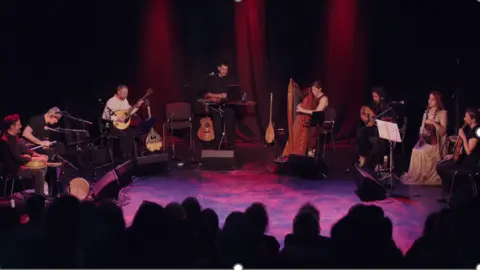 British Council
The Macalla ensemble features Lucia McGinnis (harp), Niwar Issa (qanun), Saman Kareem (oud), Helin Star Qadir (violin), Hussein Al Saedi (percussion) from the pan-Iraqi ensemble Mshakt with Marty Coyle (bouzouki), Denise Boyle (fiddle) and Paul Cutliffe (uillean pipes and whistle) of the North West Folk Collective.