Swinney to consider buffer zones around asylum hotels

 PA Media
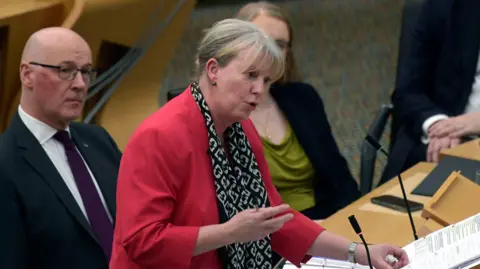
First Minister John Swinney has said he will consider introducing buffer zones around hotels housing asylum seekers in Scotland.
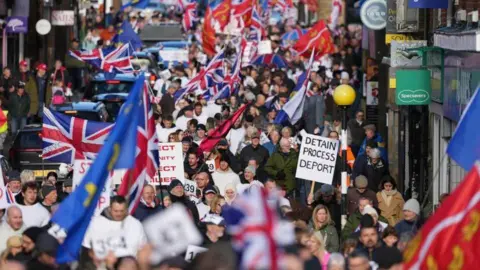
It comes after a protest outside a hotel in Perth at the weekend and follows similar demonstrations across the UK last summer.
In 2024, the Scottish government introduced a similar law which banned anti-abortion protesters from gathering within 200m (656ft) of clinics where the procedure is carried out.
But the Scottish Conservatives said buffer zones outside asylum hotels could infringe on freedom of speech and increase community tensions.
 PA Media
Swinney described protests outside one of the asylum hotels in Perth last weekend as "a really ugly set of events".
"That's in my own constituency, and I have heard reports about all that was experienced," he said.
He added: "People have a legitimate right of protest but when that protest is threatening to others and causes distress that is unacceptable.
"So a suggestion has been made that we look at buffer zones, a suggestion made by my parliamentary colleague Pete Wishart.
"We will explore that because I think there are arguments in favour of that to make sure that the right of protest is assured but, also, that the safety of other individuals is assured into the bargain."
Police Scotland said the planned protest in Perth on Saturday 10 January had a "proportionate policing plan" in place "to ensure public safety and minimise disruption".
"There were no arrests and inquiries are ongoing," a spokesperson added.
Murdo Fraser, Scottish Conservative MSP for Mid Scotland and Fife, said that although people had "every right to protest peacefully", no-one should feel "intimidated".
"There are real concerns locally about asylum hotels and it's wrong to pretend otherwise," he said.
"But bringing in buffer zones or new protest laws is a huge step. It wouldn't just affect this issue - it could hit free speech and increase community tensions.
"The priority should be backing the police and working with the community to keep order, not rushing into controversial legal changes that could take years to come into force."
Reform UK leader Nigel Farage said the UK government's immigration policies were a "total failure" after pointing to protests outside a hotel in Epping - where an asylum seeker had been housed who was later jailed for sexual offences.
Speaking at a press conference in Glenrothes, Fife, he said: "Certainly when it comes to undocumented young males, they shouldn't be free to roam the streets.
"You can see from Epping onwards, there's just too many individual acts of behaviour that cause outrage and offence within the communities.
"And neither do I support opposition to this turning violent in any way at all.
"So if there has to be a buffer zone, there has to be a buffer zone. But frankly, I think we are asking the wrong question."
Last summer saw a wave of anti-immigration protests held outside asylum hotels across the UK.
The demonstrations began at The Bell Hotel in Epping, Essex, in July after the arrest of a man living there who was later jailed for sexual offences.
Several hundred people - and on one occasion 2,000 according to Essex Police - gathered near the Bell to protest.
Other hotels across the UK were also targeted.
Scotland has seen smaller protests outside asylum hotels in Perth, Aberdeenshire and Falkirk.
At a demonstration outside a former hotel in Falkirk, one person performed a Nazi salute while another carried a banner that said "Kill 'Em All, Let God Sort 'Em Out".
Local groups also demonstrated by flying Union Jack and Saltire flags, mimicking the flying of St George's flags and Union Jacks on England's streets.
The UK government pledged to overhaul the asylum process and tackle illegal immigration, with new plans unveiled by the home secretary in November.
Under the proposals, most asylum seekers will have to wait 20 years to apply to settle permanently, with deportations to be sped up when claims are rejected.
Asylum seekers will also have their refugee status reviewed every two-and-a-half years rather than five, and could be deported if their home country is at any time deemed safe.