The Oxford Union - a lofty cradle of democracy

 BBC
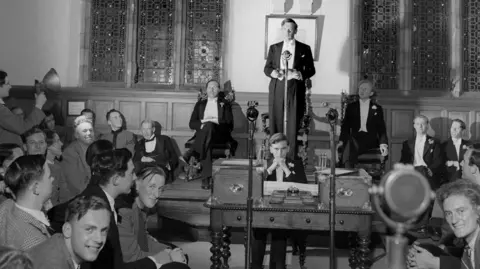
BBCFor more than 200 years, the Oxford Union has prided itself on being a bastion of free speech. Never afraid of making headlines, the student-run debating society has welcomed speakers ranging from former US president Richard Nixon to Mother Teresa of Calcutta, and has helped to launch the careers of countless politicians.
Many British Prime Ministers cut their political teeth as students in the society's grand debating chambers.
William Gladstone, Edward Heath and Boris Johnson all served as Union presidents, while a total of 13 out of 16 British Prime Ministers since 1955 attended the University of Oxford.
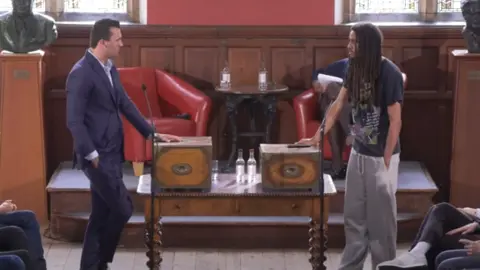
In October, the Union made news when president George Abaraonye was ousted after appearing to celebrate the death of right-wing activist Charlie Kirk.
The pair had previously faced each other in a debate in May.
The list of powerful and famous alumni has earned the Union accusations of fostering a narrow ruling class.
A gold-paved road seemed to lead to the Union from Eton College and on to 10 Downing Street, commentators have claimed.
In recent history, it was a route taken by both David Cameron and Boris Johnson.
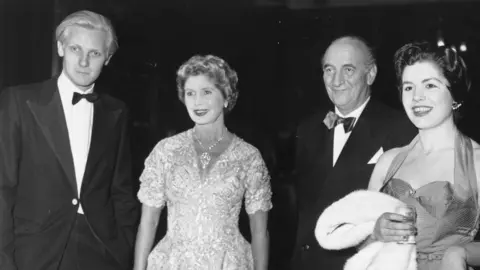
Another Conservative, former deputy prime minister Michael Heseltine, recalled: "Someone once said, I think, of the head boy of Eton, 'You are greater now than ever I can make you'. And there's an element of that, being president of the Oxford Union.
"You are singled out before your time to hold a position which, of course, has been such a remarkable part of the career of so many people."
 Getty Images
However, its members, who pay a one-off fee of up to £340 to join, are drawn from all walks of life, according to current president Moosa Harraj.
A sense of Union prestige was not lost on him as a boy growing up in Pakistan.
"At school, we were recommended to learn English through watching Oxford Union debates," he recalls.
"It was amazing to find myself here, where [former US President Richard] Nixon spoke after Watergate, where Michael Jackson spoke, where [former US President Ronald] Reagan spoke."
Nixon's speech came in 1978, four years after his resignation in the wake of the Watergate scandal.
It attracted hundreds of demonstrators and a chorus of loud chanting outside the debating chamber.
"I screwed it up and I paid the price," the former president famously told students.
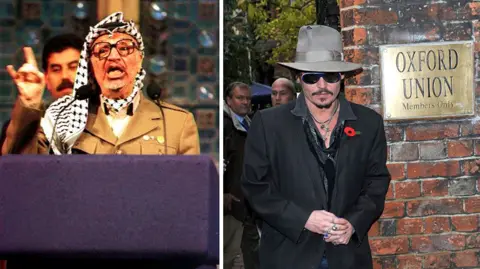
The dispatch box has seen many notable, often controversial, speeches.
Three months before his assassination, civil rights leader Malcolm X endorsed armed resistance in a BBC-televised debate in 1964.
O.J. Simpson addressed the Union following his notorious murder trial, while Sinn Fein politician Gerry Adams was subject to a government broadcast ban at the time of his appearance in the chamber.
 PA Media/Getty Images
"People think that we just invite controversial speakers," Mr Harraj says.
"The idea is never to grab headlines. The burning idea is to question the topics of the day."
A famous debate was held in 1933, when the motion "This House would not in any circumstances fight for King and Country" was passed.
Winston Churchill described what came to be known as the "Oxford vote" as "abject, squalid, shameless" and "nauseating".
However, the Union prides itself on independence of thought.
It traces its origins to a secret student meeting more than 200 years ago.
"In the early part of the 19th Century, student members of the University of Oxford were restricted in the matters they could discuss and the opinions they could air," its website records.
"Tired of the curtailment of their freedom of speech, 25 young men met near the end of 1822 and established a set of Rules that would govern a new Society and in March 1823 the 'United Debating Society' was born."
 Oxford Union/YouTube
The society built or acquired grand premises, including the Old Library, whose walls are painted with murals by Dante Gabriel Rosetti, Edward Burne-Jones and William Morris.
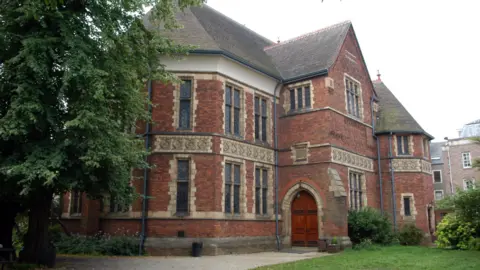
The current debating chamber stands in an ornate building in a groomed courtyard and gardens off St Michael's Street.
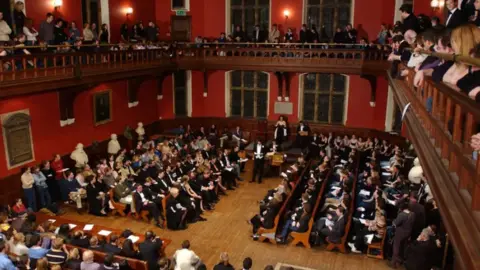
Debates sometimes demand formal attire, while white-tie dinners are held and the social calendar includes glamorous balls.
The chamber itself is modelled on the House of Commons, adding to the rarefied atmosphere.
As in parliament, votes are recorded by tellers for the Ayes and Noes.
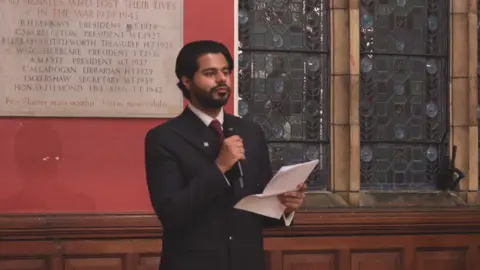 Oxford Union/YouTube
Writer and journalist Michael Crick, who was Union president in 1979, recalls trying unsuccessfully to ban white-tie events.
"There is a strong element of people who like dressing up," he observes.
"It taught me an obvious lesson, to prepare the ground. It's practice for life and people learn from their mistakes."
The Union is less politically balanced now than it was, Crick says.
He recalls being given his first chance to speak by Benazir Bhutto, later Prime Minister of Pakistan, and listening to contributions from fellow students Theresa May, William Hague and Charles Kennedy.
"For most of the past 50 years, a lot of people on the Left boycotted the Union," he says.
"It becomes quite hard to get speakers on the Left."
 PA Media
Mr Harraj says the environment may be elitist, but the Union is in no way exclusive.
"We have people from everywhere: state schools, full scholarships, disadvantaged backgrounds and a lot have gone on to be president," he points out.
A 2022 survey found 34% of members who responded went to private school and 72% were white.
Women, who were only admitted as members in 1962, formed 40% of the respondents.
Judging from history, future national leaders will be drawn from this pool.
Does Mr Harraj harbour any political ambitions?
"Everyone has ambition. Certainly, there is a desire to help, to give back," he replies.
"A lot of people in my country live in poverty. Of course, that makes you want to help people."
By the end of his presidency, which by tradition lasts a single term, he will have rubbed shoulders with the likes of former US vice president Mike Pence, Nicolai Tangern who oversees the world's largest sovereign wealth fund and Game of Thrones author George R.R. Martin.
The Union will have debated subjects ranging from Israeli foreign policy to whether "ChatGPT is better than your tutor".
The society will remain in the limelight, whether for its internal politics, whiff of elitism, controversial guests or the topics being discussed.
"When Oxford Union holds a debate... it does echo around the world," Harraj enthuses. "People do listen."
You can follow BBC Oxfordshire on Facebook, X (Twitter), or Instagram.
