Most critical cases could leave women's hospital

 BBC
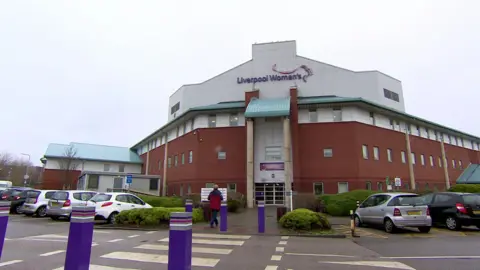
BBCControversial plans to move maternity services from Liverpool Women's Hospital to the city's main general hospitals look likely to be scaled back because of a lack of cash.
Health bosses in the city have been pressing for the service to be moved to Royal Liverpool Hospital and Aintree since 2016. They say it is safer because of the specialist medical services available at the sites.
At a meeting held earlier by the body running the NHS in Merseyside, it said it did not have the money to move all maternity services, so planned to transfer "a small number of the most complex and high-risk cases."
The Save Liverpool Women's Hospital campaign said it could not see how the move would work.
"This is the only viable option in the short-to-medium-term," Dr Fiona Lemmens, executive clinical director at NHS Cheshire and Merseyside, said.
She said the vast majority of patients at Liverpool Women's Hospital receive "excellent care facilitated by the staff and their incredible ability to mitigate the risks they find on a daily basis".
Despite this, Dr Lemmens said there have been deaths and harm linked to the fact that the site was isolated.
"We can do better than this and we should be doing better than this," she said.

Liverpool Women's Hospital is a major research centre and deals with all aspects of women's health from childbirth to the menopause and is the largest hospital of its type in Europe.
But for years its geographical location, as well as the fact it is a stand-alone site has been identified as a major issue.
One problem is that it has no critical care facilities, so if things go severely wrong, women have to be "blue lighted" in an ambulance to one of the city's two acute hospitals – Aintree or, more commonly, the Royal Liverpool.
The hospital is just 1.3 miles (2km) away from Liverpool Women's. And because the Royal Liverpool does not have a neonatal unit, if a woman is transferred there after labour, her baby has to stay at Liverpool Women's.
Every year about 220 women are transferred by ambulance between Liverpool Women's Hospital and the other major hospitals in the city – about four a week on average.
About half of those are emergency cases and it is this fact which has driven this debate over the future of Liverpool's maternity services.
The lack of maternity services at the Royal and Aintree hospitals also means that pregnant women admitted there for other health problems have no pregnancy support.
'Mitigate clinical risks'
Dr Lemmens said other options considered had included either moving all maternity services into existing buildings at the Royal Liverpool Hospital or, preferably, building new services on that site. But she said that this would have had a large financial implication.
She added that the "only viable option in the short to medium term" would be to move a small group of high risk women to the Royal Liverpool Hospital for gynaecological treatment or to give birth.
This would involve about 30 pregnant women and 75-100 complex and high-risk gynaecology patients. She said less than 1% of women would come under this group.
"It is drop in the ocean in what needs to be done to mitigate clinical risk," Dr Lemmens said.
She added that the move would be "a very small improvement on what we've got at the moment" but said doing nothing was not an option.
A review into the Liverpool Women's was first launched in 2016, when health bosses wanted to move the whole hospital down to the same site the Royal Liverpool now sits on, alongside the Clatterbridge Cancer Centre.
The plans got knocked back at the end of 2018 when the Department of Health announced it would not fund it.
The plans were paused when attention shifted to trying to get the Royal Liverpool built, and then the pandemic hit.
But in October 2024 NHS Cheshire and Merseyside announced a consultation called Case for Change, again looking at Liverpool Women's Hospital.
That did not put forward options but the people involved with the review, including the clinicians, made it clear that they wanted babies to be delivered at the Royal Liverpool and Aintree hospitals instead of Liverpool Women's Hospital.

Those running the city's hospitals said change was long overdue and were looking at how maternity services should be provided in the city.
But it has been met with stiff resistance in some quarters, with a petition against any proposed changes attracting 85,000 signatures.
More than 7,500 women give birth in Liverpool Women's Hospital each year and protesters point out that the vast majority stay there – in a hospital built specifically for, and concentrating entirely, on them.
Lesley Mahmood, co-founder, Save Liverpool Women's Hospital campaign said the group is no opposed to high-risk women having emergency or planned treatment at the Royal.
But said she said she could not see how it is practical to have "30 women giving birth in the corner of the Royal."
"One where is the room in the Royal? It's full to bursting already. Secondly, how can you safely staff for maternity 30 births, where are the midwives going to come from?" she said.
"Other trusts have got major maternity scandals and major scandals about women's treatment and they're co-located. And there is a national crisis in maternity and that's got nothing to do with co-locating that's all to do with lack of resources, cutting of funding and inadequate funding for staff."
The plan now is to run a further public engagement exercise in the summer with a final decision expected in the Autumn at the earliest
Listen to the best of BBC Radio Merseyside on Sounds and follow BBC Merseyside on Facebook, X, and Instagram. You can also send story ideas via Whatsapp to 0808 100 2230.
