Taking the bus to talk Oxford's congestion charge

 BBC
BBCIn Oxfordshire there are few issues more contentious than traffic - whether drivers are gridlocked in Oxford, bumper-to-bumper on the A34, or stuck on Cowley Road, the topic seems to be on everyone's minds.
It is something the county council has grappled with for years, and in October it decided to introduce a controversial new congestion charge.
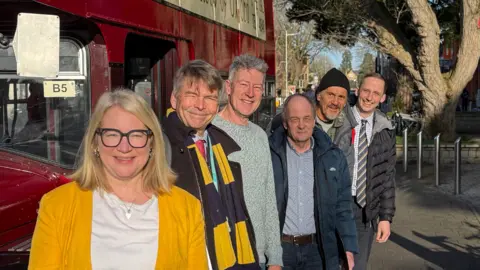
Three months on, BBC Oxford took politicians, campaigners, business people and transport bosses on a bus ride where they could go head-to-head over the issue.
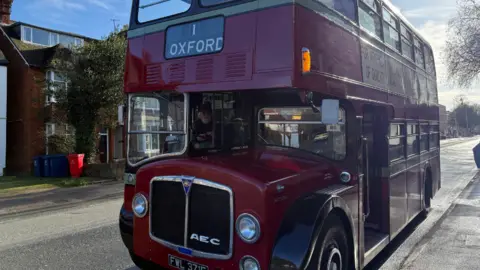
As the vintage bus departs from outside the Dew Drop Pub in Summertown, the conversation gets going straight away.
Luke Marion, from Oxford Bus Company, says he has seen a "significant improvement" in bus travel times since the charge, which have "been reflected in higher numbers of people using the bus".
"We have taken very bold measures in Oxford to try and make a change and that is something to be really very proud of," he says.
Ian Loader, from cycling campaign group Cyclox, says the charge is giving people a "nudge".
"Do you need to make every journey you make by car or could something be made by bus? Can you walk? Can you sometimes cycle?" he says.
The current data is mixed on whether or not journeys are improving because of the congestion charge.
The latest figures show that there are winners and losers - traffic is down significantly on roads where there is a charge, but other routes, particularly parts of the ring road, are busier.

Passing the Westgate Shopping Centre, the chat turns towards how the congestion charge has impacted businesses in the city.
Graham MacDonald runs two shops in the Covered Market alongside his wife, and says his businesses "fell off a cliff" after the charge was introduced.
"It came in at a critical time at the beginning of November where we should be extremely busy," he says.
"But over the last quarter of last year we were down by about 14% year on year."
He adds: "I'm not totally against it, what I'm saying is it was just a bad decision at a bad time of the year."
Responding, the council's transport chief Andrew Gant, says: "We are lucky enough to live in a beautiful mediaeval city with constrained streets, and filling those streets with traffic that isn't moving doesn't help anybody.
"That's bad for safety, that's bad for air quality and it's bad for people trying to do their jobs."

Now travelling over Magdalen Bridge, the hot topic becomes how the charge has changed the lives of people in the city.
Gant says the charge is "about managing a finite resource, which is our road space, in a sensible and proportionate way - nobody is stopping anybody using a car".
Loader chimes in to say the charge has "created an environment which is better for cyclists".
But David Henwood, shadow councillor for transport on the county council, says the charge "simply isn't a system that's built for key workers" in the city.
He says: "It penalises them and they need to be recognised - just simply saying they need to find alternative ways is not good enough."

With the bus passing a charge point on Marston Ferry Road, the group discusses the fee's impact on access to Oxford's hospitals.
Henwood says it has led to more traffic on the city's ring road, particularly around the hospitals.
"People have been calling and emailing me telling me that they missed their doctors appointments and that it's causing mayhem," he says.
There have been "some challenges around the hospital particularly at peak times", Marion accepts.
"We still have got too many people driving and parking at the hospitals," he says.
"So a big focus of what we're trying to do is encourage more people to get to the hospital on the bus."
Hospital letters now include information on the congestion charge - an indication of the concerns that patients have had about accessing NHS facilities.
It is possible to get to the hospitals without passing a charging point, but those routes can be very busy.
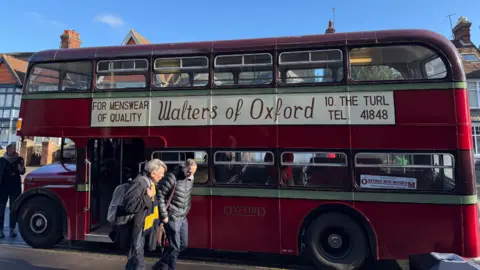
As the bus pulls in at the stop outside BBC Oxford, one thing is clear - the congestion charge remains polarising.
And even though it is temporary, what replaces it is likely to have an even bigger impact and be even more controversial.
Once Botley Road has reopened, scheduled for August this year, the congestion charging points will become traffic filters.
That means you will not be able to drive through them in a car, unless you have a permit or are willing to pay a hefty fine.
The arguments over future transport policy in Oxford are far from over.
You can follow BBC Oxfordshire on Facebook, X (Twitter), or Instagram.
